
[Paper Review] Localization Distillation for Object Detection
This paper proposes Localization Distillation (LD), a novel knowledge distillation method for object detection that transfers localization knowledge via bounding box distributions, enabling logit mimicking to outperform traditional feature imitation. By introducing valuable localization regions (VLR) for selective distillation, LD improves detection accuracy without slowing inference, achieving state-of-the-art AP gains on MS COCO, PASCAL VOC, and DOTA benchmarks.
Previous knowledge distillation (KD) methods for object detection mostly focus on feature imitation instead of mimicking the prediction logits due to its inefficiency in distilling the localization information. In this paper, we investigate whether logit mimicking always lags behind feature imitation. Towards this goal, we first present a novel localization distillation (LD) method which can efficiently transfer the localization knowledge from the teacher to the student. Second, we introduce the concept of valuable localization region that can aid to selectively distill the classification and localization knowledge for a certain region. Combining these two new components, for the first time, we show that logit mimicking can outperform feature imitation and the absence of localization distillation is a critical reason for why logit mimicking underperforms for years. The thorough studies exhibit the great potential of logit mimicking that can significantly alleviate the localization ambiguity, learn robust feature representation, and ease the training difficulty in the early stage. We also provide the theoretical connection between the proposed LD and the classification KD, that they share the equivalent optimization effect. Our distillation scheme is simple as well as effective and can be easily applied to both dense horizontal object detectors and rotated object detectors. Extensive experiments on the MS COCO, PASCAL VOC, and DOTA benchmarks demonstrate that our method can achieve considerable AP improvement without any sacrifice on the inference speed. Our source code and pretrained models are publicly available at https://github.com/HikariTJU/LD.
Motivation & Objective
- To challenge the long-standing belief that feature imitation always outperforms logit mimicking in object detection knowledge distillation.
- To investigate why logit mimicking has underperformed in object detection for years, particularly due to the lack of effective localization knowledge transfer.
- To develop a simple yet effective distillation framework that enables logit mimicking to surpass feature imitation by explicitly modeling localization uncertainty.
- To introduce the concept of valuable localization regions (VLR) to selectively distill classification and localization knowledge based on region importance.
- To establish a theoretical connection between LD and classification KD, showing equivalent optimization effects.
Proposed method
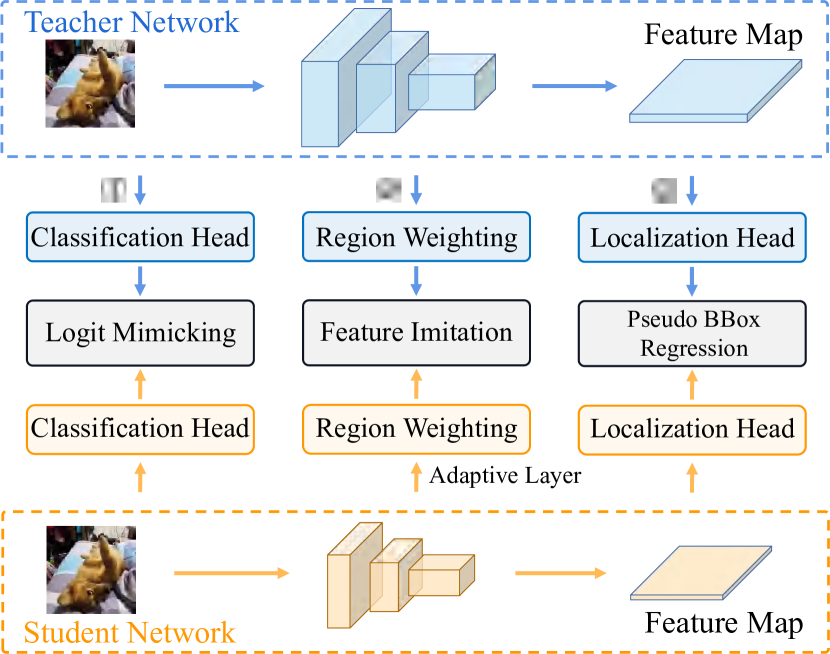
- Proposes Localization Distillation (LD), which uses the teacher's bounding box distributions as supervision to transfer richer localization knowledge than pseudo-bounding box regression.
- Leverages discretized probability distributions to model localization ambiguity, where flatness and sharpness reflect uncertainty, enabling more effective localization knowledge transfer.
- Introduces the concept of valuable localization regions (VLR), which identifies and focuses distillation on high-importance regions to improve efficiency and performance.
- Combines LD with classification KD in a unified logit-mimicking framework, allowing separate distillation of classification and localization knowledge.
- Employs gradient rescaling analysis to show that LD performs implicit gradient reweighting in the logits space, similar to focal loss, improving training stability and convergence.
- Uses a linear combination of probability distributions to decompose the teacher's output, enabling theoretical equivalence between LD and classification KD in optimization behavior.
Experimental results
Research questions
- RQ1Why has logit mimicking underperformed in object detection compared to feature imitation, despite its success in image classification?
- RQ2Can logit mimicking outperform feature imitation in object detection if localization knowledge is effectively transferred?
- RQ3How can localization ambiguity be modeled and exploited to improve distillation performance?
- RQ4What is the role of selective distillation in improving the efficiency and accuracy of knowledge distillation?
- RQ5Is there a theoretical equivalence between localization distillation and classification knowledge distillation in terms of optimization dynamics?
Key findings
- Localization Distillation (LD) enables logit mimicking to outperform feature imitation for the first time in object detection, demonstrating that the absence of localization distillation was the key reason for logit mimicking's historical underperformance.
- The proposed method achieves significant AP improvements across MS COCO, PASCAL VOC, and DOTA benchmarks without any increase in inference speed, proving its efficiency and effectiveness.
- The introduction of valuable localization regions (VLR) enhances distillation performance by focusing on high-importance regions, improving both accuracy and training stability.
- Theoretical analysis shows that LD shares the same optimization effect as classification KD, validating its equivalence in learning dynamics and providing a solid theoretical foundation.
- Gradient rescaling analysis reveals that LD implicitly performs focal loss-like gradient reweighting, which helps ease training difficulty in early stages and improves convergence.
- Extensive ablation studies confirm that LD significantly reduces localization ambiguity, learns more robust feature representations, and enhances generalization in student detectors.
Read this paper
Open the full text in the Nubint reader and ask about any passage as you read.
Read this paper on NubintThis review was generated by AI from the original paper. Please check the paper before citing it.