
[Paper Review] MA-FSAR: Multimodal Adaptation of CLIP for Few-Shot Action Recognition
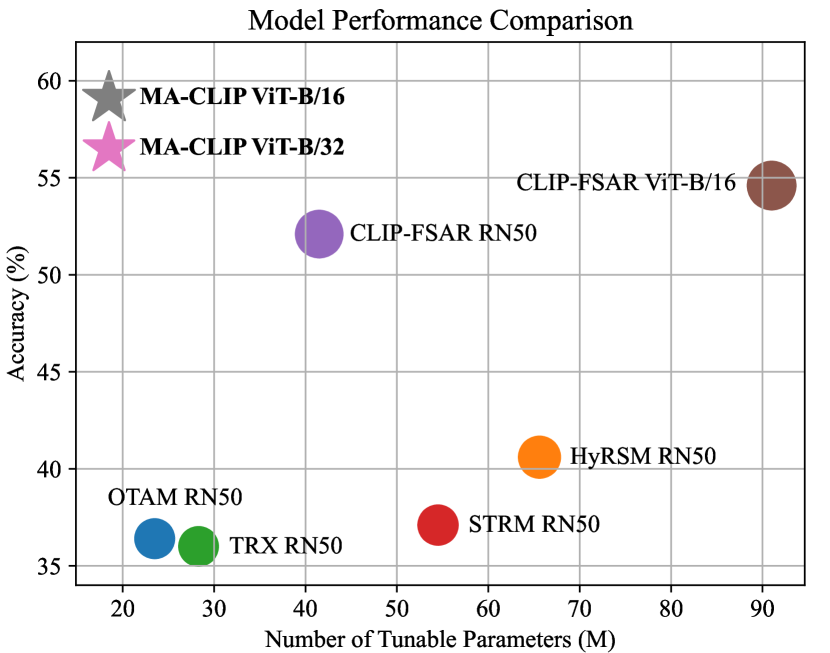
This paper proposes MA-CLIP, a parameter-efficient method that adapts CLIP for few-shot action recognition by introducing lightweight multimodal adapters and a text-guided prototype construction module. By freezing CLIP’s backbone and fine-tuning only 18.54M parameters, MA-CLIP achieves state-of-the-art accuracy with 15% higher performance than unimodal baselines and 10% improvement over CLIP-FSAR, while reducing training time and memory usage by over 80%.
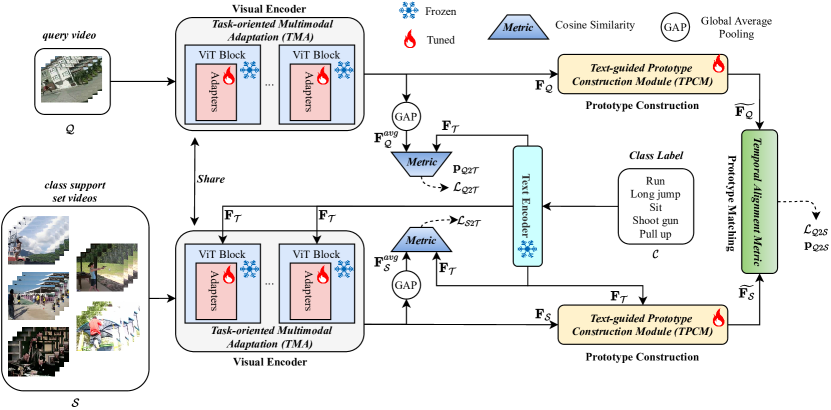
Applying large-scale vision-language pre-trained models like CLIP to few-shot action recognition (FSAR) can significantly enhance both performance and efficiency. While several studies have recognized this advantage, most of them resort to full-parameter fine-tuning to make CLIP's visual encoder adapt to the FSAR data, which not only costs high computations but also overlooks the potential of the visual encoder to engage in temporal modeling and focus on targeted semantics directly. To tackle these issues, we introduce MA-FSAR, a framework that employs the Parameter-Efficient Fine-Tuning (PEFT) technique to enhance the CLIP visual encoder in terms of action-related temporal and semantic representations. Our solution involves a Fine-grained Multimodal Adaptation, which is different from the previous attempts of PEFT in regular action recognition. Specifically, we first insert a Global Temporal Adaptation that only receives the class token to capture global motion cues efficiently. Then these outputs integrate with visual tokens to enhance local temporal dynamics by a Local Multimodal Adaptation, which incorporates text features unique to the FSAR support set branch to highlight fine-grained semantics related to actions. In addition to these token-level designs, we propose a prototype-level text-guided construction module to further enrich the temporal and semantic characteristics of video prototypes. Extensive experiments demonstrate our superior performance in various tasks using minor trainable parameters.
Motivation & Objective
- Address the challenge of few-shot action recognition with limited labeled video data and high computational costs.
- Overcome the limitations of pre-trained image models like CLIP in modeling video’s extra-temporal dimension.
- Minimize trainable parameters to prevent overfitting and enable fast, efficient transfer learning across tasks.
- Leverage multimodal video-text information to enhance spatiotemporal representation and prototype learning.
- Develop a plug-and-play framework compatible with various temporal alignment metrics for few-shot action recognition.
Proposed method
- Apply parameter-efficient fine-tuning (PEFT) by freezing CLIP’s image and text encoders and adding lightweight adapters for video-text multimodal fusion.
- Design a text-guided prototype construction module using attention mechanisms to enhance video prototype representations with textual context.
- Integrate adapters into CLIP’s visual stream to enable task-specific spatiotemporal modeling while preserving the model’s generalization capacity.
- Use a multimodal adapter that jointly processes video and text features to improve temporal modeling and feature alignment.
- Implement a plug-and-play design that supports integration with any few-shot action recognition metric, such as OTAM or TRX.
- Train the adapter heads with minimal parameters (18.54M) while keeping the main CLIP weights frozen to reduce overfitting and training cost.
Experimental results
Research questions
- RQ1Can a parameter-efficient adaptation of CLIP improve few-shot action recognition performance while minimizing trainable parameters?
- RQ2How effectively can multimodal video-text information be leveraged to enhance spatiotemporal representation in low-data regimes?
- RQ3Does a text-guided prototype construction mechanism improve video prototype learning in few-shot settings?
- RQ4To what extent does MA-CLIP reduce training cost and memory usage compared to full fine-tuning or existing baselines?
- RQ5Can MA-CLIP generalize across different temporal alignment metrics without architectural changes?
Key findings
- MA-CLIP achieves a minimum 15% accuracy improvement over ImageNet-pretrained unimodal models and 10% over CLIP-pretrained unimodal models on both SSv2-Small and Kinetics datasets.
- On the 5-way 1-shot setting, MA-CLIP outperforms CLIP-FSAR and other baselines, achieving the highest recognition accuracy with the fewest tunable parameters.
- The method reduces the number of trainable parameters to 18.54M (1/5 of full fine-tuning) and cuts memory usage by 1.6GB and training time by 0.4 hours on a single RTX 3090.
- Attention visualization confirms that MA-CLIP focuses more on action-relevant objects and reduces background attention, indicating improved spatial-temporal localization.
- When trained on only one-fourth the number of tasks required by ImageNet-baselines, MA-CLIP still achieves 15% higher accuracy on SSv2-Small, demonstrating superior data efficiency.
- The plug-and-play design enables MA-CLIP to be seamlessly integrated with various temporal alignment metrics, maintaining strong performance across different settings.
Read this paper
Open the full text in the Nubint reader and ask about any passage as you read.
Read this paper on NubintThis review was generated by AI from the original paper. Please check the paper before citing it.