
[Paper Review] Macro Placement by Wire-Mask-Guided Black-Box Optimization
This paper proposes WireMask-BBO, a black-box optimization framework for VLSI macro placement that uses a wire-mask-guided greedy procedure to accelerate objective evaluation. By directly representing solutions as macro coordinates and improving them via wire-mask-driven local search, WireMask-BBO achieves up to 50% HPWL reduction when fine-tuning existing placements, outperforming state-of-the-art methods including RL and analytical approaches.
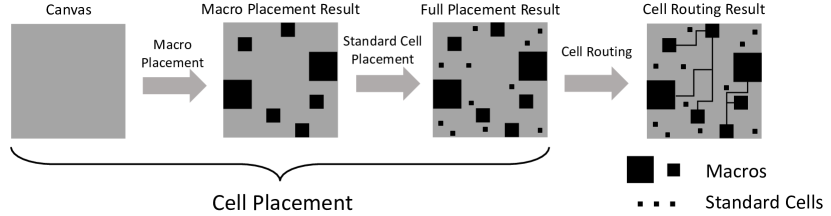
The development of very large-scale integration (VLSI) technology has posed new challenges for electronic design automation (EDA) techniques in chip floorplanning. During this process, macro placement is an important subproblem, which tries to determine the positions of all macros with the aim of minimizing half-perimeter wirelength (HPWL) and avoiding overlapping. Previous methods include packing-based, analytical and reinforcement learning methods. In this paper, we propose a new black-box optimization (BBO) framework (called WireMask-BBO) for macro placement, by using a wire-mask-guided greedy procedure for objective evaluation. Equipped with different BBO algorithms, WireMask-BBO empirically achieves significant improvements over previous methods, i.e., achieves significantly shorter HPWL by using much less time. Furthermore, it can fine-tune existing placements by treating them as initial solutions, which can bring up to 50% improvement in HPWL. WireMask-BBO has the potential to significantly improve the quality and efficiency of chip floorplanning, which makes it appealing to researchers and practitioners in EDA and will also promote the application of BBO. Our code is available at https://github.com/lamda-bbo/WireMask-BBO.
Motivation & Objective
- To address the growing complexity of VLSI chip floorplanning, especially in macro placement, where traditional methods face scalability and efficiency limitations.
- To develop a general-purpose black-box optimization framework that improves placement quality while maintaining computational efficiency.
- To enable post-processing fine-tuning of any existing placement solution to achieve significant HPWL improvements.
- To demonstrate the effectiveness of a wire-mask-guided greedy evaluation procedure in accelerating convergence and solution quality.
- To establish a reusable, open-source benchmark for future BBO algorithm development in macro placement.
Proposed method
- The framework represents macro placements directly as coordinate vectors on a discretized chip canvas, avoiding complex genotype-phenotype mappings.
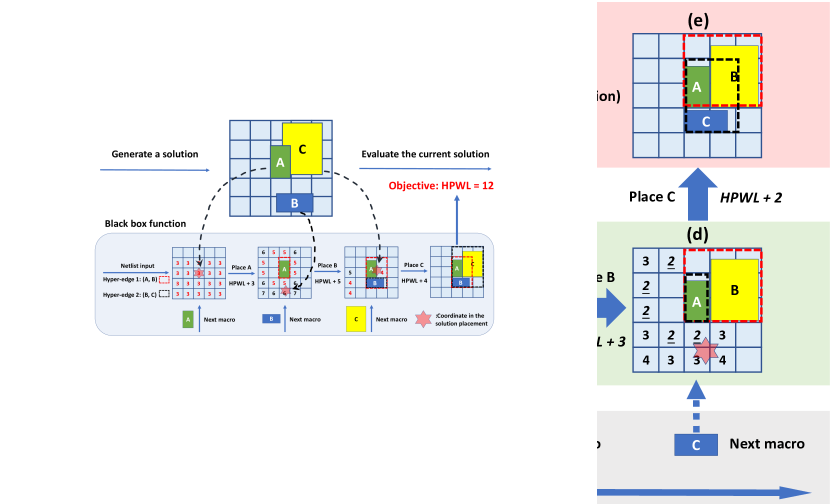
- A wire-mask is used to precompute HPWL increments for moving each macro to every candidate grid, enabling fast local evaluation.
- A greedy procedure iteratively repositions each macro to the nearest grid that minimizes HPWL while avoiding overlaps, improving the current solution before evaluation.
- The improved solution is then fed into any black-box optimization (BBO) algorithm, such as random search, Bayesian optimization, or evolutionary algorithms.
- The method is compatible with any existing placement as an initial solution, enabling effective post-processing fine-tuning.
- The framework is implemented as a modular system and released open-source to support future algorithmic innovation.
Experimental results
Research questions
- RQ1Can a wire-mask-guided greedy procedure significantly accelerate the objective evaluation in black-box optimization for macro placement?
- RQ2Does the WireMask-BBO framework outperform existing packing-based, analytical, and reinforcement learning methods in terms of HPWL and runtime?
- RQ3To what extent can WireMask-BBO improve existing placements through post-processing fine-tuning?
- RQ4How does the performance of WireMask-BBO vary across different BBO algorithms, such as random search, Bayesian optimization, and evolutionary algorithms?
- RQ5Can WireMask-BBO be effectively applied to real-world industrial benchmarks, including complex designs like the ariane RISC-V CPU?
Key findings
- WireMask-BBO, when equipped with evolutionary algorithms (WireMask-EA), achieves the best HPWL results on 6 out of 7 benchmarks, surpassing the state-of-the-art MaskPlace in 8 minutes on average.
- Fine-tuning existing placements using WireMask-EA leads to an average HPWL improvement of 53.93% for SP-SA and 17.06% for MaskPlace over 1,000 minutes.
- Even simple BBO methods like random search (WireMask-RS) achieve better HPWL than prior state-of-the-art methods, demonstrating the effectiveness of the evaluation procedure.
- The framework reduces HPWL significantly with less time compared to previous methods, showing superior efficiency and quality trade-offs.
- On the ariane RISC-V benchmark, WireMask-BBO maintains clear superiority over prior methods, including concurrent advanced approaches like ChiPFormer and AutoDMP.
- The wire-mask-guided greedy evaluation enables fast and effective exploration, making the framework highly compatible with diverse BBO algorithms and placement heuristics.
Read this paper
Open the full text in the Nubint reader and ask about any passage as you read.
Read this paper on NubintThis review was generated by AI from the original paper. Please check the paper before citing it.