
[Paper Review] MambaU-Lite: A Lightweight Model based on Mamba and Integrated Channel-Spatial Attention for Skin Lesion Segmentation
MambaU-Lite is a lightweight medical image segmentation model that integrates Mamba's efficient sequence modeling with CNNs and a novel P-Mamba block featuring integrated channel-spatial attention. It achieves state-of-the-art performance on ISIC2018 and PH2 datasets with only 420K parameters and 1.25G FLOPs, outperforming existing lightweight models in Dice and IoU scores while minimizing computational and memory costs.
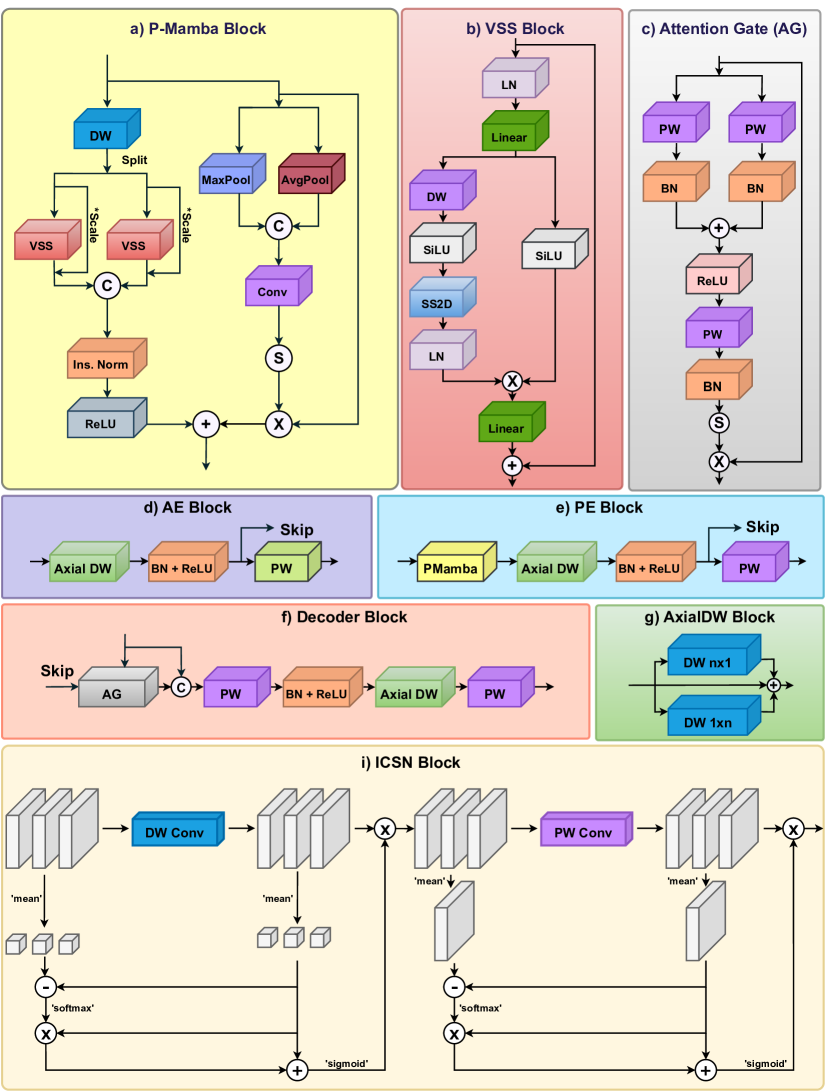
Early detection of skin abnormalities plays a crucial role in diagnosing and treating skin cancer. Segmentation of affected skin regions using AI-powered devices is relatively common and supports the diagnostic process. However, achieving high performance remains a significant challenge due to the need for high-resolution images and the often unclear boundaries of individual lesions. At the same time, medical devices require segmentation models to have a small memory foot-print and low computational cost. Based on these requirements, we introduce a novel lightweight model called MambaU-Lite, which combines the strengths of Mamba and CNN architectures, featuring just over 400K parameters and a computational cost of more than 1G flops. To enhance both global context and local feature extraction, we propose the P-Mamba block, a novel component that incorporates VSS blocks along-side multiple pooling layers, enabling the model to effectively learn multiscale features and enhance segmentation performance. We evaluate the model's performance on two skin datasets, ISIC2018 and PH2, yielding promising results. Our source code will be made publicly available at: https://github.com/nqnguyen812/MambaU-Lite.
Motivation & Objective
- To develop a lightweight deep learning model for skin lesion segmentation that maintains high accuracy while minimizing computational and memory costs.
- To address the challenge of segmenting skin lesions with ambiguous boundaries and high-resolution input images using an efficient architecture.
- To integrate Mamba's long-range modeling capability with CNNs to enhance both global context and local feature extraction.
- To reduce model size and inference cost for deployment on resource-constrained medical devices.
- To improve segmentation performance on benchmark datasets like ISIC2018 and PH2 using a novel hybrid architecture.
Proposed method
- Proposes a hybrid U-Net-like architecture combining Mamba and CNN components, with a P-Mamba block as the core module.
- Introduces the P-Mamba block, which integrates VSS (Vector-Selective Scan) blocks with multiple pooling layers to capture multi-scale features.
- Employs CBAM (Convolutional Block Attention Module) in skip connections to enhance spatial and channel-wise feature representation.
- Uses a dual loss function combining Dice loss and Tversky loss with hyperparameters γ₁=0.7 and γ₂=0.3 to optimize segmentation performance.
- Adopts a lightweight design inspired by U-Lite, reducing parameters to 0.42M and memory usage to 1.67MB.
- Trains the model using Adam optimizer with a cosine annealing learning rate schedule and data augmentation.

Experimental results
Research questions
- RQ1Can a hybrid Mamba-CNN architecture achieve high segmentation accuracy with minimal parameters and FLOPs for skin lesion analysis?
- RQ2How does the proposed P-Mamba block improve feature learning compared to standard Mamba or CNN blocks?
- RQ3Does integrating channel-spatial attention in skip connections enhance segmentation performance on challenging skin lesion datasets?
- RQ4How does MambaU-Lite compare to existing lightweight models in terms of accuracy, parameter count, and inference cost?
- RQ5Can the model generalize well across diverse skin lesion datasets like ISIC2018 and PH2 with minimal architectural complexity?
Key findings
- On the ISIC2018 dataset, MambaU-Lite achieved a Dice Similarity Coefficient (DSC) of 0.9057 and IoU of 0.8361, outperforming U-Net, Attention U-Net, UNeXt, DCSAU-Net, and U-Lite.
- On the PH2 dataset, MambaU-Lite achieved a DSC of 0.9572 and IoU of 0.9189, setting a new state-of-the-art performance among lightweight models.
- The model has only 0.42 million parameters and 1.67MB memory usage, making it significantly smaller than U-Lite (0.88M parameters, 3.51MB) and other models.
- Despite a higher FLOP count (1.25G) than U-Lite (0.69G), MambaU-Lite achieves superior accuracy, demonstrating better efficiency-accuracy trade-off.
- The P-Mamba block effectively captures multi-scale features, contributing to improved segmentation on lesions with unclear boundaries.
- The integration of CBAM in skip connections enhanced feature refinement, leading to more precise mask predictions.
Read this paper
Open the full text in the Nubint reader and ask about any passage as you read.
Read this paper on NubintThis review was generated by AI from the original paper. Please check the paper before citing it.