
[Paper Review] Mask3D: Mask Transformer for 3D Semantic Instance Segmentation
Mask3D proposes a novel Transformer-based approach for 3D semantic instance segmentation that directly predicts instance masks from point clouds using learnable instance queries, eliminating the need for hand-crafted voting schemes or geometric clustering. It achieves state-of-the-art performance across multiple benchmarks, including +12.4 mAP on ScanNet200.
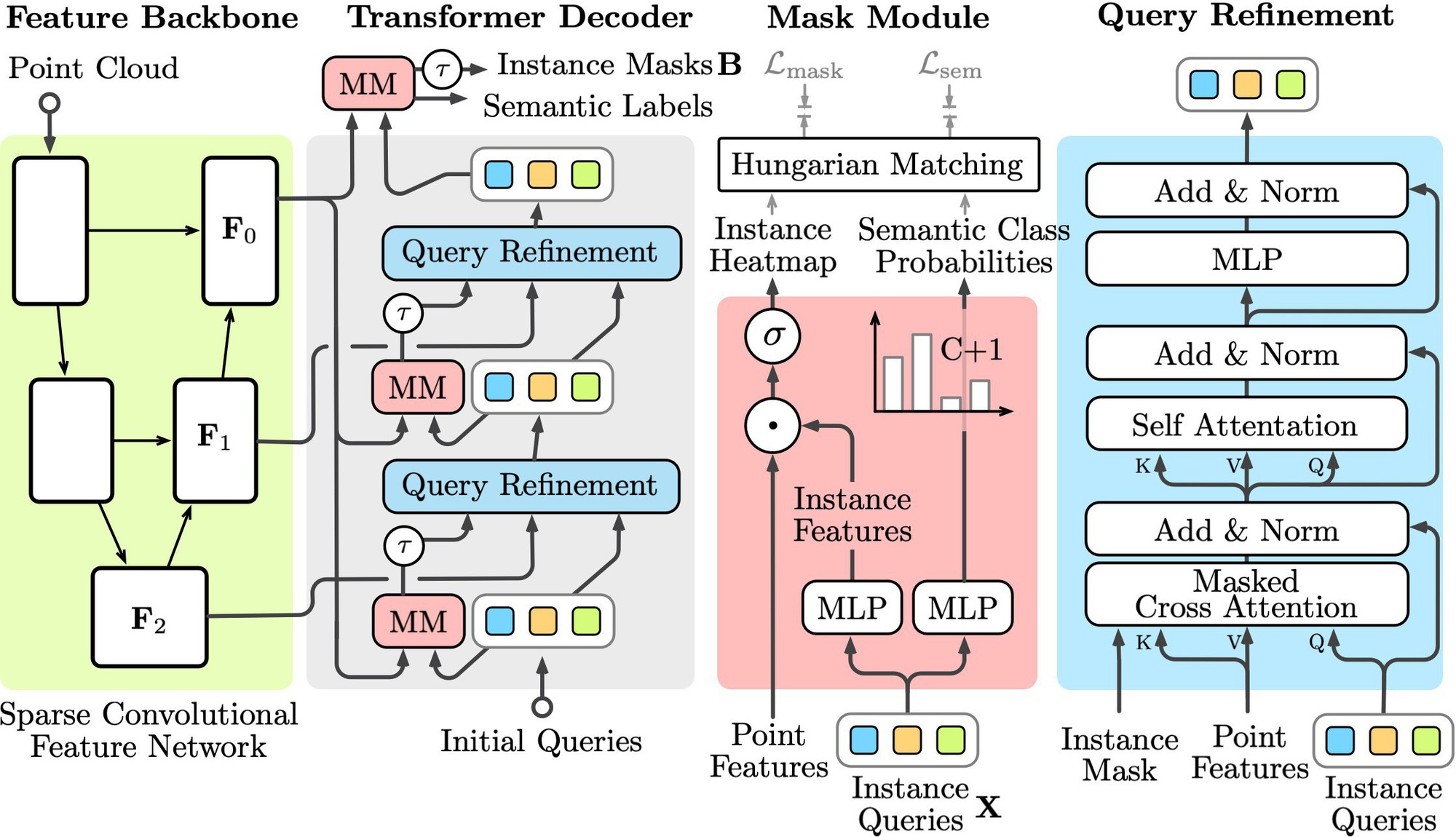
Modern 3D semantic instance segmentation approaches predominantly rely on specialized voting mechanisms followed by carefully designed geometric clustering techniques. Building on the successes of recent Transformer-based methods for object detection and image segmentation, we propose the first Transformer-based approach for 3D semantic instance segmentation. We show that we can leverage generic Transformer building blocks to directly predict instance masks from 3D point clouds. In our model called Mask3D each object instance is represented as an instance query. Using Transformer decoders, the instance queries are learned by iteratively attending to point cloud features at multiple scales. Combined with point features, the instance queries directly yield all instance masks in parallel. Mask3D has several advantages over current state-of-the-art approaches, since it neither relies on (1) voting schemes which require hand-selected geometric properties (such as centers) nor (2) geometric grouping mechanisms requiring manually-tuned hyper-parameters (e.g. radii) and (3) enables a loss that directly optimizes instance masks. Mask3D sets a new state-of-the-art on ScanNet test (+6.2 mAP), S3DIS 6-fold (+10.1 mAP), STPLS3D (+11.2 mAP) and ScanNet200 test (+12.4 mAP).
Motivation & Objective
- Address the limitations of current 3D instance segmentation methods that rely on hand-tuned components like geometric voting and clustering heuristics.
- Enable end-to-end training with a direct mask supervision signal, avoiding proxy losses on votes.
- Leverage the attention mechanism of Transformers to jointly reason over point features and learn instance queries for mask prediction.
- Demonstrate that a pure Transformer-based architecture can outperform existing CNN-based methods in 3D instance segmentation.
- Provide a unified, differentiable framework that predicts semantic labels and instance masks in parallel using attention-based query decoding.
Proposed method
- Uses instance queries as learnable embeddings that attend to multi-scale point cloud features via Transformer decoders.
- Each instance query is refined through multi-head self-attention and cross-attention with point features to generate instance-specific features.
- Predicts instance masks by computing similarity scores between instance features and all point features in the point cloud.
- Employs a bipartite matching strategy (Hungarian matching) to associate predictions with ground-truth instances during training.
- Combines binary cross-entropy and Dice loss for mask supervision to handle foreground-background class imbalance.
- Uses non-parametric query initialization via furthest point sampling (FPS) to improve performance over parametric queries.
Experimental results
Research questions
- RQ1Can a pure Transformer-based architecture directly predict 3D instance masks without relying on geometric voting or clustering heuristics?
- RQ2How does end-to-end mask supervision via a differentiable loss compare to proxy losses on votes in 3D instance segmentation?
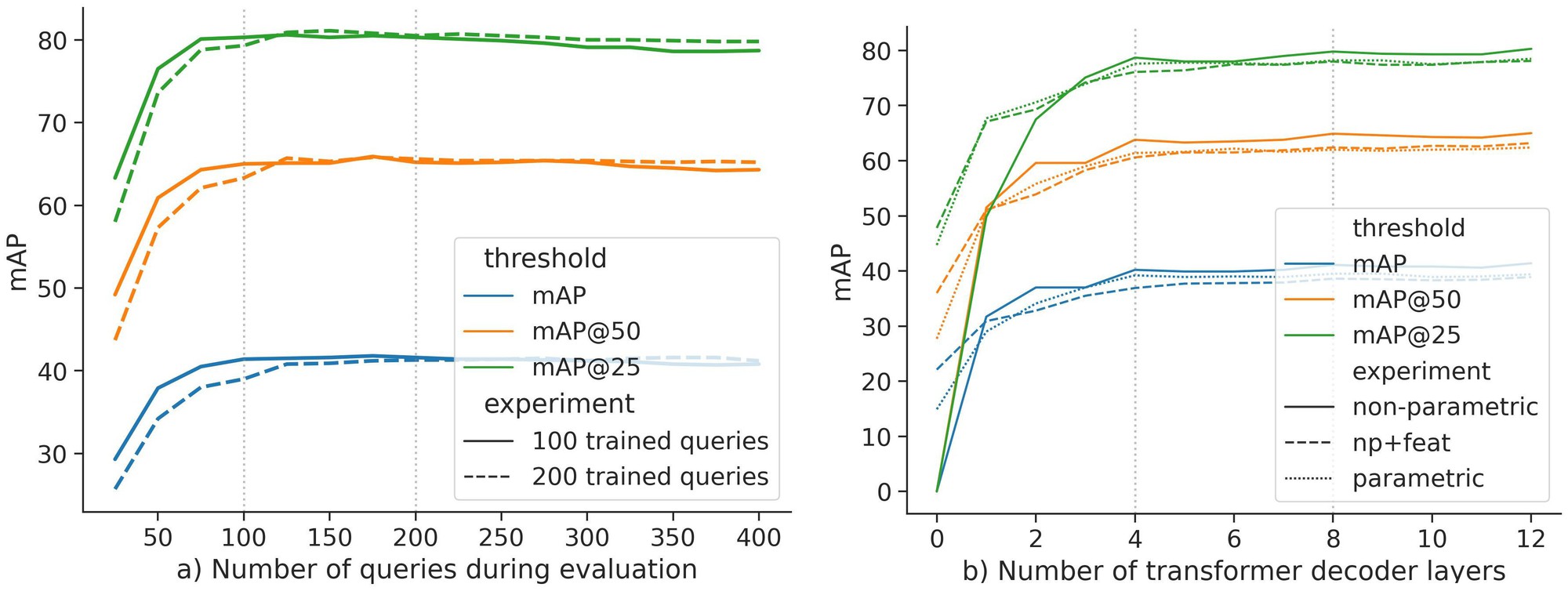
- RQ3What is the impact of query initialization strategy (parametric vs. non-parametric) on model performance?
- RQ4How does the number of instance queries affect inference quality and efficiency?
- RQ5Can a self-attention mechanism effectively capture long-range dependencies across large 3D scenes for accurate instance prediction?
Key findings
- Mask3D achieves a new state-of-the-art on ScanNet test split with a +6.2 mAP improvement over prior methods.
- On S3DIS 6-fold, Mask3D improves mAP by +10.1 compared to the previous SOTA.
- On STPLS3D, it achieves a +11.2 mAP gain, demonstrating strong generalization across domains.
- On ScanNet200, Mask3D sets a new SOTA with a +12.4 mAP improvement, highlighting its robustness on large-scale, fine-grained categories.
- Non-parametric query initialization via FPS outperforms parametric queries, with the best performance when queries are initialized to zero.
- The model shows rapid mask quality improvement in early decoder layers, with diminishing returns after four layers, indicating effective feature refinement.
Read this paper
Open the full text in the Nubint reader and ask about any passage as you read.
Read this paper on NubintThis review was generated by AI from the original paper. Please check the paper before citing it.