
[Paper Review] Masked Autoencoders are Efficient Class Incremental Learners
This paper proposes a novel bilateral Masked Autoencoder (MAE) framework for efficient class incremental learning (CIL), leveraging masked patch reconstruction to store exemplars more efficiently and improve replay quality. By fusing image-level and embedding-level features from two complementary MAE branches, the method achieves state-of-the-art performance on CIFAR-100, ImageNet-Subset, and ImageNet-Full with reduced forgetting and enhanced representation stability.
Class Incremental Learning (CIL) aims to sequentially learn new classes while avoiding catastrophic forgetting of previous knowledge. We propose to use Masked Autoencoders (MAEs) as efficient learners for CIL. MAEs were originally designed to learn useful representations through reconstructive unsupervised learning, and they can be easily integrated with a supervised loss for classification. Moreover, MAEs can reliably reconstruct original input images from randomly selected patches, which we use to store exemplars from past tasks more efficiently for CIL. We also propose a bilateral MAE framework to learn from image-level and embedding-level fusion, which produces better-quality reconstructed images and more stable representations. Our experiments confirm that our approach performs better than the state-of-the-art on CIFAR-100, ImageNet-Subset, and ImageNet-Full. The code is available at https://github.com/scok30/MAE-CIL .
Motivation & Objective
- To address catastrophic forgetting in class incremental learning (CIL) by leveraging the reconstructive power of Masked Autoencoders (MAEs).
- To improve exemplar efficiency in rehearsal-based CIL by storing only random image patches instead of full images.
- To enhance replay data quality and representation stability through a bilateral MAE architecture with image-level and embedding-level fusion.
- To achieve state-of-the-art performance on standard CIL benchmarks under constrained memory budgets.
Proposed method
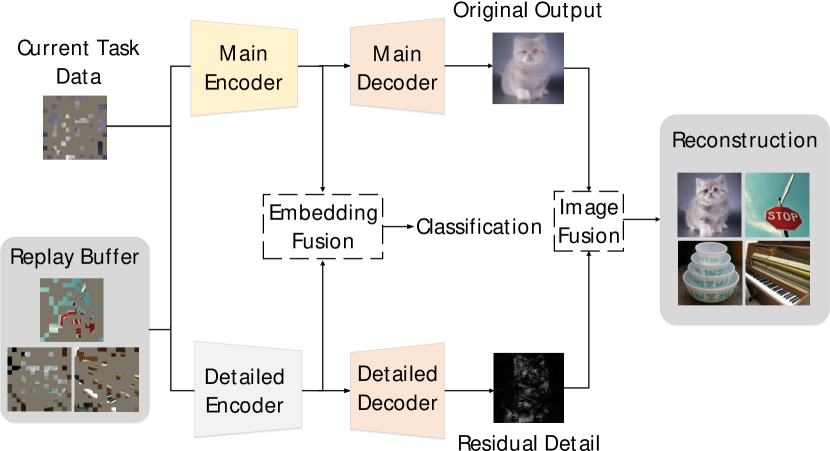
- Store random patches from past task images in a replay buffer, enabling compact exemplar storage with minimal memory overhead.
- Use a masked autoencoder to reconstruct full images from sparse, randomly masked patches, enabling effective self-supervised representation learning.
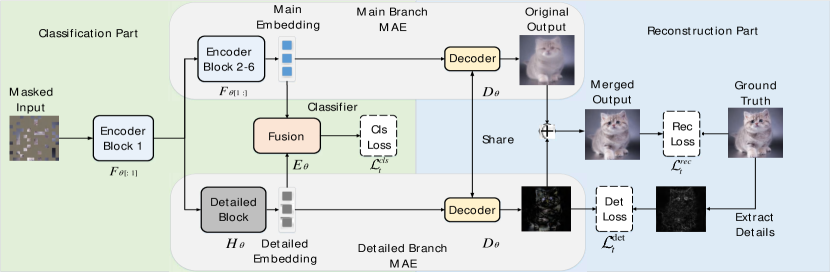
- Design a bilateral MAE framework with two parallel branches: one for main reconstruction and one for learning high-frequency details to improve image quality.
- Fuse features from both branches at the embedding level to produce more diverse and stable representations for improved generalization.
- Integrate a supervised classification head with the MAE to jointly optimize for classification accuracy and reconstruction fidelity.
- Apply masked input data during training to act as a regularizer, improving model robustness and reducing overfitting to stored exemplars.
Experimental results
Research questions
- RQ1Can masked autoencoders be effectively repurposed as efficient learners for class incremental learning by leveraging patch-based reconstruction for exemplar storage?
- RQ2How does the bilateral MAE architecture with image-level and embedding-level fusion improve reconstruction quality and representation stability compared to standard MAEs in CIL?
- RQ3Does the proposed method outperform existing state-of-the-art rehearsal-based CIL approaches under the same memory constraints?
- RQ4To what extent does the use of patch-level exemplars reduce memory usage while maintaining or improving performance?
- RQ5How does the model generalize under data distribution shifts, as measured by feature space density metrics?
Key findings
- The proposed bilateral MAE framework achieves 79.12% average accuracy on CIFAR-100 with 10 tasks, outperforming the previous state-of-the-art method (CIM) by 3.82% under the same memory budget.
- With only 80 exemplars per class stored as patches, the method achieves 68.40% top-1 accuracy on the last task of CIFAR-100, significantly outperforming DyTox (62.10%) and other memory-efficient baselines.
- The feature space density metric (π) is substantially higher for the proposed method, indicating more generalizable and robust representations under data shift.
- Reconstruction quality is significantly improved by the detailed branch, which captures high-frequency textures missing in the main branch, leading to more realistic and diverse replay data.
- The method maintains strong performance across all tasks, with a low forgetting rate (F↓ = 12.17) on CIFAR-100, demonstrating effective stability-plasticity trade-off.
- Ablation studies confirm that performance gains are not solely due to increased exemplar count but stem from the architectural innovation of bilateral fusion and patch-based reconstruction.
Read this paper
Open the full text in the Nubint reader and ask about any passage as you read.
Read this paper on NubintThis review was generated by AI from the original paper. Please check the paper before citing it.