
[Paper Review] Measurement of the $B^{0} ightarrow D^{*-} \ell^{+} ν_{\ell}$ branching ratio and $|V_{cb}|$ with a fully reconstructed accompanying $B$ meson in 2019-2021 Belle II data
This paper presents a precise measurement of the $B^0 \to D^{*-} \ell^+ \nu_\ell$ branching fraction and $|V_{cb}|$ using fully reconstructed $B$ meson pairs in 189.3 fb$^{-1}$ of Belle II data from 2019–2021. The study achieves $\mathcal{B}(B^0 \to D^{*-} \ell^+ \nu_\ell) = (5.27 \pm 0.22_{\text{stat}} \pm 0.38_{\text{syst}})\%$, consistent with world averages, and determines $|V_{cb}| \times 10^3 = 37.9 \pm 2.7$, improving constraints on the CKM matrix element via exclusive semileptonic decays.
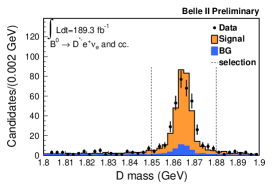
We present a measurement of the $B^{0} ightarrow D^{*-} \ell^{+} ν_{\ell}$ ($\ell=e,μ$) branching ratio and of the CKM parameter $|V_{cb}|$ using signal decays accompanied by a fully reconstructed $B$ meson. The Belle II data set of electron-positron collisions at the $Υ(4S)$ resonance, corresponding to 189.3$\,$fb$^{-1}$ of integrated luminosity, is analyzed. With the Caprini-Lellouch-Neubert form factor parameterization, the parameters $η_{ m EW} F(1) |V_{cb}|$ and $ρ^{2}$ are extracted, where $η_{ m EW}$ is an electroweak correction, $F(1)$ is a normalization factor and $ρ^{2}$ is a form factor shape parameter. We reconstruct 516 signal decays and thereby obtain $\mathcal{B} (B^{0} ightarrow D^{*-} \ell^{+} ν_{\ell} ) = \left(5.27 \pm 0.22~ m{\left(stat ight)} \pm 0.38~ m{\left(syst ight)} ight) \%$, $η_{EW} F(1) |V_{cb}| imes 10^{3} = 34.6 \pm 1.8~ m{\left(stat ight)} \pm 1.7~ m{\left(syst ight)}$, and $ρ^{2} = 0.94 \pm 0.18~ m{\left(stat ight)} \pm 0.11~ m{\left(syst ight)}$.
Motivation & Objective
- To measure the $B^0 \to D^{*-} \ell^+ \nu_\ell$ branching fraction with high precision using fully reconstructed $B$ meson pairs in $e^+e^-$ collisions at the $\Upsilon(4S)$ resonance.
- To determine the CKM matrix element $|V_{cb}|$ by combining the measured branching fraction with theoretical form factors and electroweak radiative corrections.
- To reduce systematic uncertainties by using a fully reconstructed $B$ meson as a tag, minimizing reliance on Monte Carlo simulations for signal reconstruction.
- To test the consistency of exclusive semileptonic $B$ decays with the Standard Model prediction for $|V_{cb}|$, addressing the long-standing $B \to D^*\ell\nu$ puzzle.
Proposed method
- The analysis uses 189.3 fb$^{-1}$ of $e^+e^-$ collision data collected at the $\Upsilon(4S)$ resonance by the Belle II experiment.
- Signal events are selected via a fully reconstructed $B^0 \to D^{*-} \ell^+ \nu_\ell$ decay with a $B^0$ meson reconstructed in the accompanying $B^0 \bar{B}^0$ pair.
- The $D^{*-}$ is reconstructed via $D^{*-} \to \pi^- \bar{D}^0$ and $\bar{D}^0 \to K^+ \pi^-$, with kinematic constraints applied to improve resolution.
- The $B^0$ tagging efficiency and background suppression are enhanced using kinematic and topological variables, including beam energy and energy difference.
- Systematic uncertainties are evaluated through data-driven methods, including event-level selection, simulation sample size, and external inputs such as branching fractions and form factors.
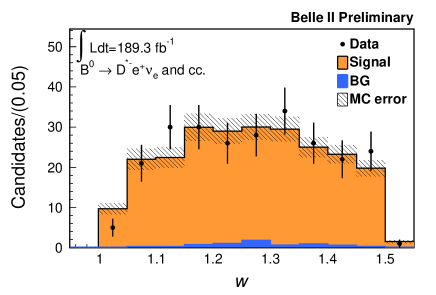
- A binned maximum-likelihood fit is performed on the $w = q^2$ distribution to extract $\eta_{\text{EW}}F(1)|V_{cb}|$ and $\rho^2$, with covariance matrices incorporating systematic correlations.
Experimental results
Research questions
- RQ1What is the precise branching fraction of the exclusive $B^0 \to D^{*-} \ell^+ \nu_\ell$ decay using fully reconstructed $B$ mesons?
- RQ2How does the measured $|V_{cb}|$ value compare to the world average, and does it resolve the $B \to D^*\ell\nu$ tension?
- RQ3What is the impact of systematic uncertainties on the $|V_{cb}|$ determination, particularly from detector efficiency, simulation size, and external inputs?
- RQ4How well does the measured $d\Gamma/dw$ distribution agree with the theoretical model, and what is the goodness-of-fit?
Key findings
- The measured branching fraction is $\mathcal{B}(B^0 \to D^{*-} \ell^+ \nu_\ell) = (5.27 \pm 0.22_{\text{stat}} \pm 0.38_{\text{syst}})\%$, consistent with the world average of $(5.06 \pm 0.12)\%$.
- The value of $\eta_{\text{EW}}F(1)|V_{cb}| \times 10^3 = 34.6 \pm 1.8_{\text{stat}} \pm 1.7_{\text{syst}}$ is in agreement with the world average of $35.27 \pm 0.38$.
- The $|V_{cb}|$ value is determined as $37.9 \pm 2.7$ after incorporating $\eta_{\text{EW}} = 1.00662 \pm 0.00016$ and $F(1) = 0.906 \pm 0.004_{\text{stat}} \pm 0.012_{\text{syst}}$.
- The fit to the $d\Gamma/dw$ distribution yields a reduced $\chi^2$ of 1.6 with a p-value of 40.7%, indicating good agreement with the model.
- The total systematic uncertainty on the branching fraction is 7.3%, dominated by tracking and lepton identification efficiencies (4.1% and 2.0%, respectively).
- The covariance matrix for $\eta_{\text{EW}}F(1)|V_{cb}|$ and $\rho^2$ shows moderate correlations across $w$ bins, with $\rho^2 = 0.94 \pm 0.18_{\text{stat}} \pm 0.11_{\text{syst}}$.
Read this paper
Open the full text in the Nubint reader and ask about any passage as you read.
Read this paper on NubintThis review was generated by AI from the original paper. Please check the paper before citing it.