
[Paper Review] Measurement of the pion form factor with CMD-3 detector and its implication to the hadronic contribution to muon (g-2)
This paper presents a high-precision measurement of the pion form factor using the CMD-3 detector at the VEPP-2000 e+e− collider, achieving a 0.2% systematic uncertainty. The result yields a leading-order hadronic contribution to the muon anomalous magnetic moment of $ a_{\mu}^{had;LO}(2\pi,\mathrm{CMD3}) = 5260(42)\times 10^{-11} $, resolving discrepancies with previous data and improving agreement with the experimental value of $ a_\mu $, thus reducing the tension in the Standard Model prediction.
The cross section of the process $e^+e^- oπ^+π^-$ has been measured in the center-of-mass energy range from 0.32 to 1.2 GeV with the CMD-3 detector at the electron-positron collider VEPP-2000. The measurement is based on an integrated luminosity of about 88 pb$^{-1}$, of which 62 pb$^{-1}$ represent a complete dataset collected by CMD-3 at center-of-mass energies below 1 GeV. In the dominant region near the $ρ$ resonance a systematic uncertainty of 0.7% was achieved. The implications of the presented results for the evaluation of the hadronic contribution to the anomalous magnetic moment of the muon are discussed.
Motivation & Objective
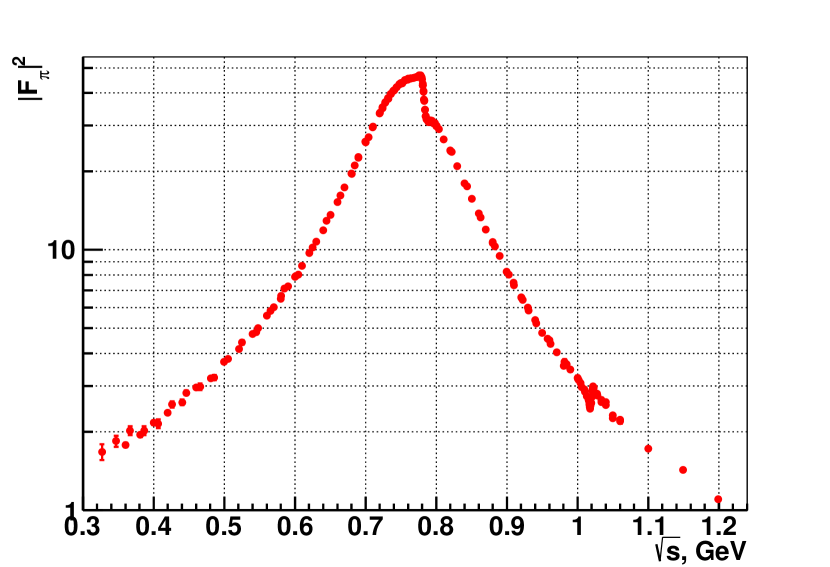
- To measure the pion form factor $ |F_\pi|^2 $ with high precision in the energy range $ \sqrt{s} = 0.327\text{--}1.2 $ GeV using the CMD-3 detector at VEPP-2000.
- To reduce the uncertainty in the leading-order hadronic contribution to the muon anomalous magnetic moment $ a_\mu^{had;LO} $, which is a major source of theoretical uncertainty.
- To resolve discrepancies between previous experimental measurements of $ e^+e^- \to \pi^+\pi^- $, particularly in the $ \rho $-meson region.
- To validate the detector calibration and analysis procedures through independent cross-checks, including $ e^+e^- \to \mu^+\mu^- $ and vector meson dominance model predictions.
- To provide a benchmark dataset for future lattice QCD and MUonE experiment comparisons.
Proposed method
- Data were collected using the CMD-3 detector at the VEPP-2000 e+e− collider, operating in the energy range $ \sqrt{s} = 0.327\text{--}1.2 $ GeV.
- The pion form factor was extracted from the measured $ e^+e^- \to \pi^+\pi^- $ cross section using radiative corrections and detector response simulations.
- Systematic uncertainties were evaluated using multiple independent checks, including $ e^+e^- \to \mu^+\mu^- $ cross section measurements and comparison with the generalized vector meson dominance (GVMD) model.
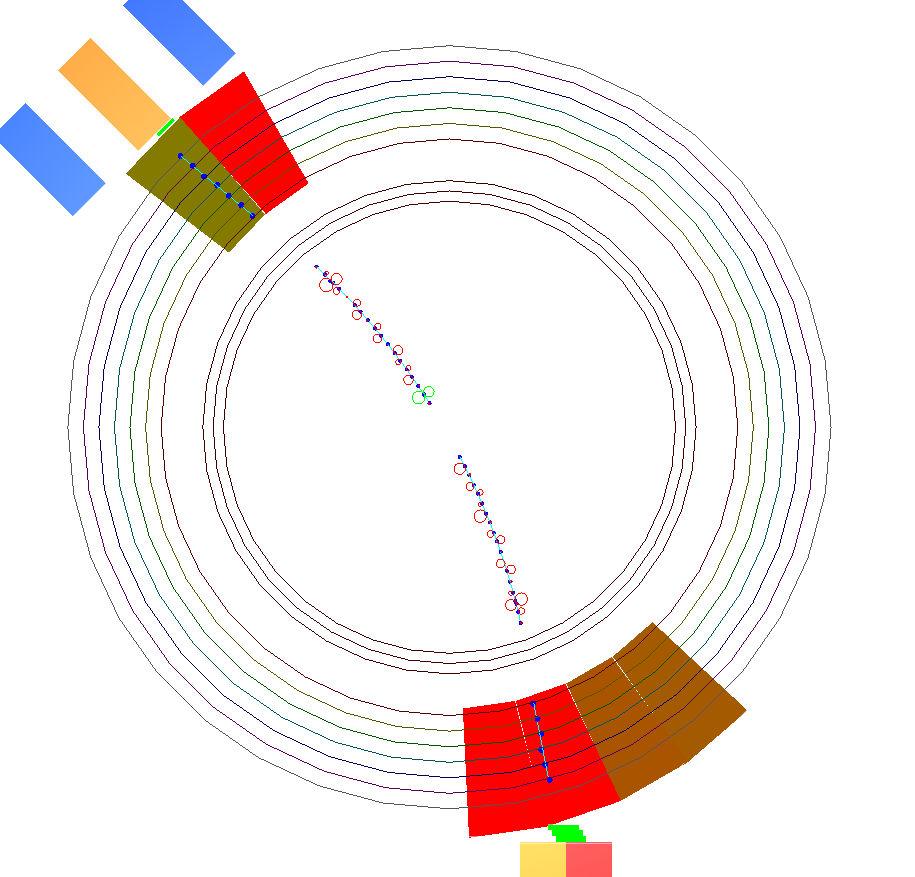
- The analysis employed momentum-based tracking to separate muons from pions, enabling validation of the reconstruction and correction procedures.
- A fit to the CMD-3 data was performed to extract the form factor, with systematic errors propagated via a full covariance matrix approach.
- The hadronic contribution to $ a_\mu^{had;LO} $ was calculated using the CMD-3 data in the $ \pi^+\pi^- $ channel, with external data used outside the measured energy range.
Experimental results
Research questions
- RQ1What is the precise value of the pion form factor $ |F_\pi|^2 $ in the $ \rho $-meson region, and how does it compare to previous measurements?
- RQ2To what extent do the new CMD-3 data reduce the uncertainty in the leading-order hadronic contribution to the muon anomalous magnetic moment?
- RQ3How well do the measured $ e^+e^- \to \pi^+\pi^- $ cross sections agree with the generalized vector meson dominance (GVMD) model predictions?
- RQ4What is the consistency of the detector reconstruction and radiative correction procedures, as validated by $ e^+e^- \to \mu^+\mu^- $ measurements?
- RQ5Does the new data resolve the long-standing discrepancy between different experimental determinations of $ a_\mu^{had;LO} $?
Key findings
- The measured pion form factor shows a 5% larger value than previous energy scan experiments (CMD-2, SND) in the $ \rho $-meson region ($ \sqrt{s} = 0.6\text{--}0.75 $ GeV).
- The leading-order hadronic contribution to the muon anomalous magnetic moment is determined as $ a_{\mu}^{had;LO}(2\pi,\mathrm{CMD3}) = 5260(42)\times 10^{-11} $, with the uncertainty dominated by systematic effects.
- The result improves agreement with the experimental value of $ a_\mu $, yielding a difference of $ 49(55)\times 10^{-11} $, within 0.9 standard deviations.
- The consistency of the analysis is confirmed by a $ e^+e^- \to \mu^+\mu^- $ cross section measurement, yielding a ratio of $ 1.0017 \pm 0.0016 $ to the QED prediction.
- The generalized vector meson dominance (GVMD) model prediction agrees with the data within $ \delta A = (-2.9 \pm 2.3) \times 10^{-4} $, indicating consistency with the detector response and analysis chain.
- The systematic uncertainty of $ 42\times 10^{-11} $ in the $ a_\mu^{had;LO} $ determination is fully attributed to systematic effects in the pion form factor measurement.
Read this paper
Open the full text in the Nubint reader and ask about any passage as you read.
Read this paper on NubintThis review was generated by AI from the original paper. Please check the paper before citing it.