
[Paper Review] Measurement of the Positive Muon Anomalous Magnetic Moment to 0.20 ppm
The Fermilab Muon g-2 Collaboration reports a new measurement of the positive muon anomalous magnetic moment a_mu using 2019–2020 data, achieving 0.20 ppm precision and updating the world average.
We present a new measurement of the positive muon magnetic anomaly, $a_μ\equiv (g_μ- 2)/2$, from the Fermilab Muon $g\!-\!2$ Experiment using data collected in 2019 and 2020. We have analyzed more than 4 times the number of positrons from muon decay than in our previous result from 2018 data. The systematic error is reduced by more than a factor of 2 due to better running conditions, a more stable beam, and improved knowledge of the magnetic field weighted by the muon distribution, $ ildeω'^{}_p$, and of the anomalous precession frequency corrected for beam dynamics effects, $ω_a$. From the ratio $ω_a / ildeω'^{}_p$, together with precisely determined external parameters, we determine $a_μ= 116\,592\,057(25) imes 10^{-11}$ (0.21 ppm). Combining this result with our previous result from the 2018 data, we obtain $a_μ ext{(FNAL)} = 116\,592\,055(24) imes 10^{-11}$ (0.20 ppm). The new experimental world average is $a_μ( ext{Exp}) = 116\,592\,059(22) imes 10^{-11}$ (0.19 ppm), which represents a factor of 2 improvement in precision.
Motivation & Objective
- Motivate a high-precision test of the Standard Model via the muon magnetic anomaly a_mu.
- Improve experimental control of muon spin precession and magnetic field mapping to reduce systematics.
- Combine multiple analyses and blinding schemes to robustly extract a_mu from omega_a and omega_p' measurements.
- Provide an updated experimental value of a_mu with reduced uncertainties and compare to SM predictions.
Proposed method
- Measure the anomalous precession frequency omega_a from time-dependent positron signals in calorimeters.
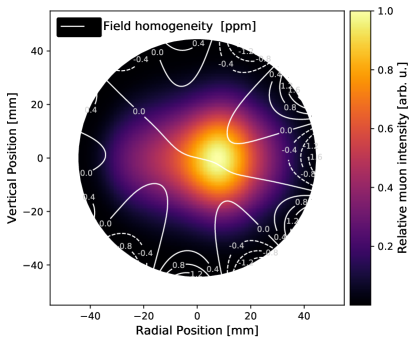
- Map the magnetic field with NMR trolley probes and calibrate to obtain tilde(omega_p') weighted by the muon distribution.
- Compute a_mu from the ratio R_mu' = omega_a / tilde(omega_p') using external constants (mu_p', mu_e, m_mu/m_e, g_e/2).
- Apply beam-dynamics corrections (C_e, C_p, C_pa, C_dd, C_ml) and field transient corrections (B_k, B_q) to obtain the true omega_a and tilde(omega_p').
- Combine independent analyses and blinding schemes across Run-2/3 and Run-1, validating consistency and systematics.
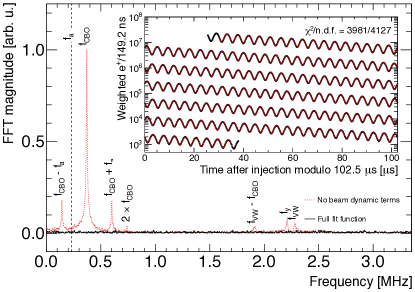
Experimental results
Research questions
- RQ1What is the precise value of the positive muon anomalous magnetic moment a_mu given Run-2/3 data?
- RQ2How do beam dynamics and magnetic field systematic corrections impact the extraction of a_mu from omega_a and tilde(omega_p')?
- RQ3Do the Run-2/3 results agree with the earlier Run-1 measurement and with the Standard Model predictions?
- RQ4What is the combined experimental world average for a_mu including BN L and FNAL results, and what are the dominant uncertainty sources?
Key findings
- a_mu(FNAL) = 116592055(24) × 10^-11 (0.20 ppm) from Run-2/3 data combined with Run-1 adjustments.
- The new experimental world average is a_mu(exp) = 116592059(22) × 10^-11 (0.19 ppm).
- Statistical uncertainty for omega_a is 201 ppb and systematic uncertainty is 25 ppb for Run-2/3.
- The overall 622 ppb total uncertainty associated with R_mu' is reduced, enabling a twofold improvement in precision over prior results.
- Run-2/3 achieved a fourfold increase in detected positrons compared to Run-1, with systematic uncertainties reduced by more than a factor of two.
- Consistency is found between Run-2/3 and adjusted Run-1 values within correlated uncertainties.
Read this paper
Open the full text in the Nubint reader and ask about any passage as you read.
Read this paper on NubintThis review was generated by AI from the original paper. Please check the paper before citing it.