
[Paper Review] Merge, Ensemble, and Cooperate! A Survey on Collaborative Strategies in the Era of Large Language Models
This survey categorizes LLM collaboration into three approaches—Merging, Ensemble, and Cooperation—and reviews methods, adaptations, and future directions for leveraging multiple LLMs.
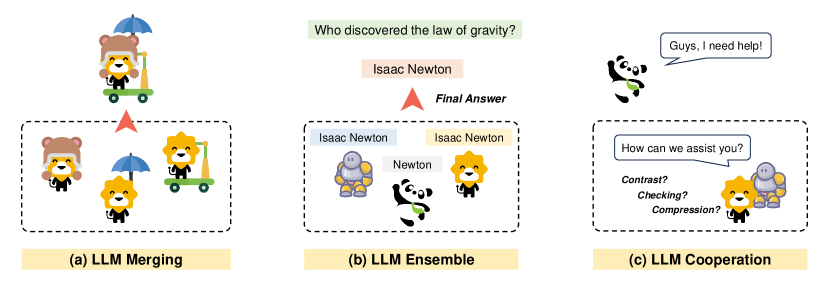
The remarkable success of Large Language Models (LLMs) has ushered natural language processing (NLP) research into a new era. Despite their diverse capabilities, LLMs trained on different corpora exhibit varying strengths and weaknesses, leading to challenges in maximizing their overall efficiency and versatility. To address these challenges, recent studies have explored collaborative strategies for LLMs. This paper provides a comprehensive overview of this emerging research area, highlighting the motivation behind such collaborations. Specifically, we categorize collaborative strategies into three primary approaches: Merging, Ensemble, and Cooperation. Merging involves integrating multiple LLMs in the parameter space. Ensemble combines the outputs of various LLMs. Cooperation} leverages different LLMs to allow full play to their diverse capabilities for specific tasks. We provide in-depth introductions to these methods from different perspectives and discuss their potential applications. Additionally, we outline future research directions, hoping this work will catalyze further studies on LLM collaborations and paving the way for advanced NLP applications.
Motivation & Objective
- Examine why collaborating multiple LLMs can outperform single models due to diverse strengths and weaknesses.
- Define and organize collaboration strategies into merging, ensemble, and cooperation.
- Summarize techniques, architectures, and applications of each category in the LLM era.
- Highlight challenges, limitations, and future research directions in LLM collaboration.
Proposed method
- Classify LLM collaboration methods into three categories: merging (parameter-space fusion), ensemble (output fusion), and cooperation (task-specific coordination).
- Detail sub-approaches within each category (e.g., M-ROS, M-MTC, task vectors, pruning, incremental training for merging).
- Describe ensemble paradigms (before, during, and after inference) and address vocabulary/alignment challenges for heterogeneous LLMs.
- Discuss cooperation strategies that leverage diverse capabilities for efficiency, knowledge transfer, and alignment.
- Provide discussion on toolkit support (MergeKit) and practical considerations for LLM collaboration.
Experimental results
Research questions
- RQ1What are the main collaborative strategies for LLMs and how do they differ in requirements and outcomes?
- RQ2How do merging, ensemble, and cooperation methods leverage diverse LLM strengths to improve performance and versatility?
- RQ3What are the key techniques, challenges, and future directions in each collaboration category (Merging, Ensemble, Cooperation)?
- RQ4How can practical tooling and workflows support scalable LLM collaboration?
Key findings
- Merging strategies aim to create stronger single models by combining parameters, with M-ROS and M-MTC as core objectives.
- Ensemble approaches focus on combining outputs at different stages of inference to improve reliability and quality across models with compatible vocabularies.
- Cooperation methods emphasize task-specific coordination and efficient utilization of diverse capabilities beyond simple merging or ensembling.
- Research identifies that identical-architecture merging is most straightforward, while ensemble and cooperation relax compatibility requirements, enabling broader collaboration.
- Practical developments include task vectors, adaptive weighting, pruning techniques (DARE, DPPA), and toolkits (MergeKit) to support merging and related workflows.
- The survey outlines various future directions and challenges, including alignment taxes, hallucinations, privacy concerns, and the need for scalable evaluation benchmarks.
Read this paper
Open the full text in the Nubint reader and ask about any passage as you read.
Read this paper on NubintThis review was generated by AI from the original paper. Please check the paper before citing it.