
[Paper Review] MidiCaps: A Large-Scale MIDI Dataset With Text Captions
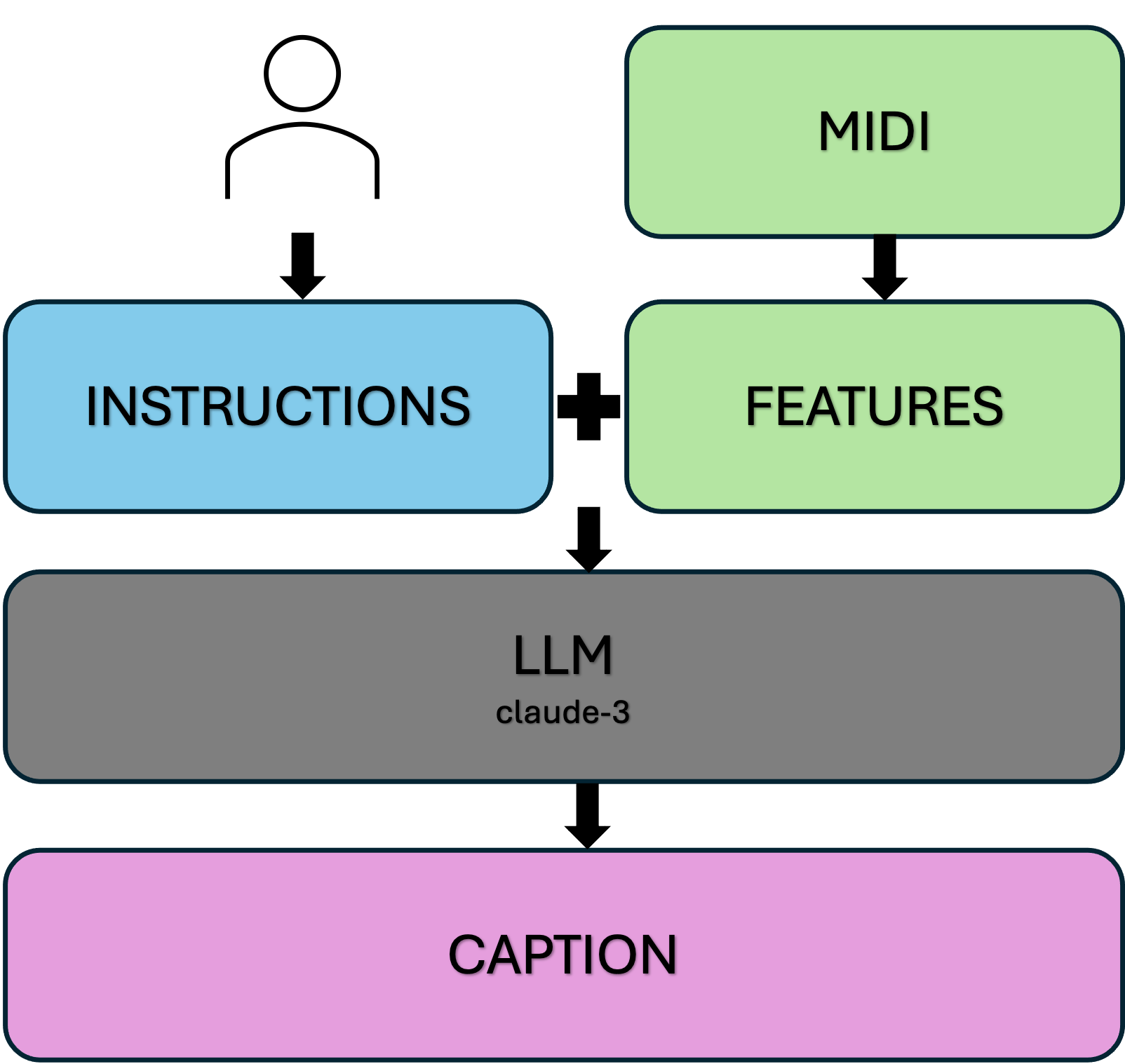
This paper introduces MidiCaps, the first large-scale open dataset of 168,407 MIDI files paired with human-like textual captions. Using in-context learning with the Claude-3 LLM, it generates descriptive captions from extracted music features—such as tempo, chords, genre, and mood—demonstrating high-quality alignment in listening studies, thus enabling text-to-MIDI generation and cross-modal music understanding research.
Generative models guided by text prompts are increasingly becoming more popular. However, no text-to-MIDI models currently exist due to the lack of a captioned MIDI dataset. This work aims to enable research that combines LLMs with symbolic music by presenting, the first openly available large-scale MIDI dataset with text captions. MIDI (Musical Instrument Digital Interface) files are widely used for encoding musical information and can capture the nuances of musical composition. They are widely used by music producers, composers, musicologists, and performers alike. Inspired by recent advancements in captioning techniques, we present a curated dataset of over 168k MIDI files with textual descriptions. Each MIDI caption describes the musical content, including tempo, chord progression, time signature, instruments, genre, and mood, thus facilitating multi-modal exploration and analysis. The dataset encompasses various genres, styles, and complexities, offering a rich data source for training and evaluating models for tasks such as music information retrieval, music understanding, and cross-modal translation. We provide detailed statistics about the dataset and have assessed the quality of the captions in an extensive listening study. We anticipate that this resource will stimulate further research at the intersection of music and natural language processing, fostering advancements in both fields.
Motivation & Objective
- To address the lack of large-scale, open, captioned MIDI datasets for training text-to-MIDI models.
- To enable research in text-guided music generation by providing high-quality, descriptive captions for symbolic music.
- To develop a scalable, automated framework for generating accurate and natural-sounding captions for MIDI files.
- To validate caption quality through a comprehensive listening study comparing AI-generated and human-written captions.
- To establish a foundation for future work in music understanding, music information retrieval, and multimodal LLMs applied to music.
Proposed method
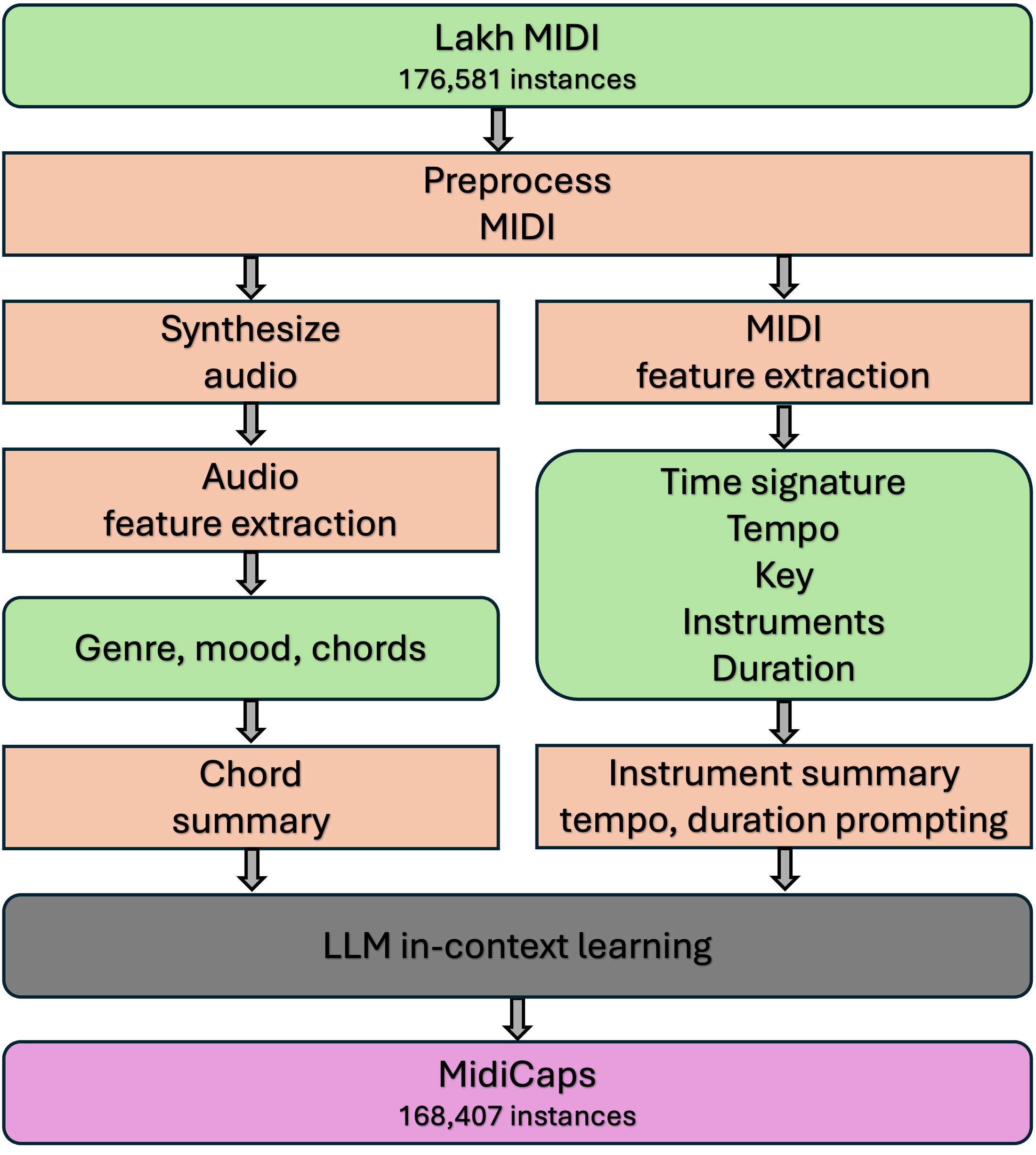
- Extracted 168,407 MIDI files from the Lakh MIDI dataset as the source corpus.
- Automatically extracted music-specific features including tempo, time signature, chord progression, instrument presence, genre, and mood using state-of-the-art MIR tools.
- Designed a prompt engineering framework using in-context learning with the Claude-3 LLM to generate captions based on extracted features and a small set of expert-annotated examples.
- Used a curated set of 500 feature-caption pairs to fine-tune the LLM’s in-context behavior for consistency and descriptive richness.
- Applied a two-stage evaluation: first, a listening study with 23 participants (16 general listeners, 7 music experts) to assess caption quality across 7 dimensions.
- Evaluated caption quality using a 7-point Likert scale across overall matching, human-likeness, genre, mood, key, chord, and tempo alignment.
Experimental results
Research questions
- RQ1Can large language models generate high-quality, descriptive captions for MIDI files using only a small number of in-context examples?
- RQ2How well do AI-generated captions align with the actual musical content of MIDI files across key attributes like tempo, chords, genre, and mood?
- RQ3How do AI-generated captions compare to human-written captions in terms of perceived quality and musical accuracy?
- RQ4To what extent can automated captioning frameworks produce natural-sounding, musically coherent descriptions at scale?
- RQ5Can a synthetic captioning pipeline achieve human-level perceptual alignment in music captioning without full human annotation?
Key findings
- The AI-generated captions achieved an average overall matching score of 5.63 (out of 7) among general listeners, slightly outperforming human-written captions (5.46).
- Music experts rated the AI-generated captions at 4.92 for overall matching, which is still strong and comparable to human-written captions (5.40).
- For human-likeness, general listeners rated AI captions at 5.32, close to the human-written score of 5.21, while music experts rated them at 4.98, near the human benchmark of 5.09.
- In tempo matching, AI captions outperformed human-written captions, with scores of 5.86 (general) and 5.77 (experts), respectively.
- For chord matching, music experts rated AI captions at 5.09, slightly below the human benchmark (5.74), but still indicating strong alignment despite the inherent difficulty of summarizing complex chord progressions.
- The listening study confirmed that the captions are perceptually aligned with the MIDI files and are natural-sounding, supporting the viability of the framework for downstream music-AI applications.
Read this paper
Open the full text in the Nubint reader and ask about any passage as you read.
Read this paper on NubintThis review was generated by AI from the original paper. Please check the paper before citing it.