
[Paper Review] MIMONets: Multiple-Input-Multiple-Output Neural Networks Exploiting Computation in Superposition
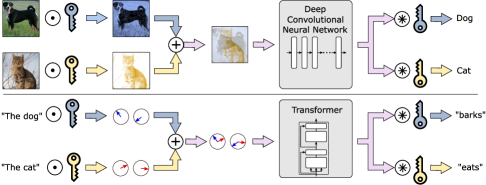
MIMONets introduce a novel framework for Multiple-Input-Multiple-Output neural networks that exploit computation in superposition using Vector-Symbolic Architectures (VSA), enabling simultaneous processing of multiple inputs via fixed-width distributed representations. The method achieves up to 4× speedup with minimal accuracy loss by binding inputs to high-dimensional keys, applying holistic nonlinear transformations, and unbinding individual results, demonstrating success in both CNNs (MIMOConv) and Transformers (MIMOFormer).
With the advent of deep learning, progressively larger neural networks have been designed to solve complex tasks. We take advantage of these capacity-rich models to lower the cost of inference by exploiting computation in superposition. To reduce the computational burden per input, we propose Multiple-Input-Multiple-Output Neural Networks (MIMONets) capable of handling many inputs at once. MIMONets augment various deep neural network architectures with variable binding mechanisms to represent an arbitrary number of inputs in a compositional data structure via fixed-width distributed representations. Accordingly, MIMONets adapt nonlinear neural transformations to process the data structure holistically, leading to a speedup nearly proportional to the number of superposed input items in the data structure. After processing in superposition, an unbinding mechanism recovers each transformed input of interest. MIMONets also provide a dynamic trade-off between accuracy and throughput by an instantaneous on-demand switching between a set of accuracy-throughput operating points, yet within a single set of fixed parameters. We apply the concept of MIMONets to both CNN and Transformer architectures resulting in MIMOConv and MIMOFormer, respectively. Empirical evaluations show that MIMOConv achieves about 2-4 x speedup at an accuracy delta within [+0.68, -3.18]% compared to WideResNet CNNs on CIFAR10 and CIFAR100. Similarly, MIMOFormer can handle 2-4 inputs at once while maintaining a high average accuracy within a [-1.07, -3.43]% delta on the long range arena benchmark. Finally, we provide mathematical bounds on the interference between superposition channels in MIMOFormer. Our code is available at https://github.com/IBM/multiple-input-multiple-output-nets.
Motivation & Objective
- Address the growing computational cost of large deep neural networks by enabling concurrent processing of multiple inputs to reduce inference latency.
- Overcome the challenge of applying nonlinear transformations in superposition, which has previously been limited to linear operations due to interference.
- Enable dynamic, on-demand trade-offs between accuracy and throughput during inference using a single model with fixed parameters.
- Extend the superposition paradigm to complex architectures like Transformers, where attention mechanisms pose significant interference challenges.
- Provide theoretical bounds on interference in superposition channels and validate the method empirically on standard benchmarks.
Proposed method
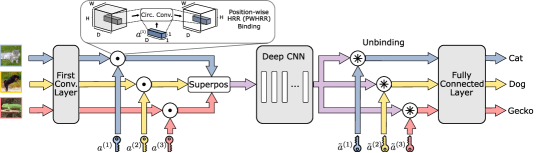
- Represent multiple inputs as key-value pairs in a fixed-width distributed vector-symbolic data structure using high-dimensional keys for binding.
- Apply a single nonlinear transformation (e.g., convolutional or attention layers) to the entire superposed data structure, enabling holistic computation in superposition.
- Use a locality-preserving binding operation (PWHRR) and isometry-inducing regularization to minimize interference between superposition channels.
- Implement a learned unbinding mechanism using inverse keys to recover individual transformed outputs after processing.
- For Transformers, employ a 2D grid binding scheme to compute attention scores in superposition, ensuring convergence to exact dot-product attention in high dimensions.
- Derive probabilistic tail bounds on interference distortion, showing convergence to noise-free attention as dimensionality increases.
Experimental results
Research questions
- RQ1Can nonlinear neural transformations be applied holistically to multiple inputs in superposition without significant interference?
- RQ2How can interference between superposition channels be minimized in deep nonlinear architectures like CNNs and Transformers?
- RQ3Can MIMONets achieve a dynamic, on-demand trade-off between accuracy and throughput during inference using a single model?
- RQ4To what extent can superposition-based computation preserve attention quality in Transformer architectures?
- RQ5What theoretical guarantees can be provided on the distortion and convergence of attention in superpositioned data structures?
Key findings
- MIMOConv achieves approximately 2× to 4× speedup on CIFAR10 and CIFAR100 with accuracy losses of 1.24% to 3.18% when processing four inputs in superposition.
- MIMOFormer maintains high average accuracy on the Long Range Arena benchmark, with only a 1.07% to 3.43% drop when handling two to four inputs simultaneously.
- On synthetic sequence modeling tasks, MIMOFormer achieves 96.52% and 99.40% accuracy for attention and associative recall, respectively, outperforming DataMUX by over 70 percentage points.
- Theoretical analysis shows that interference distortion in MIMOFormer diminishes with increasing dimensionality, converging to exact dot-product attention.
- MIMONets enable dynamic switching between accuracy-throughput operating points at inference time without retraining, using a single fixed-parameter model.
- Empirical results confirm that MIMOFormer successfully approximates true attention without the blurring issues seen in prior methods like DataMUX.
Read this paper
Open the full text in the Nubint reader and ask about any passage as you read.
Read this paper on NubintThis review was generated by AI from the original paper. Please check the paper before citing it.