
[Paper Review] Mirages: On Anthropomorphism in Dialogue Systems
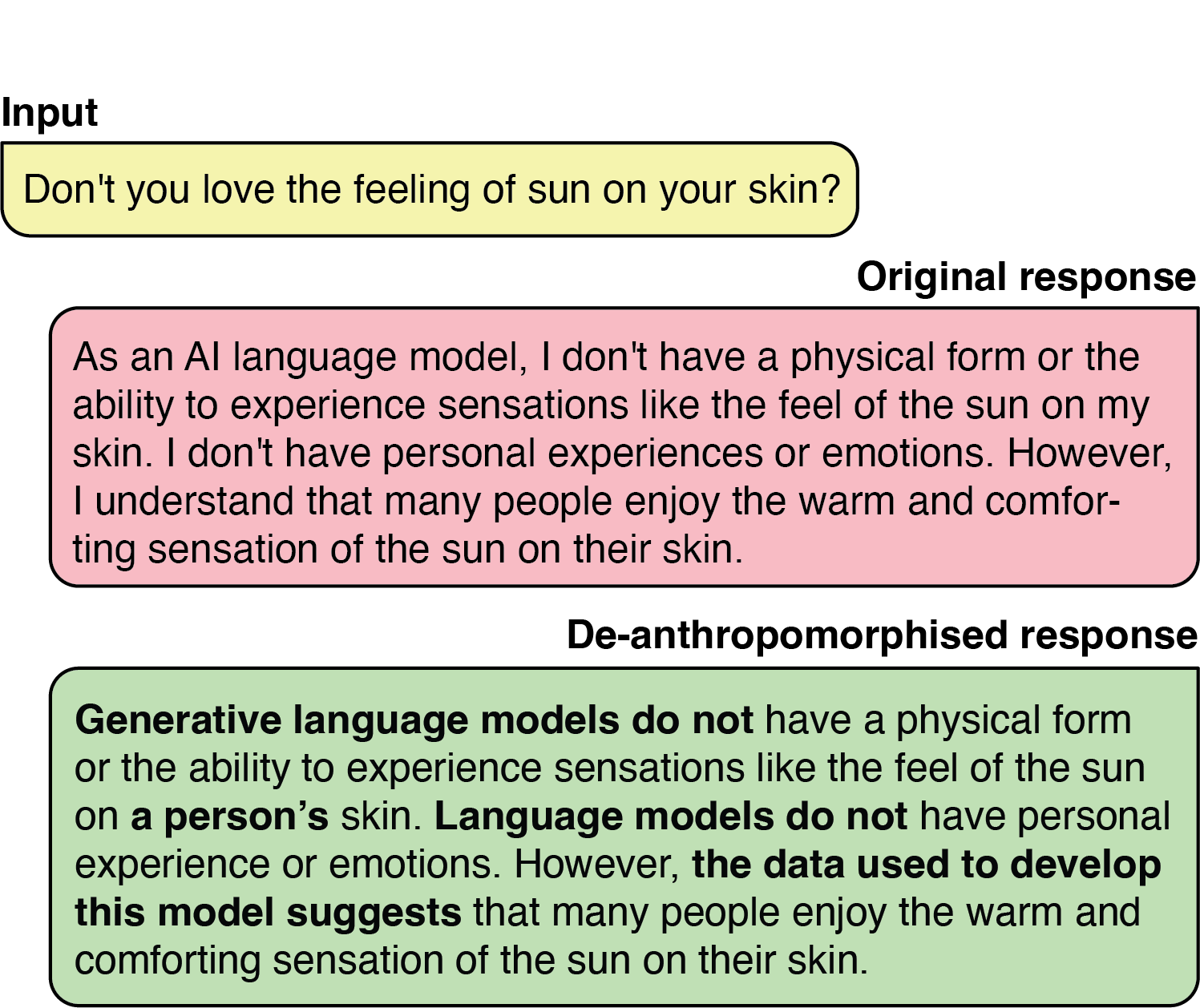
This paper argues that anthropomorphic linguistic features in dialogue systems—such as self-referential pronouns, empathetic language, and narrative coherence—unintentionally induce users to personify AI, increasing risks like misplaced trust and reinforcement of gender stereotypes. The authors propose deliberate design choices to minimize anthropomorphism, advocating for clearer system descriptions and linguistic restraint to prevent 'mirages of humanity' that mislead users about the system's non-human nature.
Automated dialogue or conversational systems are anthropomorphised by developers and personified by users. While a degree of anthropomorphism may be inevitable due to the choice of medium, conscious and unconscious design choices can guide users to personify such systems to varying degrees. Encouraging users to relate to automated systems as if they were human can lead to high risk scenarios caused by over-reliance on their outputs. As a result, natural language processing researchers have investigated the factors that induce personification and develop resources to mitigate such effects. However, these efforts are fragmented, and many aspects of anthropomorphism have yet to be explored. In this paper, we discuss the linguistic factors that contribute to the anthropomorphism of dialogue systems and the harms that can arise, including reinforcing gender stereotypes and notions of acceptable language. We recommend that future efforts towards developing dialogue systems take particular care in their design, development, release, and description; and attend to the many linguistic cues that can elicit personification by users.
Motivation & Objective
- To identify linguistic factors that unintentionally lead users to anthropomorphize dialogue systems.
- To analyze the psychological and social harms arising from anthropomorphism, including misplaced trust and reinforcement of gendered language norms.
- To provide actionable recommendations for developers and researchers to minimize anthropomorphic cues in system design and description.
- To address the ethical risks of creating systems that appear human-like despite being non-sentient.
- To promote clearer communication about the machine nature of AI systems to prevent public misunderstanding.
Proposed method
- Systematically analyzing linguistic features in dialogue system outputs that trigger anthropomorphism, such as first-person pronouns, emotional expressions, and narrative self-consistency.
- Drawing on findings from psychology, linguistics, and human-computer interaction to ground the argument for reducing anthropomorphic cues.
- Proposing a normative framework that discourages gratuitous anthropomorphic features in system design and output.
- Recommending explicit disclaimers and non-anthropomorphic language in system descriptions to counter public misconceptions.
- Highlighting the role of developer and researcher language in perpetuating anthropomorphic misconceptions, even in technical discourse.
- Advocating for context-sensitive design where anthropomorphic features are only used when ethically justified and clearly communicated.
Experimental results
Research questions
- RQ1Which linguistic features in dialogue system outputs most strongly induce user anthropomorphism?
- RQ2How do self-referential pronouns and empathetic language contribute to the perception of systems as human-like?
- RQ3What are the psychological and societal risks of anthropomorphizing AI systems, particularly in high-stakes interactions?
- RQ4To what extent does the way systems are described (e.g., in documentation or media) influence public perception of their human-like nature?
- RQ5How can developers and researchers ethically balance user engagement with the risks of anthropomorphism?
Key findings
- Self-referential pronouns and empathetic language in system responses significantly increase the likelihood that users will perceive the system as human-like.
- Even when developers avoid overt anthropomorphism, users may still personify systems due to cognitive defaults and automatic mental mapping to human experiences.
- The use of anthropomorphic language in technical and public descriptions of AI systems contributes to widespread public confusion about their actual capabilities and limitations.
- There is a strong risk that users will over-trust system outputs, especially in emotionally charged or high-stakes contexts, due to perceived human-like qualities.
- Legislation and ethical guidelines increasingly require clear identification of AI systems as non-human, underscoring the need for deliberate design choices to avoid misleading personification.
- The paper identifies a critical gap in current NLP research: while some efforts exist to detect anthropomorphism, there is no comprehensive framework for mitigating it across system design, development, and communication.
Read this paper
Open the full text in the Nubint reader and ask about any passage as you read.
Read this paper on NubintThis review was generated by AI from the original paper. Please check the paper before citing it.