
[Paper Review] Mixed Attention Network for Hyperspectral Image Denoising
This paper proposes a Mixed Attention Network (MAN) for hyperspectral image denoising that jointly models inter-spectral correlations via multi-head recurrent spectral attention and intra-spectral relationships through progressive spectral channel attention, while using an attentive skip connection to adaptively fuse low- and high-level features. MAN achieves state-of-the-art performance on simulated and real-world noise with lower parameters and inference time than prior methods.
Hyperspectral image denoising is unique for the highly similar and correlated spectral information that should be properly considered. However, existing methods show limitations in exploring the spectral correlations across different bands and feature interactions within each band. Besides, the low- and high-level features usually exhibit different importance for different spatial-spectral regions, which is not fully explored for current algorithms as well. In this paper, we present a Mixed Attention Network (MAN) that simultaneously considers the inter- and intra-spectral correlations as well as the interactions between low- and high-level spatial-spectral meaningful features. Specifically, we introduce a multi-head recurrent spectral attention that efficiently integrates the inter-spectral features across all the spectral bands. These features are further enhanced with a progressive spectral channel attention by exploring the intra-spectral relationships. Moreover, we propose an attentive skip-connection that adaptively controls the proportion of the low- and high-level spatial-spectral features from the encoder and decoder to better enhance the aggregated features. Extensive experiments show that our MAN outperforms existing state-of-the-art methods on simulated and real noise settings while maintaining a low cost of parameters and running time.
Motivation & Objective
- To address the limitations of existing methods in modeling complex spectral correlations and feature interactions in hyperspectral image (HSI) denoising.
- To improve denoising performance by jointly capturing inter-spectral dependencies across bands and intra-spectral relationships within each band.
- To enhance feature fusion between encoder and decoder by learning adaptive, spatial-spectral-wise attention weights for skip connections.
- To maintain high efficiency with minimal parameters and fast inference, especially for real-world applications.
Proposed method
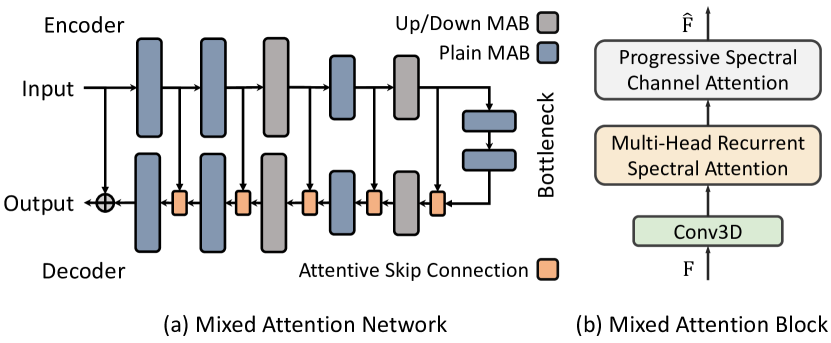
- Introduces Multi-Head Recurrent Spectral Attention (MHRSA), which applies recurrent attention across spectral bands using two lightweight MLPs to generate dynamic attention maps and value features, enabling efficient bi-directional context aggregation.
- Proposes Progressive Spectral Channel Attention (PSCA), which sequentially applies dynamic and static channel mixing to enhance features within each spectral band after inter-spectral fusion.
- Designs an Attentive Skip Connection (ASC) that learns element-wise fusion weights for features from encoder and decoder, allowing adaptive selection of informative spatial-spectral regions.
- Combines MHRSA, PSCA, and ASC within a U-shaped network architecture to progressively refine features across multiple scales and spectral dimensions.
- Employs a lightweight design with minimal parameter growth, relying on MLPs instead of dense convolutions for attention computation.
- Trains end-to-end on simulated and real HSI denoising benchmarks, with ablation studies validating component contributions.
Experimental results
Research questions
- RQ1Can recurrent spectral attention effectively model inter-spectral correlations across all bands while maintaining computational efficiency?
- RQ2Can progressive intra-spectral channel attention improve feature representation within each spectral band after inter-spectral fusion?
- RQ3Does an adaptive skip connection that learns spatial-spectral-wise attention weights outperform standard additive or concatenative skip connections?
- RQ4Can the joint modeling of inter- and intra-spectral correlations, along with adaptive feature fusion, lead to state-of-the-art denoising performance with low parameter cost?
Key findings
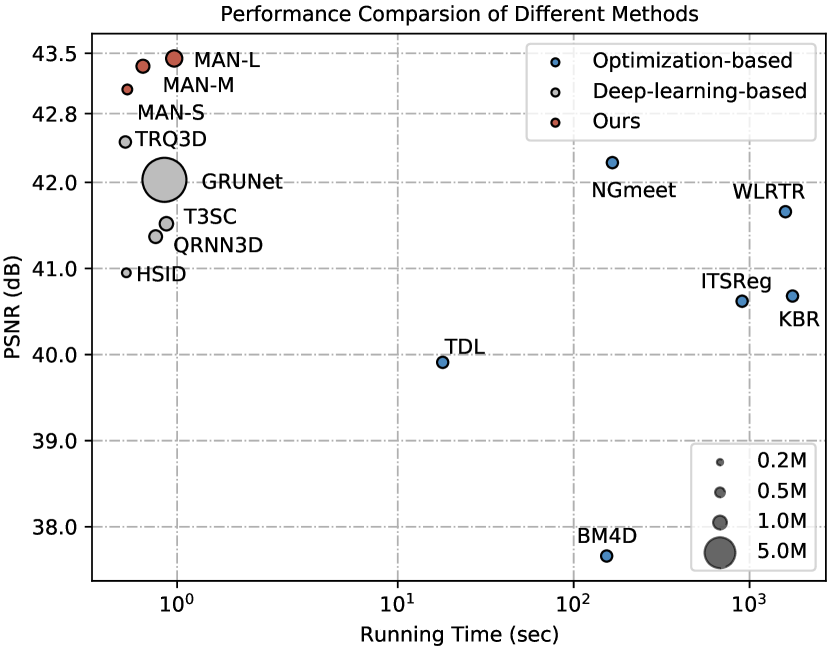
- The proposed MAN achieves state-of-the-art PSNR of 41.94 dB on the ICVL dataset under Gaussian noise (σ=50), outperforming all SOTA methods.
- MAN achieves a 0.36 dB improvement over the baseline UNet with 3D convolutions and ReLU, demonstrating the effectiveness of PSCA in enhancing intra-spectral features.
- The MHRSA block contributes the largest performance gain, improving PSNR by 0.52 dB, confirming the importance of modeling inter-spectral correlations.
- The attentive skip connection provides a 0.35 dB improvement over standard additive skip connections, showing its ability to selectively emphasize informative features.
- MAN maintains a small model size (1.39M parameters) and fast inference time (0.97s), outperforming heavier models like GRUNet (14.2M params, 0.87s) in both speed and accuracy.
- Visualization confirms that the attention maps from ASC and MHRSA are spatially and spectrally adaptive, focusing on different regions and bands depending on content.
Read this paper
Open the full text in the Nubint reader and ask about any passage as you read.
Read this paper on NubintThis review was generated by AI from the original paper. Please check the paper before citing it.