
[Paper Review] Monocular 3D Object Detection Leveraging Accurate Proposals and Shape Reconstruction
This paper proposes MonoPSR, a monocular 3D object detection method that generates accurate 3D proposals from 2D detections using pinhole camera geometry and jointly optimizes 3D localization with shape reconstruction via a learnable point cloud in object coordinates. By introducing a novel projection alignment loss to enforce 2D-3D consistency, it achieves state-of-the-art performance on the KITTI benchmark, including new SOTA results for pedestrian and cyclist classes, with a 68% improvement over prior monocular methods.
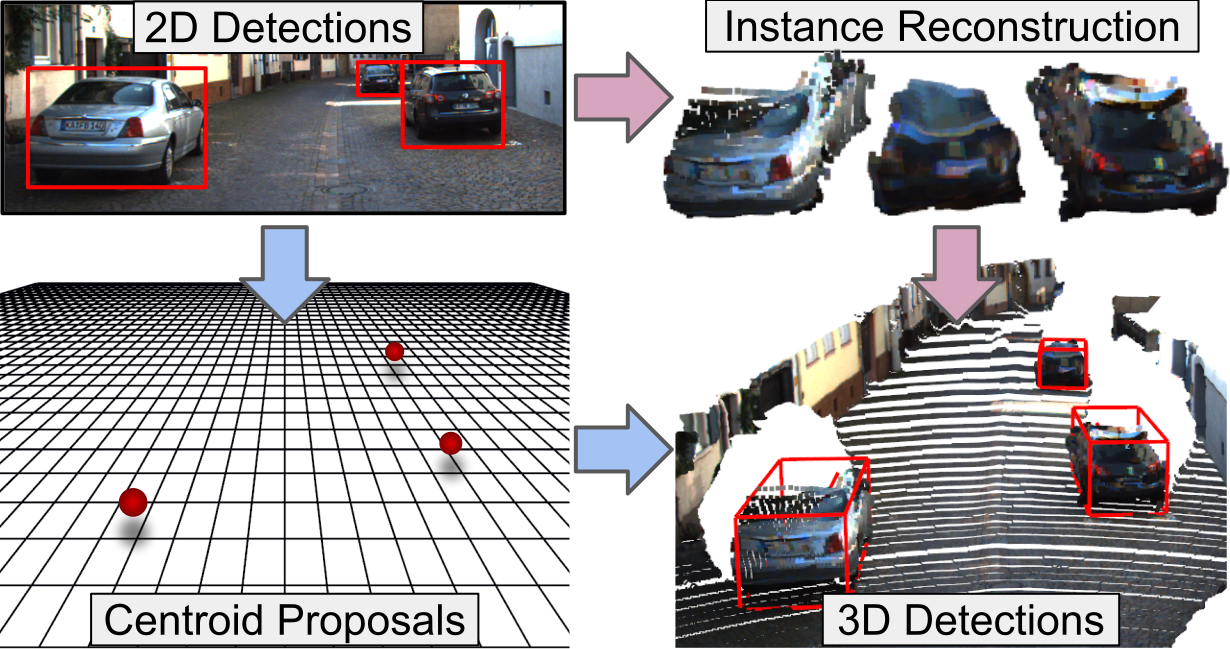
We present MonoPSR, a monocular 3D object detection method that leverages proposals and shape reconstruction. First, using the fundamental relations of a pinhole camera model, detections from a mature 2D object detector are used to generate a 3D proposal per object in a scene. The 3D location of these proposals prove to be quite accurate, which greatly reduces the difficulty of regressing the final 3D bounding box detection. Simultaneously, a point cloud is predicted in an object centered coordinate system to learn local scale and shape information. However, the key challenge is how to exploit shape information to guide 3D localization. As such, we devise aggregate losses, including a novel projection alignment loss, to jointly optimize these tasks in the neural network to improve 3D localization accuracy. We validate our method on the KITTI benchmark where we set new state-of-the-art results among published monocular methods, including the harder pedestrian and cyclist classes, while maintaining efficient run-time.
Motivation & Objective
- To address the under-constrained nature of monocular 3D object detection by leveraging strong geometric priors from 2D object detectors.
- To improve 3D localization accuracy by reducing the 3D search space through high-quality 3D proposals derived from 2D bounding boxes and pinhole camera constraints.
- To exploit shape and scale information from predicted instance point clouds to enhance localization, rather than relying on rigid CAD models.
- To jointly optimize 3D detection and shape reconstruction using a novel projection alignment loss that ensures consistency between 2D image observations and 3D predictions.
- To achieve state-of-the-art performance on the KITTI 3D detection benchmark, including previously unreported results for pedestrian and cyclist categories.
Proposed method
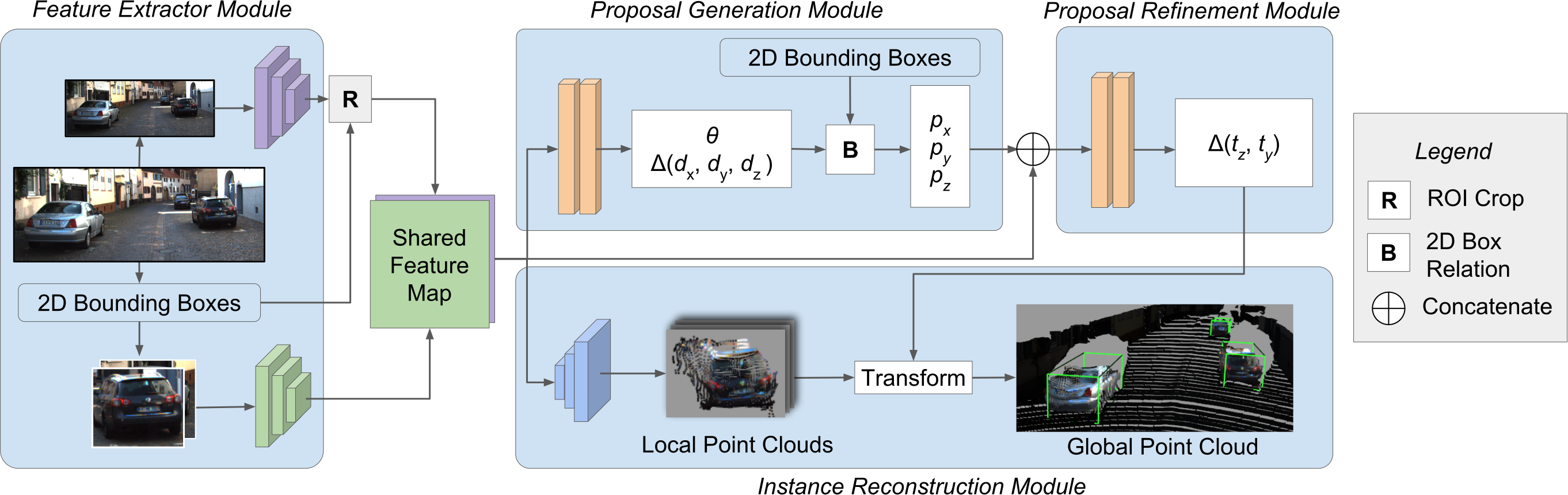
- The method generates 3D proposals by estimating the 3D centroid using the re-projection of the 2D bounding box center and the perspective relationship between object height and depth in the pinhole camera model.
- It employs a two-stage proposal regression framework inspired by Faster R-CNN, regressing from anchor boxes to refine the final amodal, oriented 3D bounding box.
- An instance reconstruction module predicts a point cloud in a canonical object coordinate system to encode local shape and scale information.
- The predicted point cloud is transformed into the camera coordinate frame using the estimated centroid, enabling joint optimization of localization and shape.
- A novel projection alignment loss is introduced to project the reconstructed 3D point cloud into image space and enforce consistency with the 2D detection box.
- The network is trained end-to-end with aggregate losses, including the projection alignment loss, to jointly optimize proposal regression, point cloud estimation, and 2D-3D consistency.
Experimental results
Research questions
- RQ1Can 3D proposals generated from 2D detections using pinhole camera geometry significantly reduce the 3D localization search space and improve accuracy?
- RQ2How can shape reconstruction via predicted point clouds be effectively leveraged to improve 3D object localization in monocular settings?
- RQ3Can a joint optimization framework with a novel projection alignment loss enhance 2D-3D consistency and boost detection performance?
- RQ4Does the proposed method achieve state-of-the-art results on the KITTI benchmark, particularly for challenging classes like pedestrians and cyclists?
- RQ5Can the method maintain high efficiency while outperforming prior monocular methods that rely on restrictive assumptions or limited priors?
Key findings
- MonoPSR achieves a 68% improvement in 3D AP at 0.5 IoU over the previous monocular SOTA method on the KITTI benchmark.
- The method sets new state-of-the-art results for pedestrian and cyclist detection on the KITTI validation set, with 31.89% and 23.77% 3D AP at 0.25 IoU, respectively.
- The use of 3D proposals reduces depth estimation error to 1.22m average absolute error (standard deviation 1.84m) on the hard car category, outperforming direct depth estimation.
- Joint optimization with the projection alignment loss increases 3D AP at 0.5 IoU by 7.2% compared to a baseline without shape reconstruction losses.
- The method maintains efficient inference time, with a total runtime of 120ms on a Titan X GPU, in addition to the 80ms from the 2D detector.
- Qualitative results show that 3D box projections closely match 2D detections for cars and cyclists, while remaining flexible enough to handle the large variation in pedestrian projections.
Read this paper
Open the full text in the Nubint reader and ask about any passage as you read.
Read this paper on NubintThis review was generated by AI from the original paper. Please check the paper before citing it.