
[Paper Review] Monotonicity conjecture for multi-party entanglement I
This paper proposes a monotonicity conjecture for multi-party entanglement measures under coarse-graining, establishing a new framework for quantifying entanglement in pure quantum states across multiple parties. Using dimer partition functions and Pfaffians on lattices, the authors derive a measure based on antisymmetric matrices and prove its invariance under permutations and additivity for product states, with key results validated via Kasteleyn's theorem on genus-zero graphs.
In this paper, we conjecture a monotonicity property that we call monotonicity under coarse-graining for a class of multi-partite entanglement measures. We check these properties by computing the measures for various types of states using different methods.
Motivation & Objective
- To formulate a new monotonicity property—monotonicity under coarse-graining—for multi-partite entanglement measures in pure quantum states.
- To define a symmetric, additive entanglement measure for q-partite pure states that respects local unitary invariance and vanishes on separable states.
- To establish a connection between entanglement measures and the partition function of fully packed dimers on lattice graphs via Pfaffian formalism.
- To validate the proposed measure using Kasteleyn’s theorem on the sign consistency of dimer configurations on graphs of genus zero.
- To demonstrate that the measure derived from the Pfaffian of an antisymmetric adjacency matrix correctly captures entanglement structure in generalized W states.
Proposed method
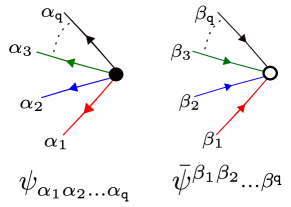
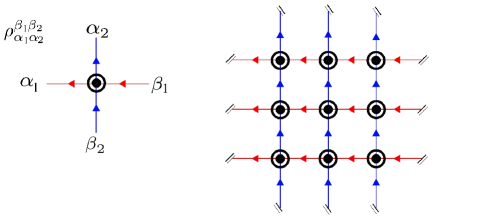
- The entanglement measure is constructed using the Pfaffian of an antisymmetric adjacency matrix derived from a bipartite lattice graph representing the state’s tensor network.
- The lattice is oriented such that edges flow from ψ to ψ̄ vertices, ensuring consistent sign assignment in the Pfaffian expansion.
- The matrix K, representing inter-partite contractions, is expressed as a sum of tensor products involving shift matrices and complex parameters z₁, z₂, z₃.
- The determinant of K is computed as a product over roots of unity, yielding a symmetric expression in z₁, z₂, z₃ that matches the partition function Z₊₊.
- The full partition function is reconstructed by restoring positive signs to all monomial terms, consistent with Kasteleyn’s method for genus-g graphs.
- The measure is defined via the logarithm of the absolute value of the Pfaffian, ensuring invariance under local unitaries and permutation symmetry.
Experimental results
Research questions
- RQ1Does a monotonicity property under coarse-graining hold for multi-partite entanglement measures in pure states?
- RQ2Can a symmetric, additive entanglement measure be defined for q-partite pure states that vanishes on separable states?
- RQ3Is the entanglement measure derived from the Pfaffian of a lattice adjacency matrix invariant under local unitary transformations?
- RQ4Can the dimer partition function on a hexagonal lattice with periodic boundary conditions be consistently signed to yield a positive-definite measure?
- RQ5Does the measure exhibit the expected behavior under tensor product states and permutations of parties?
Key findings
- The entanglement measure is invariant under local unitary transformations and symmetric under permutations of the parties, as required for a physical entanglement measure.
- The measure is additive for product states, satisfying the condition M(|Ψ⟩⊗|Φ⟩) = M(|Ψ⟩) + M(|Φ⟩).
- The measure is computed as the logarithm of the absolute value of the Pfaffian of an antisymmetric matrix, which equals the determinant of the inter-partite coupling matrix K.
- For the generalized W state on a hexagonal lattice with periodic boundary conditions, the determinant of K is given by ∏ᵢ₌₁ⁿ ∏ⱼ₌₁ⁿ (z₁ωⁱ + z₂ωʲ + z₃), where ω is a primitive n-th root of unity.
- The full partition function is reconstructed by restoring positive signs to all terms, consistent with Kasteleyn’s theorem for genus-1 graphs, requiring a sum over four spin structures.
- The resulting measure is symmetric under permutation of z₁, z₂, z₃, confirming the expected invariance and consistency with physical expectations.
Read this paper
Open the full text in the Nubint reader and ask about any passage as you read.
Read this paper on NubintThis review was generated by AI from the original paper. Please check the paper before citing it.