
[Paper Review] More PAC-Bayes bounds: From bounded losses, to losses with general tail behaviors, to anytime validity
This paper introduces new PAC-Bayes bounds for machine learning generalization that generalize beyond bounded losses to distributions with heavier tails, using a novel discretization-based optimization technique over event spaces. It derives tighter, parameter-free bounds for bounded and sub-Gaussian losses, and extends all results to anytime-valid bounds via a simple, general method, improving interpretability and practicality over prior approaches.
In this paper, we present new high-probability PAC-Bayes bounds for different types of losses. Firstly, for losses with a bounded range, we recover a strengthened version of Catoni's bound that holds uniformly for all parameter values. This leads to new fast-rate and mixed-rate bounds that are interpretable and tighter than previous bounds in the literature. In particular, the fast-rate bound is equivalent to the Seeger--Langford bound. Secondly, for losses with more general tail behaviors, we introduce two new parameter-free bounds: a PAC-Bayes Chernoff analogue when the loss' cumulative generating function is bounded, and a bound when the loss' second moment is bounded. These two bounds are obtained using a new technique based on a discretization of the space of possible events for the ``in probability'' parameter optimization problem. This technique is both simpler and more general than previous approaches optimizing over a grid on the parameters' space. Finally, using a simple technique that is applicable to any existing bound, we extend all previous results to anytime-valid bounds.
Motivation & Objective
- To develop tighter, more interpretable PAC-Bayes bounds for bounded losses by strengthening Catoni’s bound and recovering the Seeger–Langford bound.
- To extend PAC-Bayes theory to losses with general tail behaviors, including sub-Gaussian and second-moment-bounded cases.
- To introduce a new discretization-based optimization technique that simplifies and generalizes prior grid-based parameter optimization in PAC-Bayes.
- To provide a general, simple method to convert any existing PAC-Bayes bound into an anytime-valid bound, applicable across loss types.
Proposed method
- Proposes a new discretization technique over the space of possible events in the 'in probability' parameter optimization problem, replacing grid-based parameter search.
- Uses a union bound over discretized events defined by relative entropy levels of the posterior with respect to the prior.
- Derives a PAC-Bayes Chernoff analogue for losses with bounded cumulant generating functions, and a second-moment-based bound for sub-exponential tails.
- Applies a novel optimization strategy that selects a deterministic parameter for each event class, avoiding arbitrary parameter tuning.
- Extends all derived bounds to anytime-validity using a simple, general technique applicable to any existing bound.
- Employs a ghost sample technique and Markov kernels to decouple training and generalization risk estimation.
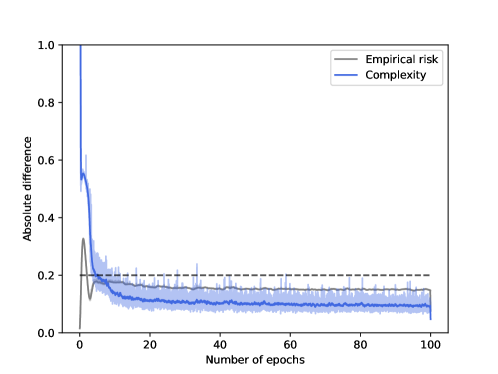
Experimental results
Research questions
- RQ1Can PAC-Bayes bounds be tightened and made more interpretable for bounded losses without relying on arbitrary parameters?
- RQ2How can PAC-Bayes bounds be extended to losses with general tail behaviors beyond bounded or sub-Gaussian assumptions?
- RQ3Can a parameter-free, non-grid-based optimization technique be developed for PAC-Bayes bounds that improves over existing methods?
- RQ4What is the minimal additional cost to convert standard high-probability bounds into anytime-valid bounds?
- RQ5Can the new discretization technique be used to derive tighter bounds for both bounded and sub-Gaussian losses?
Key findings
- The paper recovers a strengthened version of Catoni’s bound that holds uniformly for all parameter values, leading to a tighter fast rate bound equivalent to the Seeger–Langford bound.
- For losses with bounded cumulant generating functions, a new parameter-free PAC-Bayes Chernoff analogue is derived, improving adaptivity and interpretability.
- For losses with bounded second moments, a new parameter-free bound is derived using the same discretization technique, extending applicability to sub-exponential tails.
- The proposed discretization method is both simpler and more general than prior grid-based optimization, avoiding the need for arbitrary parameter selection.
- All bounds are extended to anytime-validity using a general, simple technique, enabling sequential analysis and adaptive confidence levels.
- The method achieves tighter bounds than previous approaches by optimizing over event classes rather than parameter values, reducing looseness in union bounds.
Read this paper
Open the full text in the Nubint reader and ask about any passage as you read.
Read this paper on NubintThis review was generated by AI from the original paper. Please check the paper before citing it.