
[Paper Review] MOVE: Effective and Harmless Ownership Verification via Embedded External Features
This paper proposes MOVE, a novel model ownership verification method that embeds external features via style transfer on a few training samples to enable effective and harmless detection of stolen models. The approach achieves high accuracy in identifying various model stealing attacks while preserving model functionality and avoiding backdoor risks, outperforming existing watermarking and defense methods in both white-box and black-box settings.
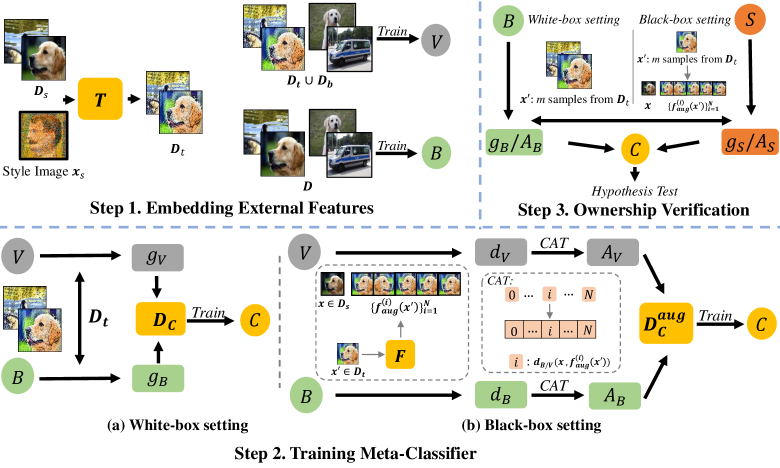
Currently, deep neural networks (DNNs) are widely adopted in different applications. Despite its commercial values, training a well-performing DNN is resource-consuming. Accordingly, the well-trained model is valuable intellectual property for its owner. However, recent studies revealed the threats of model stealing, where the adversaries can obtain a function-similar copy of the victim model, even when they can only query the model. In this paper, we propose an effective and harmless model ownership verification (MOVE) to defend against different types of model stealing simultaneously, without introducing new security risks. In general, we conduct the ownership verification by verifying whether a suspicious model contains the knowledge of defender-specified external features. Specifically, we embed the external features by modifying a few training samples with style transfer. We then train a meta-classifier to determine whether a model is stolen from the victim. This approach is inspired by the understanding that the stolen models should contain the knowledge of features learned by the victim model. In particular, evision{we develop our MOVE method under both white-box and black-box settings and analyze its theoretical foundation to provide comprehensive model protection.} Extensive experiments on benchmark datasets verify the effectiveness of our method and its resistance to potential adaptive attacks. The codes for reproducing the main experiments of our method are available at https://github.com/THUYimingLi/MOVE.
Motivation & Objective
- To address the growing threat of model stealing, where adversaries copy well-trained deep neural networks (DNNs) through queries or direct access.
- To overcome the limitations of existing verification-based defenses that either reduce model performance or introduce hidden backdoors.
- To develop a defense that is both effective—detecting diverse stealing methods—and harmless—preserving model accuracy and avoiding security risks.
- To ensure the watermarking mechanism is fundamentally different from backdoor attacks and membership inference, by embedding sample-specific, non-malicious features.
- To provide comprehensive protection under both white-box and black-box threat models.
Proposed method
- Embed external features into a few training samples using style transfer, preserving original labels to avoid functional degradation.
- Train a meta-classifier on the victim model's predictions to detect whether a suspicious model contains knowledge of the embedded features.
- Perform ownership verification via hypothesis testing, comparing the suspicious model’s behavior on transformed samples to the expected behavior of the original model.
- Use a benign model trained on clean data to calibrate the meta-classifier, ensuring it learns to detect feature knowledge rather than memorization of training data.
- Apply the method in both white-box and black-box settings to ensure broad applicability and robustness against adaptive attacks.
- Leverage the distinctiveness of style-transfer-based features to resist detection by existing backdoor and membership inference attacks.
Experimental results
Research questions
- RQ1Can a model ownership verification system detect various types of model stealing attacks, including direct copy, distillation, zero-shot, fine-tuning, and query-based attacks?
- RQ2Does embedding features via style transfer on a few labeled samples preserve model accuracy and avoid introducing malicious backdoors?
- RQ3How does the proposed method compare to existing watermarking and defense mechanisms in terms of detection accuracy and resistance to adaptive attacks?
- RQ4Can the method distinguish between models that have learned the embedded features and those that have not, even when the features are not part of the original training distribution?
- RQ5Is the defense robust against detection by membership inference and backdoor analysis tools that target traditional watermarking schemes?
Key findings
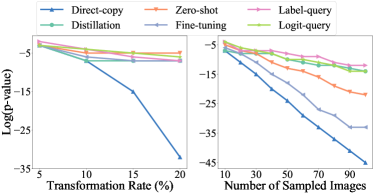
- MOVE achieves near-perfect detection (Δμ > 0.90) on direct-copy and distillation attacks across both CIFAR-10 and ImageNet datasets, with p-values < 10−5.
- The method maintains high detection performance (Δμ > 0.5) on more complex attacks like zero-shot, fine-tuning, and query-based stealing, even under black-box settings.
- Using transformed images generated from test data instead of training data yields similar detection performance, confirming that the method detects feature knowledge rather than memorization of training samples.
- The embedded triggers from style transfer are visually meaningless and structurally distinct from those in backdoor-based defenses, making them undetectable by standard backdoor detection methods.
- MOVE resists membership inference and backdoor detection techniques, as the features are sample-specific and not tied to specific classes or labels.
- The method shows minimal performance degradation on benign samples, confirming its harmlessness and practicality for real-world deployment.
Read this paper
Open the full text in the Nubint reader and ask about any passage as you read.
Read this paper on NubintThis review was generated by AI from the original paper. Please check the paper before citing it.