
[Paper Review] Multi-scale Location-aware Kernel Representation for Object Detection
This paper proposes Multi-scale Location-aware Kernel Representation (MLKP), a novel method that enhances object detection by capturing high-order statistics of deep features in object proposals through a low-dimensional polynomial kernel approximation on multi-scale feature maps. By preserving spatial location information, MLKP improves Faster R-CNN by 4.9%, 4.7%, and 5.0% on PASCAL VOC 2007, VOC 2012, and MS COCO benchmarks, respectively, demonstrating significant gains in detecting small and hard objects.
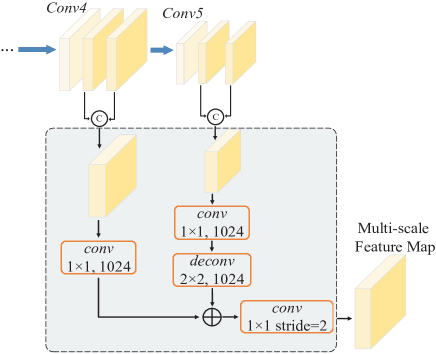
Although Faster R-CNN and its variants have shown promising performance in object detection, they only exploit simple first-order representation of object proposals for final classification and regression. Recent classification methods demonstrate that the integration of high-order statistics into deep convolutional neural networks can achieve impressive improvement, but their goal is to model whole images by discarding location information so that they cannot be directly adopted to object detection. In this paper, we make an attempt to exploit high-order statistics in object detection, aiming at generating more discriminative representations for proposals to enhance the performance of detectors. To this end, we propose a novel Multi-scale Location-aware Kernel Representation (MLKP) to capture high-order statistics of deep features in proposals. Our MLKP can be efficiently computed on a modified multi-scale feature map using a low-dimensional polynomial kernel approximation.Moreover, different from existing orderless global representations based on high-order statistics, our proposed MLKP is location retentive and sensitive so that it can be flexibly adopted to object detection. Through integrating into Faster R-CNN schema, the proposed MLKP achieves very competitive performance with state-of-the-art methods, and improves Faster R-CNN by 4.9% (mAP), 4.7% (mAP) and 5.0% (AP at IOU=[0.5:0.05:0.95]) on PASCAL VOC 2007, VOC 2012 and MS COCO benchmarks, respectively. Code is available at: https://github.com/Hwang64/MLKP.
Motivation & Objective
- To address the limitation of Faster R-CNN in detecting small and hard objects due to reliance on first-order feature statistics.
- To explore the integration of high-order statistics into object detection while preserving spatial location information.
- To develop a framework-agnostic, efficient method that enhances proposal representation for improved classification and regression.
- To achieve state-of-the-art performance on standard benchmarks by combining multi-scale features with location-sensitive kernel representations.
Proposed method
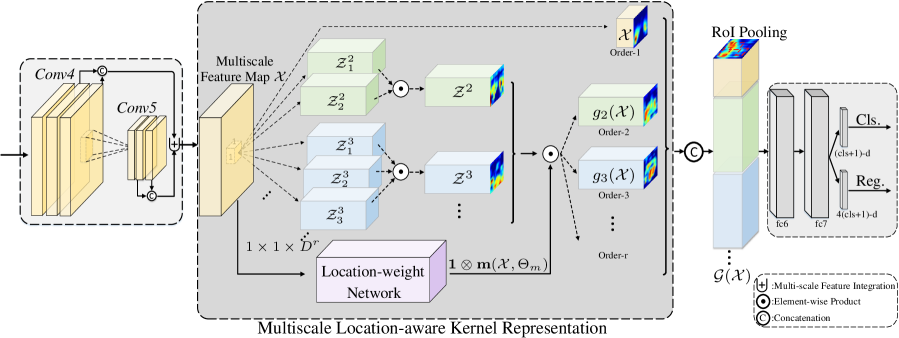
- Proposes a multi-scale location-aware kernel representation (MLKP) that computes r-th order polynomial kernel approximations on multi-scale feature maps.
- Uses 1×1 convolutions and element-wise multiplication to efficiently compute polynomial kernel representations across multiple orders.
- Introduces a learnable location-weight network with parameters Θₘ to measure the contribution of each spatial location, preserving spatial sensitivity.
- Applies a remapping operation (1⊗) to maintain spatial structure after kernel computation, enabling standard RoI pooling.
- Concatenates representations from all polynomial kernel orders into a final, discriminative feature vector that retains spatial information.
- Integrates MLKP into the Faster R-CNN framework with end-to-end training, maintaining compatibility with standard detection pipelines.
Experimental results
Research questions
- RQ1Can high-order statistics of deep features improve object detection performance when properly localized?
- RQ2How can high-order representations be computed efficiently while preserving spatial information for object detection?
- RQ3Can a kernel-based approach effectively model multi-scale features without discarding location context?
- RQ4Does a location-aware, polynomial kernel approximation outperform first-order feature representations in detecting small and hard objects?
- RQ5Can the proposed method generalize across different backbone networks and detection benchmarks?
Key findings
- MLKP improves Faster R-CNN by 4.9% in mean average precision (mAP) on PASCAL VOC 2007, demonstrating strong performance gains.
- On PASCAL VOC 2012, MLKP achieves a 5.1% improvement over Faster R-CNN using VGG-16, confirming effectiveness on challenging object categories.
- On MS COCO, MLKP improves Faster R-CNN by 5.0% at IOU=[0.5:0.05:0.95], outperforming state-of-the-art methods including DSSD and SSD.
- The method achieves superior detection of small and hard objects, such as distant persons and plants, due to its location-aware, high-order representation.
- MLKP outperforms HyperNet, RON, and ION-Net by 1.8%, 0.5%, and 1.6% respectively, proving the advantage of location-sensitive kernel learning.
- With ResNet-101, MLKP improves Faster R-CNN by 4.2% on MS COCO and surpasses region-free methods like DSSD and SSD, indicating strong generalization across backbones.
Read this paper
Open the full text in the Nubint reader and ask about any passage as you read.
Read this paper on NubintThis review was generated by AI from the original paper. Please check the paper before citing it.