
[Paper Review] Multi-scale Transformer-based Network for Emotion Recognition from Multi Physiological Signals
This paper proposes a multi-scale Transformer-based deep learning model for continuous emotion recognition from multimodal physiological signals, leveraging multi-scale feature extraction and Gaussian transformation to enhance representation learning. The model achieves an RMSE of 1.45 on the EPiC 2023 competition benchmark, demonstrating strong performance across multiple evaluation scenarios, especially in the across-subject setting.
This paper presents an efficient Multi-scale Transformer-based approach for the task of Emotion recognition from Physiological data, which has gained widespread attention in the research community due to the vast amount of information that can be extracted from these signals using modern sensors and machine learning techniques. Our approach involves applying a Multi-modal technique combined with scaling data to establish the relationship between internal body signals and human emotions. Additionally, we utilize Transformer and Gaussian Transformation techniques to improve signal encoding effectiveness and overall performance. Our model achieves decent results on the CASE dataset of the EPiC competition, with an RMSE score of 1.45.
Motivation & Objective
- To develop an end-to-end deep learning architecture that effectively captures temporal and multi-scale patterns in multimodal physiological signals for continuous emotion recognition.
- To address the challenge of noisy and non-stationary physiological signals by integrating multi-scale feature extraction and robust signal encoding techniques.
- To improve model generalization across subjects and emotional stimuli by leveraging attention mechanisms and scalable feature learning.
- To evaluate the model’s performance on the EPiC 2023 competition dataset, which provides moment-to-moment valence and arousal annotations from real-time physiological data.
- To investigate the impact of different data partitioning strategies (across-time, across-subject, across-elicitor, across-version) on model robustness and generalization.
Proposed method
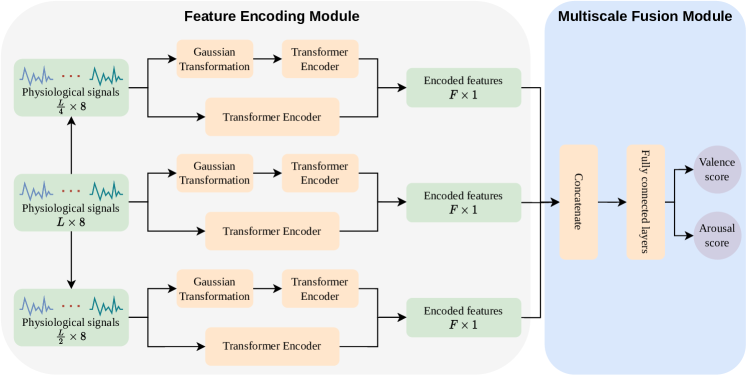
- The model employs a multi-scale Transformer encoder with four attention heads and 1024 hidden dimensions to extract hierarchical representations from physiological signals.
- Multi-scale feature extraction is applied to capture both local and global temporal patterns across 8 physiological signals: ECG, BVP, EMG_CORU, EMG_TRAP, EMG_ZYGO, GSR, RSP, and SKT.
- Gaussian transformation is applied to the input signals to improve signal encoding and enhance model robustness to noise and non-stationarity.
- The model is trained end-to-end using the AdamW optimizer with cosine annealing warm restarts over 10 epochs, minimizing mean squared error (MSE) loss.
- Sequence length is fixed at 2048, and the model is evaluated across four distinct scenarios: across-time, across-subject, across-elicitor, and across-version.
- The architecture is implemented using TensorFlow and trained on a single GTX 3090 GPU, enabling efficient processing of high-resolution physiological sequences.
Experimental results
Research questions
- RQ1How well can a multi-scale Transformer-based architecture model continuous valence and arousal from multimodal physiological signals compared to existing methods?
- RQ2What is the impact of multi-scale feature extraction and Gaussian transformation on the robustness and accuracy of emotion recognition in noisy physiological data?
- RQ3How does the model generalize across different evaluation scenarios, particularly across subjects and unseen emotional stimuli?
- RQ4Can the model effectively learn temporal dynamics of emotional changes from real-time physiological signals collected during video viewing?
- RQ5What is the contribution of attention mechanisms and multi-head self-attention to capturing complex, non-linear relationships in physiological signal sequences?
Key findings
- The proposed model achieves an overall RMSE of 1.45 on the test set of the EPiC 2023 competition, indicating strong performance in continuous emotion regression.
- The best performance is observed in the across-subject scenario, with RMSE of 1.336 for arousal and 1.345 for valence, suggesting strong generalization to unseen individuals.
- The model shows low standard deviation (0.2276 for arousal and 0.0576 for valence) in the across-subject scenario, indicating high consistency and reliability.
- Performance degrades in the across-elicitor scenario, with RMSE of 1.509 for arousal and 1.514 for valence, indicating limited generalization to previously unseen emotional stimuli.
- The across-version scenario yields RMSE of 1.369 for arousal and 1.352 for valence, showing moderate performance when testing on a different version of the same emotional stimulus.
- The across-time scenario results (RMSE 1.503 for arousal, 1.639 for valence) suggest that the model struggles to predict later emotional states based on earlier data, highlighting temporal generalization challenges.
Read this paper
Open the full text in the Nubint reader and ask about any passage as you read.
Read this paper on NubintThis review was generated by AI from the original paper. Please check the paper before citing it.