
[Paper Review] MultiFusion: Fusing Pre-Trained Models for Multi-Lingual, Multi-Modal Image Generation
MultiFusion introduces a multilingual, multimodal diffusion model that fuses pre-trained language, vision, and embedding models to enable complex, interleaved text and image prompts for image generation. By aligning pre-trained components via adapters and attention manipulation, it achieves multilingual capabilities without multilingual fine-tuning, reducing training compute by 95% compared to training from scratch.
The recent popularity of text-to-image diffusion models (DM) can largely be attributed to the intuitive interface they provide to users. The intended generation can be expressed in natural language, with the model producing faithful interpretations of text prompts. However, expressing complex or nuanced ideas in text alone can be difficult. To ease image generation, we propose MultiFusion that allows one to express complex and nuanced concepts with arbitrarily interleaved inputs of multiple modalities and languages. MutliFusion leverages pre-trained models and aligns them for integration into a cohesive system, thereby avoiding the need for extensive training from scratch. Our experimental results demonstrate the efficient transfer of capabilities from individual modules to the downstream model. Specifically, the fusion of all independent components allows the image generation module to utilize multilingual, interleaved multimodal inputs despite being trained solely on monomodal data in a single language.
Motivation & Objective
- To enable expressive, complex image generation through arbitrarily interleaved multimodal and multilingual inputs.
- To transfer multilingual capabilities from a pre-trained language model to a diffusion model without requiring multilingual fine-tuning data.
- To reduce training compute for multilingual, multimodal diffusion models by leveraging modular, pre-trained components.
- To develop a benchmark for evaluating compositional understanding in multimodal prompting.
- To provide a flexible, modular framework for integrating diverse pre-trained models into a unified generative system.
Proposed method
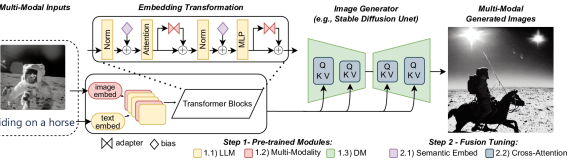
- MultiFusion uses a decoder language model as the core, augmented with adapters finetuned for vision and semantic search.
- Vision and text encoders are aligned via adapters and bias modules to enable cross-attention conditioning in the diffusion model.
- Cross-attention mechanisms condition the diffusion model on embeddings from the language model, using multimodal inputs at inference time.
- Attention manipulation techniques are applied to control the influence of visual and textual inputs during generation.
- The model is trained on monolingual, English-only data, with multilingual capabilities transferred via the language model’s encoder.
- A new benchmark, MCC-250, is introduced to evaluate compositional generalization in multimodal prompting.
Experimental results
Research questions
- RQ1Can a diffusion model generate high-quality images using arbitrarily interleaved text and image prompts without requiring multimodal or multilingual training data?
- RQ2To what extent can multilingual capabilities of a pre-trained language model be transferred to a downstream image generation task?
- RQ3How effective is attention manipulation in controlling the influence of visual and textual inputs during image generation?
- RQ4Can a modular, adapter-based fusion of pre-trained models achieve performance comparable to end-to-end trained models with significantly reduced compute?
- RQ5How well does the model generalize to compositional prompts combining multiple modalities and languages?
Key findings
- MultiFusion successfully generates high-fidelity images using interleaved text and image prompts across five languages, despite being trained only on English data.
- The model achieves multilingual image generation by leveraging the multilingual capabilities of the underlying language model, eliminating the need for multilingual fine-tuning.
- The use of adapters and attention manipulation enables precise control over the influence of visual and textual inputs during generation.
- The model reduces training compute by over 95% compared to training a comparable diffusion model from scratch.
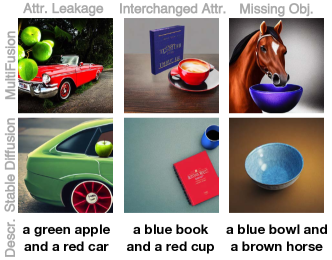
- The MCC-250 benchmark demonstrates that MultiFusion generalizes compositionally to complex, multimodal prompts, outperforming baseline models in compositional understanding.
- Despite limitations in exact image copying, the model effectively uses input images as stylistic or structural references, with performance sensitive to input image quality and composition.
Read this paper
Open the full text in the Nubint reader and ask about any passage as you read.
Read this paper on NubintThis review was generated by AI from the original paper. Please check the paper before citing it.