
[Paper Review] Multilingual End-to-End Speech Translation
This paper proposes a multilingual end-to-end speech translation (E2E-ST) framework using a universal sequence-to-sequence model that directly translates speech from multiple source languages into multiple target languages, sharing all parameters across language pairs. It demonstrates significant performance gains over bilingual models in both one-to-many and many-to-many translation scenarios, with strong zero-shot generalization to low-resource language pairs like Mboshi–French.
In this paper, we propose a simple yet effective framework for multilingual end-to-end speech translation (ST), in which speech utterances in source languages are directly translated to the desired target languages with a universal sequence-to-sequence architecture. While multilingual models have shown to be useful for automatic speech recognition (ASR) and machine translation (MT), this is the first time they are applied to the end-to-end ST problem. We show the effectiveness of multilingual end-to-end ST in two scenarios: one-to-many and many-to-many translations with publicly available data. We experimentally confirm that multilingual end-to-end ST models significantly outperform bilingual ones in both scenarios. The generalization of multilingual training is also evaluated in a transfer learning scenario to a very low-resource language pair. All of our codes and the database are publicly available to encourage further research in this emergent multilingual ST topic.
Motivation & Objective
- To address the limitations of bilingual end-to-end speech translation by enabling multilingual training across multiple source and target languages.
- To eliminate error propagation from separate ASR and MT modules by directly mapping speech to target text in a unified framework.
- To improve performance and generalization in low-resource settings through multilingual pre-training and transfer learning.
- To provide a unified, parameter-efficient architecture that avoids language-specific modeling and complex pipeline decoding.
- To encourage reproducible research by releasing code and data for multilingual E2E-ST.
Proposed method
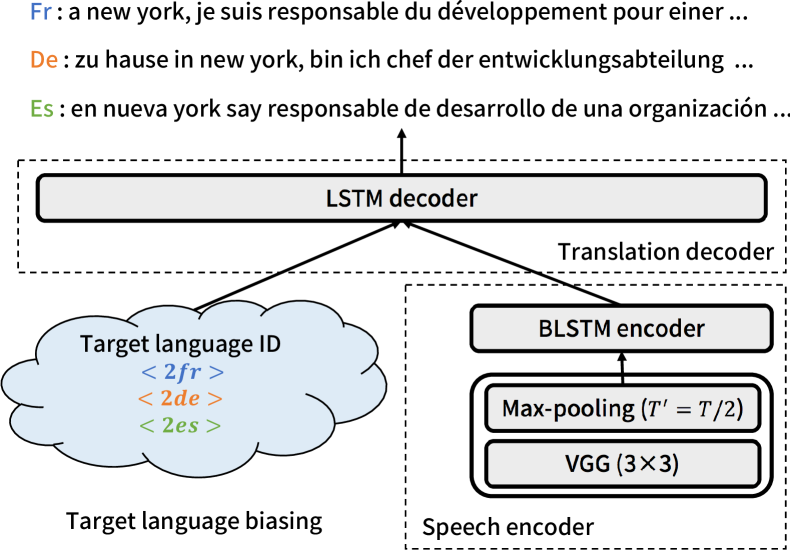
- Uses a universal sequence-to-sequence model with shared encoder and decoder parameters across all language pairs, enabling joint training on multilingual speech translation data.
- Employs character-level tokenization for both source and target sequences to mitigate data sparsity and avoid vocabulary explosion in multilingual settings.
- Applies end-to-end training with joint optimization of speech-to-text translation, leveraging attention-based encoder-decoder architectures.
- Performs transfer learning by initializing low-resource models (e.g., Mboshi–French) from multilingual pre-trained E2E-ST models without using Mboshi transcriptions during pre-training.
- Utilizes a shared encoder-decoder architecture that supports zero-shot translation and parameter sharing across languages, inspired by multilingual NMT and ASR approaches.
- Employs a hybrid CTC/attention loss for the encoder to improve alignment and training stability, especially in low-resource scenarios.
Experimental results
Research questions
- RQ1Can a single universal sequence-to-sequence model effectively perform multilingual end-to-end speech translation across multiple source and target language pairs?
- RQ2How does multilingual E2E-ST compare to bilingual E2E-ST in terms of translation performance in one-to-many and many-to-many settings?
- RQ3To what extent does multilingual pre-training improve zero-shot transfer performance on a very low-resource language pair like Mboshi–French?
- RQ4Does parameter sharing across languages in a unified E2E-ST model reduce error propagation and improve robustness compared to pipeline systems?
- RQ5Can the model generalize to unseen language pairs without fine-tuning or prior knowledge of the target language's characters?
Key findings
- The multilingual E2E-ST model significantly outperforms bilingual models in both one-to-many and many-to-many translation scenarios, with BLEU scores improving from 4.55 (bilingual) to 6.92 (O2M) on the Mboshi–French low-resource task.
- The O2M (one-to-many) multilingual model achieved the highest BLEU score of 6.92 on the Mboshi–French test set, outperforming the M2Ma (6.52) and M2Mc (5.50) configurations.
- Multilingual pre-training improved zero-shot transfer performance on the Mboshi–French language pair compared to bilingual pre-training, demonstrating better generalization to unseen low-resource languages.
- The model achieved competitive performance on standard benchmarks (Fisher, LibriSpeech, TED), with multilingual training reducing the gap between E2E-ST and pipeline systems.
- The use of character-level units outperformed BPE in all settings due to better handling of data sparsity, especially in low-resource scenarios.
- The framework successfully enabled zero-shot translation without requiring language identification or separate text normalization, simplifying the pipeline and reducing error propagation.
Read this paper
Open the full text in the Nubint reader and ask about any passage as you read.
Read this paper on NubintThis review was generated by AI from the original paper. Please check the paper before citing it.