
[Paper Review] MuSR: Testing the Limits of Chain-of-thought with Multistep Soft Reasoning
MuSR introduces a novel benchmark for evaluating multistep soft reasoning in large language models using natural language narratives, generated via a neurosymbolic synthetic-to-natural pipeline. The dataset challenges models like GPT-4 with complex, commonsense-rich stories (e.g., 1000-word murder mysteries), revealing persistent gaps in chain-of-thought reasoning despite advanced prompting techniques.
While large language models (LLMs) equipped with techniques like chain-of-thought prompting have demonstrated impressive capabilities, they still fall short in their ability to reason robustly in complex settings. However, evaluating LLM reasoning is challenging because system capabilities continue to grow while benchmark datasets for tasks like logical deduction have remained static. We introduce MuSR, a dataset for evaluating language models on multistep soft reasoning tasks specified in a natural language narrative. This dataset has two crucial features. First, it is created through a novel neurosymbolic synthetic-to-natural generation algorithm, enabling the construction of complex reasoning instances that challenge GPT-4 (e.g., murder mysteries roughly 1000 words in length) and which can be scaled further as more capable LLMs are released. Second, our dataset instances are free text narratives corresponding to real-world domains of reasoning; this makes it simultaneously much more challenging than other synthetically-crafted benchmarks while remaining realistic and tractable for human annotators to solve with high accuracy. We evaluate a range of LLMs and prompting techniques on this dataset and characterize the gaps that remain for techniques like chain-of-thought to perform robust reasoning.
Motivation & Objective
- To address the lack of realistic, complex reasoning benchmarks that combine natural language narratives with multistep commonsense reasoning.
- To develop a scalable, neurosymbolic dataset generation method that produces fact-consistent, human-solvable narratives grounded in reasoning trees.
- To evaluate the robustness of chain-of-thought prompting and neurosymbolic methods on complex, real-world reasoning tasks.
- To identify persistent reasoning gaps in state-of-the-art LLMs despite advanced prompting strategies.
Proposed method
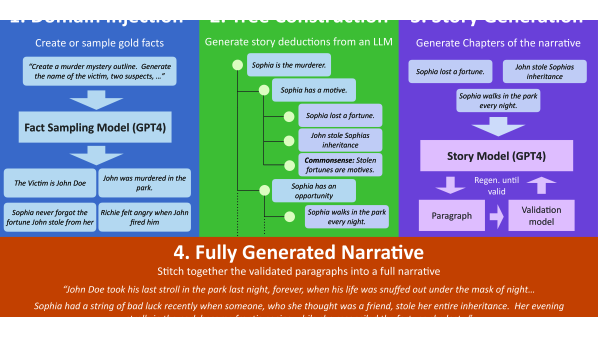
- A neurosymbolic synthetic-to-natural generation pipeline creates reasoning trees first, encoding multistep inferences from domain-specific facts.
- The reasoning tree is recursively expanded using LLMs to encode commonsense inferences required to deduce the correct answer.
- Narratives are generated in iterative chunks using GPT-4, with fact consistency and recall validated at each step.
- The process ensures narrative realism and logical coherence while preserving core facts and reasoning paths.
- The dataset is constructed across three domains: murder mysteries, object placement, and team assignment, each requiring deep commonsense and system-2 reasoning.
- Evaluation includes zero-shot and few-shot chain-of-thought prompting, as well as neurosymbolic baselines, on 750 instances across domains.
Experimental results
Research questions
- RQ1Can LLMs like GPT-4 reliably recover reasoning paths from long, natural language narratives without explicit intermediate supervision?
- RQ2How do chain-of-thought prompting and neurosymbolic methods perform on multistep, commonsense reasoning tasks embedded in complex narratives?
- RQ3To what extent do current LLMs fail to reason robustly on narratives requiring sustained attention and integration of multiple facts?
- RQ4How does the neurosymbolic generation method scale to produce increasingly complex reasoning narratives as models evolve?
Key findings
- GPT-4 fails to recover the correct reasoning path from the final narrative using any prompting strategy, indicating that reasoning is not robustly encoded in natural language narratives.
- Chain-of-thought prompting shows limited improvement on MuSR, revealing persistent reasoning gaps even in state-of-the-art models.
- The neurosymbolic generation pipeline successfully produces fact-consistent, human-solvable narratives of up to 1000 words, enabling scalable benchmark creation.
- The dataset is not solvable by rule-based systems, confirming its complexity and suitability for evaluating advanced reasoning.
- Human annotators solve MuSR instances with high accuracy, validating the dataset’s realism and tractability.
- MuSR outperforms existing benchmarks by combining natural language, multistep reasoning, commonsense, and intermediate reasoning structure.
Read this paper
Open the full text in the Nubint reader and ask about any passage as you read.
Read this paper on NubintThis review was generated by AI from the original paper. Please check the paper before citing it.