
[Paper Review] Network Estimation and Packet Delivery Prediction for Control over Wireless Mesh Networks
This paper proposes a network estimator using a graph-based wireless mesh model with two-state Markov chains to predict packet delivery sequences in lossy multihop networks. By providing joint probability predictions of future packet losses, the method enables a finite-horizon LQG controller to compensate for predicted outages, significantly improving control performance over standard controllers in simulations.
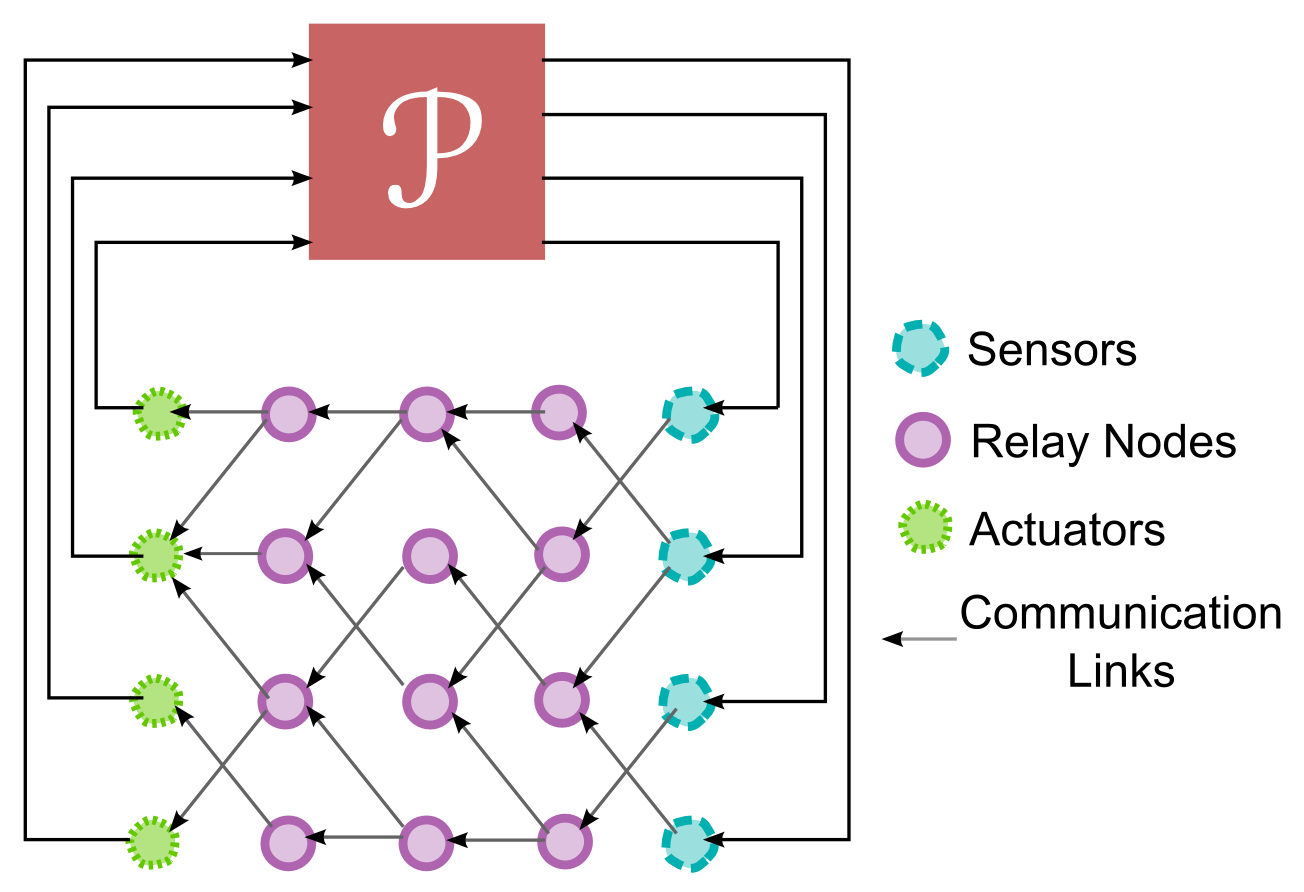
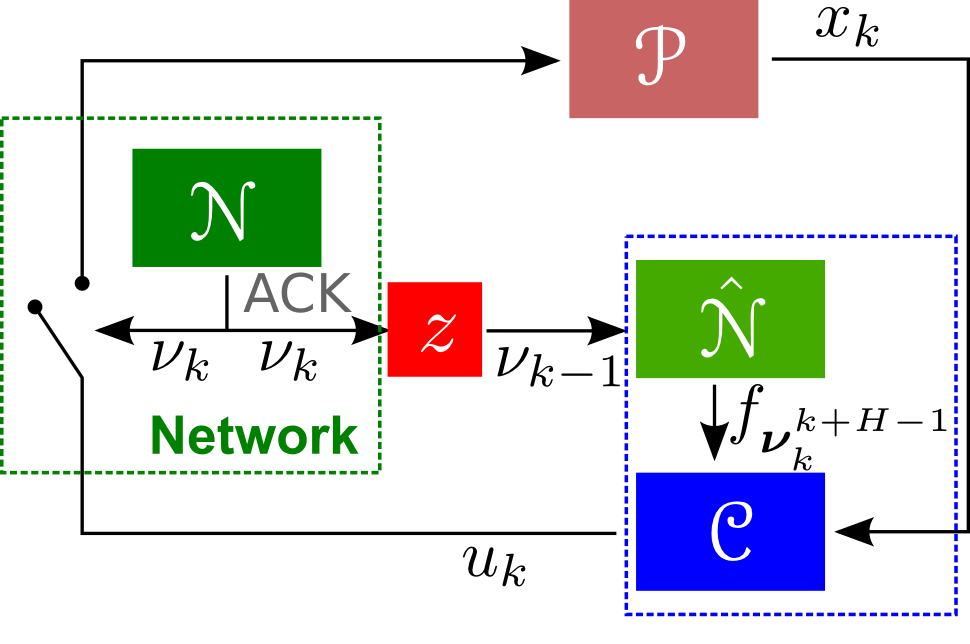
Much of the current theory of networked control systems uses simple point-to-point communication models as an abstraction of the underlying network. As a result, the controller has very limited information on the network conditions and performs suboptimally. This work models the underlying wireless multihop mesh network as a graph of links with transmission success probabilities, and uses a recursive Bayesian estimator to provide packet delivery predictions to the controller. The predictions are a joint probability distribution on future packet delivery sequences, and thus capture correlations between successive packet deliveries. We look at finite horizon LQG control over a lossy actuation channel and a perfect sensing channel, both without delay, to study how the controller can compensate for predicted network outages.
Motivation & Objective
- To improve control system performance in networked control systems (NCS) by providing accurate packet delivery predictions for lossy wireless mesh networks.
- To address the limitation of existing NCS models that treat networks as simple point-to-point or star topologies with fixed packet loss probabilities.
- To develop a network estimator that captures temporal and spatial correlations in packet delivery by modeling links as Markov-modulated processes.
- To enable the controller to react to predicted network outages through a future-packet-delivery-optimized (FPD) LQG controller.
- To bridge the gap between network and control layers by exchanging richer network state information than just average loss probabilities.
Proposed method
- Models the wireless mesh network as a directed graph where each link has a transmission success probability governed by a two-state Markov chain (Gilbert-Elliott model).
- Uses a recursive Bayesian estimator to compute the joint probability distribution over future packet delivery sequences based on current and past network states.
- Integrates the network estimator with a finite-horizon LQG controller that uses predicted delivery sequences to optimize control actions.
- Employs a global TDMA transmission schedule and fixed routing topology to define the network structure and timing constraints.
- Derives the network state probability distribution over all possible link state combinations (2^E states), though the model assumes statistical independence between links.
- Evaluates controller performance using simulation-based comparison with an IID controller (i.i.d. packet drops) and an ON controller (no network knowledge).
Experimental results
Research questions
- RQ1Can a network estimator that models multihop mesh networks with correlated packet losses improve control system performance compared to traditional models?
- RQ2How does the accuracy of packet delivery prediction affect the performance of a finite-horizon LQG controller in a lossy actuation channel?
- RQ3To what extent do assumptions of link independence and Markovian link behavior impact the fidelity of packet delivery predictions in real-world mesh networks?
- RQ4Can a controller that uses predicted network outages (via FPD) outperform controllers that assume i.i.d. or no network knowledge?
- RQ5What are the trade-offs between model complexity (e.g., full state space) and prediction accuracy in network estimation for NCS?
Key findings
- The FPD controller achieved a control cost of 681.68, significantly lower than the IID controller (1,008.2) and the ON controller (1,158.9), demonstrating the benefit of using predictive network state information.
- The proposed network estimator successfully captures correlations in packet delivery sequences through a joint probability distribution, enabling better controller decisions than models assuming independent or i.i.d. losses.
- The GEIHS network model, while simplified, provides sufficiently accurate predictions to improve control performance, suggesting it is a viable abstraction for NCS design.
- The study reveals that inaccurate network predictions can degrade FPD controller performance, highlighting the need for robustness in prediction-based control strategies.
- The results suggest that network model selection is critical: overly complex models may not improve prediction accuracy, while overly simplistic models may miss key dynamics.
- The framework enables a more interactive interface between network and control layers, where network parameters (e.g., link transition probabilities) can be used to tune controller behavior.
Read this paper
Open the full text in the Nubint reader and ask about any passage as you read.
Read this paper on NubintThis review was generated by AI from the original paper. Please check the paper before citing it.