
[논문 리뷰] Neutral material around the B[e] supergiant star LHA 115-S 65: An outflowing disk or a detached Keplerian rotating disk?
이 연구는 소마그라나은운의 빠르게 회전하는 B[e] 초거성 LHA 115-S 65의 원성주 환경을 고해상도 및 저해상도 광학 스펙트럼을 사용하여 조사한다. [O i] 발광선과 이중피크를 띠는 [Ca ii] 선들은 고밀도이자 중성이며 편평한 원판 구조임을 시사한다. 선 밝기와 프로파일의 모델링 결과는 유동하는 원판보다는 분리된 케플러 운동을 하는 원판이 더 우수한 것으로 나타나, S 65는 LBV 이전 단계일 가능성이 있으며, 라이트형 파랑 변광성 별(LBV)과 유사한 특성을 지닌다.
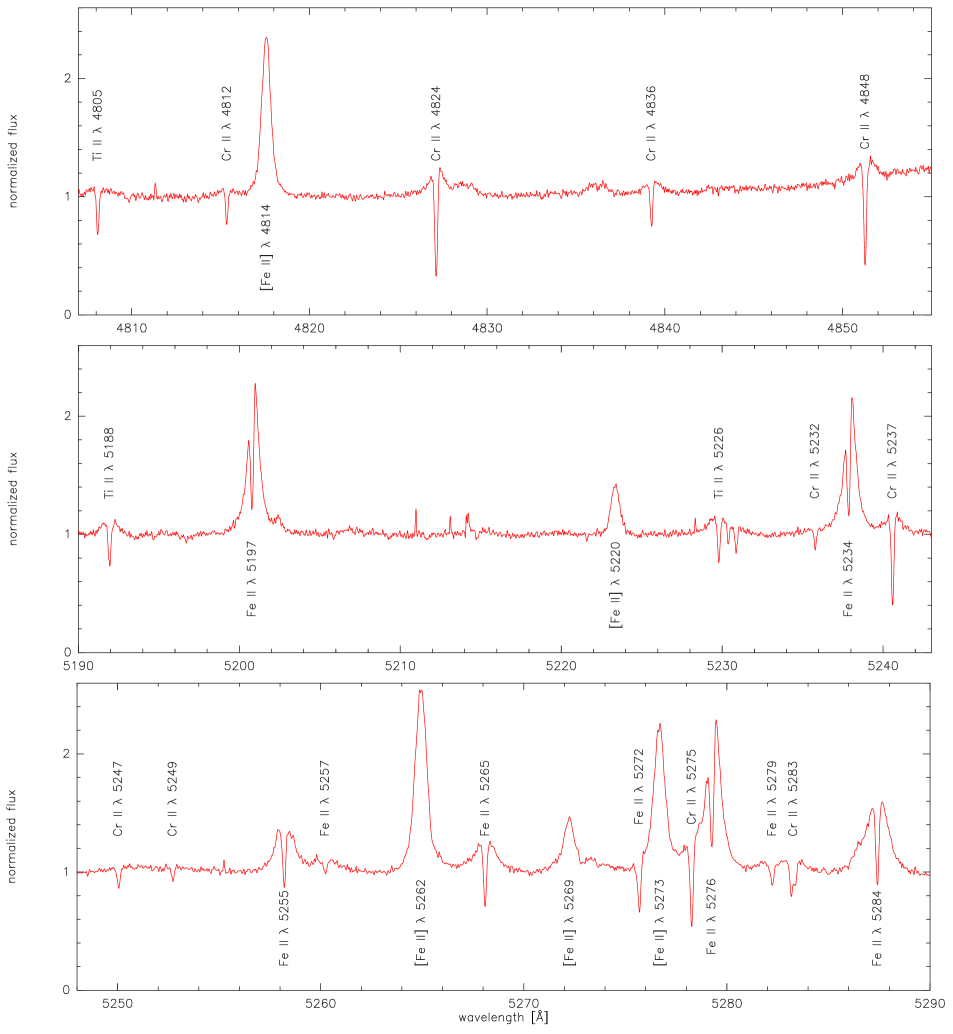
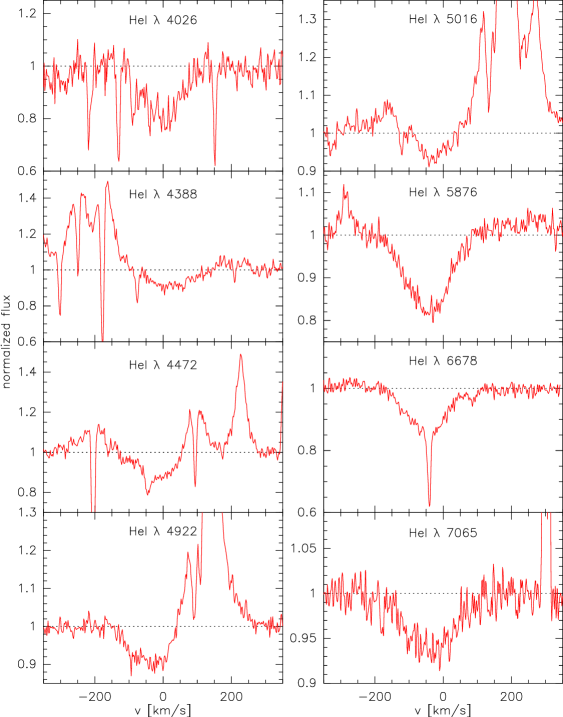
B[e] supergiants are surrounded by large amounts of hydrogen neutral material, traced by the emission in the optical [OI] lines. This neutral material is most plausibly located within their dense, cool circumstellar disks, which are formed from the (probably non-spherically symmetric) wind material released by the star. Neither the formation mechanism nor the resulting structure and internal kinematics of these disks (or disk-like outflows) are well known. However, rapid rotation, lifting the material from the equatorial surface region, seems to play a fundamental role. The B[e] supergiant LHA 115-S 65 (S65) in the SMC is one of the two most rapidly rotating B[e] stars known. Its almost edge-on orientation allows a detailed kinematical study of its optically thin forbidden emission lines. With a focus on the [OI] lines, we test the two plausible disk scenarios: the outflowing and the Keplerian rotating disk. Based on high- and low-resolution optical spectra, we investigate the density and temperature structure in those disk regions that are traced by the [OI] emission to constrain the disk sizes and mass fluxes needed to explain the observed [OI] line luminosities. In addition, we compute the emerging line profiles expected for either an outflowing disk or a Keplerian rotating disk, which can directly be compared to the observed profiles. Both disk scenarios deliver reasonably good fits to the line luminosities and profiles of the [OI] lines. Nevertheless, the Keplerian disk model seems to be the more realistic one, because it also agrees with the kinematics derived from the large number of additional lines in the spectrum. As additional support for the presence of a high-density, gaseous disk, the spectrum shows two very intense and clearly double-peaked [CaII] lines. We discuss a possible disk-formation mechanism, and similarities between S65 and the group of LBVs.
연구 동기 및 목표
- B[e] 초거성 LHA 115-S 65 주위 중성 원성주 물질의 운동학적 구조를 규명하는 것.
- 관측된 [O i] 발광선이 유동하는 원판인지, 케플러 운동을 하는 원판인지 테스트하는 것.
- [O i] 선 밝기와 프로파일을 사용하여 원판의 물리적 특성, 즉 질량, 크기, 질량 유량을 제약하는 것.
- S 65가 라이트형 파랑 변광성 별(LBV)과 회전, 질량 손실, 원판 구조 측면에서 유사한 특성을 공유하는지 평가하는 것.
- 고속 회전이 거대한 별에서 고밀도의 등위 원성주 원판을 형성하는 데 기여하는 메커니즘을 조사하는 것.
제안 방법
- ESO의 라 실리아 관측소에 위치한 1.52m 및 2.2m 망원경을 사용하여 LHA 115-S 65의 고해상도 및 저해상도 광학 스펙트럼을 확보하였다.
- [O i] λ6300 발광선의 밝기를 분석하여 원판 형성 영역 내 중성 수소의 총 질량을 추정하였다.
- 두 가지 원판 시나리오인 유동하는 원판과 분리된 케플러 운동 원판에 대해 복사선 프로파일을 모델링하였다.
- 관측된 이중피크 [Ca ii] 선을 고밀도이자 편평한 원판 기하학적 구조를 뒷받침하는 독립적 증거로 사용하였다.
- 두 모델에서 예측한 선 프로파일을 관측된 프로파일과 비교하여 최적의 운동학적 구조를 결정하였다.
- 많은 수의 추가 발광선에서 유도된 운동학적 특성과 케플러 원판 모델의 일관성을 평가하였다.
실험 결과
연구 질문
- RQ1LHA 115-S 65 주위 원성주 물질은 유동하는 원판인지, 케플러 운동을 하는 원판인지가 더 적절한가?
- RQ2[O i] 발광선에 의해 추적된 원판 영역 내 중성 수소의 총 질량은 얼마인가?
- RQ3관측된 [O i] 및 [Ca ii] 선 프로파일은 원성주 원판의 기하학적 구조와 운동학적 특성을 어떻게 제약하는가?
- RQ4헤르츠프룽-라스터(HR) 다이어그램 상의 위치와 높은 회전 속도를 고려할 때, S 65는 라이트형 파랑 변광성 별(LBV)과의 연관성이 있는가?
- RQ5원판 형성 메커니즘은 특히 임계 회전 속도 근처에서 발생하는 회전 유도 질량 손실로 설명될 수 있는가?
주요 결과
- [O i] 선 밝기는 발광선이 추적하는 영역 내 총 기체 질량이 약 1.5 × 10⁻² M☉임을 시사한다.
- 원판 내 이온화 수소의 비율은 0.1% 미만으로, 원판이 주로 중성 수소로 이루어져 있음을 확인한다.
- 이중피크 [Ca ii] 선은 고밀도이자 편평한 원성주 원판의 강력한 독립적 증거를 제공한다.
- 선 프로파일의 모델링 결과는 케플러 운동 원판이 유동하는 원판보다 더 우수한 것으로 나타나, 관측된 운동학적 특성과 더 잘 일치한다.
- 별의 HR 다이어그램 상의 위치는 LBV 최소 불안정성 스트립 근처에 있으며, 그 회전 속도는 임계 한계의 75% 이상을 초과하여 LBV 진화와의 가능성이 있는 연관성을 시사한다.
- S 65의 원판 질량 및 유량 속도는 LBV 성운에서 관측된 값들과 일치하여, 잠재적인 진화적 연관성을 더욱 뒷받침한다.
더 나은 연구,지금 바로 시작하세요
연구 설계부터 논문 작성까지, 연구 시간을 획기적으로 줄여보세요.
카드 등록 없음 · 무료 플랜 제공
이 리뷰는 AI가 만들고, 인간 에디터가 검토했습니다.