
[Paper Review] Neutrino-Assisted Early Dark Energy is a Natural Resolution of the Hubble Tension
This paper defends the neutrino-assisted early dark energy (νEDE) model as a natural and cosmologically viable resolution to the Hubble tension. By correcting errors in a prior critique, it shows that νEDE's natural initial conditions arise from a non-zero scalar field minimum due to neutrino couplings, enabling a sustained, physically motivated EDE injection around matter-radiation equality without fine-tuning.
It has very recently been claimed that the neutrino-assisted early dark energy model -- a promising resolution of the Hubble tension that can ameliorate the theoretical fine-tuning and coincidence problems that plague other theories -- does not provide natural or cosmologically interesting results. In this short paper, we show that these conclusions are incorrect for three reasons. First, we identify errors in the calculations. Second, we dispute the definition in of what constitutes an 'interesting' and 'natural' model. Finally, we demonstrate that the conclusions of were arrived at without fully exploring the full parameter space of the model. Neutrino-assisted early dark energy remains a natural and interesting potential resolution of the Hubble tension that merits further study.
Motivation & Objective
- To refute claims by de Souza and Rosenfeld (2023) that νEDE is neither natural nor cosmologically interesting.
- To correct errors in the prior analysis, particularly in the calculation of neutrino energy density and pressure used to constrain the EDE kick.
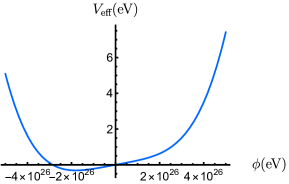
- To establish that the natural initial condition for the scalar field in νEDE is not φ_i = 0, but |φ_i| ≈ |φ_min| ≠ 0 due to neutrino coupling.
- To argue that the cosmological interest of νEDE should be judged by integrated EDE energy injection, not just peak magnitude.
- To demonstrate that the full parameter space of νEDE remains viable and warrants further study despite incomplete exploration in prior work.
Proposed method
- Re-evaluate the effective potential of the scalar field in νEDE, showing that the minimum is displaced from φ = 0 due to Yukawa coupling to neutrinos.
- Use the equation of motion for the scalar field coupled to neutrinos to derive the time-dependent effective potential and field evolution.
- Apply the condition that the neutrino mass scale is comparable to the temperature at matter-radiation equality to naturally trigger EDE onset.
- Re-analyze the EDE energy fraction f_EDE(z) as a function of redshift, emphasizing that the duration and integral of the kick matter more than its peak.
- Reassess the parameter space by considering viable values of λ and β that were underexplored in de Souza and Rosenfeld (2023), including non-Planck neutrino mass values.
- Compare νEDE to uncoupled EDE models to highlight the theoretical advantages of νEDE in resolving fine-tuning and coincidence problems.
Experimental results
Research questions
- RQ1Does the νEDE model remain a viable and natural resolution of the Hubble tension despite claims to the contrary?
- RQ2Are the equations used in de Souza and Rosenfeld (2023) to constrain the EDE kick magnitude physically correct for νEDE?
- RQ3What is the correct initial condition for the scalar field in νEDE, and is it naturally φ_i = 0 or |φ_i| ≈ |φ_min| ≠ 0?
- RQ4Can νEDE produce sufficient EDE energy injection around matter-radiation equality to resolve the Hubble tension when properly evaluated?
- RQ5Is the conclusion that νEDE is uninteresting justified, or does it stem from an incomplete exploration of the parameter space and flawed definitions of 'natural' and 'interesting'?
Key findings
- The equations used in de Souza and Rosenfeld (2023) to limit the EDE kick magnitude are incorrect due to the use of unphysical neutrino energy density and pressure.
- The natural initial condition for the scalar field in νEDE is not φ_i = 0, but |φ_i| ≈ |φ_min| ≈ 10^{-6} M_Pl, driven by the Yukawa coupling to neutrinos.
- The effective potential in νEDE is displaced from zero at high redshift, as shown in Fig. 1, confirming that φ_min ≠ 0.
- The EDE injection in νEDE is not a sharp peak but a prolonged process, so cosmological interest must be judged by the integrated energy injection, not just the maximum magnitude.
- A large range of initial conditions |φ_i| ≠ 0 are naturally realized in νEDE, and these can successfully inject f_EDE ≈ 10% around z ≈ 3000–4000.
- The existence of uncoupled EDE models with similar initial conditions does not undermine νEDE’s theoretical appeal, as νEDE resolves both fine-tuning and coincidence problems.
Read this paper
Open the full text in the Nubint reader and ask about any passage as you read.
Read this paper on NubintThis review was generated by AI from the original paper. Please check the paper before citing it.