
[Paper Review] Neutrino magnetic dipole portal with low energy neutrino nucleus scattering data
This paper uses low-energy neutrino-nucleus scattering data from Dresden-II and COHERENT experiments to probe sterile neutrinos via their magnetic dipole portal in the 0.1–50 MeV mass range. It demonstrates that Dresden-II sets leading constraints for $ m_N \lesssim 0.5\,\text{MeV} $ in the $ e $-flavor portal, while COHERENT’s full dataset with timing resolution enables unique probing of $ m_N \approx 10\text{--}40\,\text{MeV} $ for the $ \mu $-flavor portal.
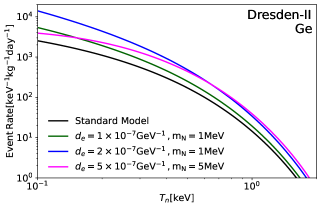
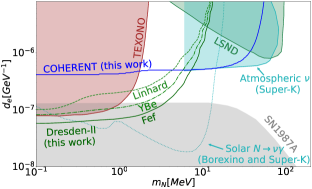
Sterile neutrinos that couple to the Standard Model via the neutrino magnetic dipole portals have been extensively studied at various experiments. In this work, we scrutinize these interactions for sterile neutrinos in the mass range of $\unit[0.1]{}-\unit[50]{MeV}$ through the nuclear and electron recoils at various neutrino scattering experiments. For the $e$-flavor specific dipole portal, we demonstrate that Dresden-II can provide leading constraints for $m_N \lesssim \unit[0.5]{MeV}$, setting aside currently unresolved theoretical uncertainties. For the $μ$-flavor case, we show that the COHERENT experiment can probe a unique parameter region for $m_N$ in the range of $\unit[10]{}-\unit[40]{MeV}$ with the full dataset collected by the CsI[Na] scintillation detector, including both the energy and timing structure of the neutrino beam. We also present limits on the parameter regions of the $τ$-flavor dipole portal using measurements of the solar neutrino flux from dark matter direct detection experiments.
Motivation & Objective
- To constrain sterile neutrino magnetic dipole portal interactions in the sub-GeV mass range using low-energy neutrino scattering data.
- To address the unexplored parameter space for sterile neutrino magnetic moments above the supernova cooling band.
- To improve constraints on $ e $-, $ \mu $-, and $ \tau $-flavor dipole portals using existing experimental datasets.
- To leverage timing and energy structure in COHERENT’s CsI[Na] data to disentangle $ \nu_\mu $, $ \bar{\nu}_\mu $, and $ \bar{\nu}_e $ contributions.
- To provide independent constraints on the $ \tau $-flavor portal using solar neutrino flux measurements from PandaX-4T and Xenon1T.
Proposed method
- Utilizes the neutrino dipole portal Lagrangian $ \mathcal{L}_{\text{NDP}} = \frac{d_\alpha}{2}(\bar{N}\sigma^{\mu\nu}\nu^\alpha F_{\mu\nu}) + \text{h.c.} $ to model sterile neutrino interactions.
- Calculates differential cross sections for coherent elastic neutrino-nucleus scattering (CE$\nu$NS) and elastic neutrino-electron scattering (E$\nu$ES) in the SM and with the NDP contribution.
- Applies the isotopic average of event rates over natural abundances of xenon isotopes to compare SM predictions with data from dark matter detectors.
- Uses the ratio of predicted to SM event numbers $ \left\langle N^{\text{SM+NDP}}(\mathcal{N}) \right\rangle / \left\langle N^{\text{SM}}(\mathcal{N}) \right\rangle \lesssim \Phi_{90\%}/\Phi_{\text{SSM}} $ to set constraints on $ d_\alpha $.
- Incorporates time-of-flight information from COHERENT’s CsI[Na] detector to separate contributions from $ \nu_\mu $, $ \bar{\nu}_\mu $, and $ \bar{\nu}_e $ fluxes.
- Applies 90% C.L. upper limits on solar neutrino fluxes from PandaX-4T ($ \Phi_{90\%} \simeq 9.0 \times 10^6\,\text{cm}^{-2}\text{s}^{-2} $) and Xenon1T ($ \Phi_{90\%} \simeq 1.4 \times 10^7\,\text{cm}^{-2}\text{s}^{-2} $) to constrain the $ \tau $-flavor portal.
Experimental results
Research questions
- RQ1Can Dresden-II reactor antineutrino data provide leading constraints on the $ e $-flavor magnetic dipole portal for $ m_N \lesssim 0.5\,\text{MeV} $?
- RQ2Can COHERENT’s full dataset, including timing structure, probe a unique parameter region for $ \mu $-flavor dipole portal in the $ 10\text{--}40\,\text{MeV} $ mass range?
- RQ3To what extent do solar neutrino flux measurements from PandaX-4T and Xenon1T constrain the $ \tau $-flavor dipole portal?
- RQ4How do the constraints from COHERENT compare to previous limits from MiniBooNE, CHARM-II, and Super-K?
- RQ5What is the impact of nuclear recoil energy thresholds on the sensitivity of dark matter detectors to the $ \tau $-flavor portal?
Key findings
- Dresden-II data provide leading constraints on the $ e $-flavor magnetic dipole portal for $ m_N \lesssim 0.5\,\text{MeV} $, assuming the Fef quenching model.
- COHERENT’s full dataset with timing resolution enables unique probing of the $ \mu $-flavor portal for $ m_N \approx 10\text{--}40\,\text{MeV} $, improving previous limits by roughly one order of magnitude.
- The monochromatic $ \nu_\mu $ peak from pion decay at $ m_N \simeq 30\,\text{MeV} $ further constrains the $ \mu $-flavor portal exclusion region.
- Constraints from PandaX-4T and Xenon1T on the $ \tau $-flavor portal are a factor of 3 better than previous limits based on nuclear recoil, due to lower energy thresholds (0.5 keV vs. 4.5 keV).
- The $ \tau $-flavor portal constraints from PandaX-4T and Xenon1T cover the same region as Borexino and Super-K, which search for $ N $ decays from solar neutrino upscattering.
- A large parameter space for $ m_N \gtrsim 40\,\text{MeV} $ remains unexplored above the supernova cooling band, suggesting a need for future dedicated searches.
Read this paper
Open the full text in the Nubint reader and ask about any passage as you read.
Read this paper on NubintThis review was generated by AI from the original paper. Please check the paper before citing it.