
[Paper Review] New ideas on the formation and astrophysical detection of primordial black holes
This paper reviews novel mechanisms for primordial black hole (PBH) formation, including those driven by Yukawa interactions and phase transitions, and proposes advanced detection strategies such as identifying orphan kilonovae linked to fast radio bursts. It demonstrates that PBHs can form with minimal new physics, particularly via scalar-mediated forces, and highlights promising astrophysical signatures for testing PBH dark matter. The key contribution is a unified framework linking particle physics models to observable PBH signals across diverse mass scales.
Recently, a number of novel scenarios for primordial black hole (PBH) formation have been discovered. Some of them require very minimal new physics, some others require no new ingredients besides those already present in commonly considered models, such as supersymmetry. At the same time, new strategies have emerged for detection of PBHs. For example, an observation of an orphan kilonova unaccompanied by the gravitational waves signal of merging neutron stars, but associated with a fast radio burst, could be a smoking gun of PBH dark matter. We review some new ideas for PBH formation and detection.
Motivation & Objective
- To explore minimal new physics scenarios enabling primordial black hole (PBH) formation, particularly through Yukawa interactions in a dark sector.
- To identify viable astrophysical detection channels for PBHs, including orphan kilonovae and neutron star heating, as smoking-gun signals.
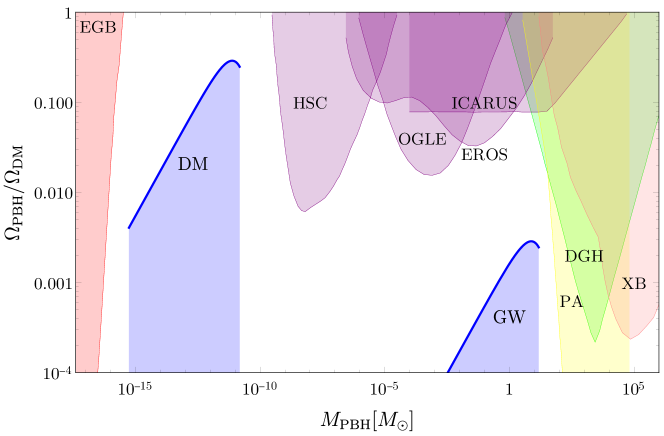
- To assess the viability of PBHs as dark matter candidates across the mass range 10^17–10^23 g using recent observational constraints.
- To unify non-inflationary PBH formation mechanisms—such as phase transitions and topological defects—within a single theoretical framework.
- To evaluate the potential of short-lived PBHs and current-day black hole formation to explain high-energy cosmic ray anomalies and the GeV excess.
Proposed method
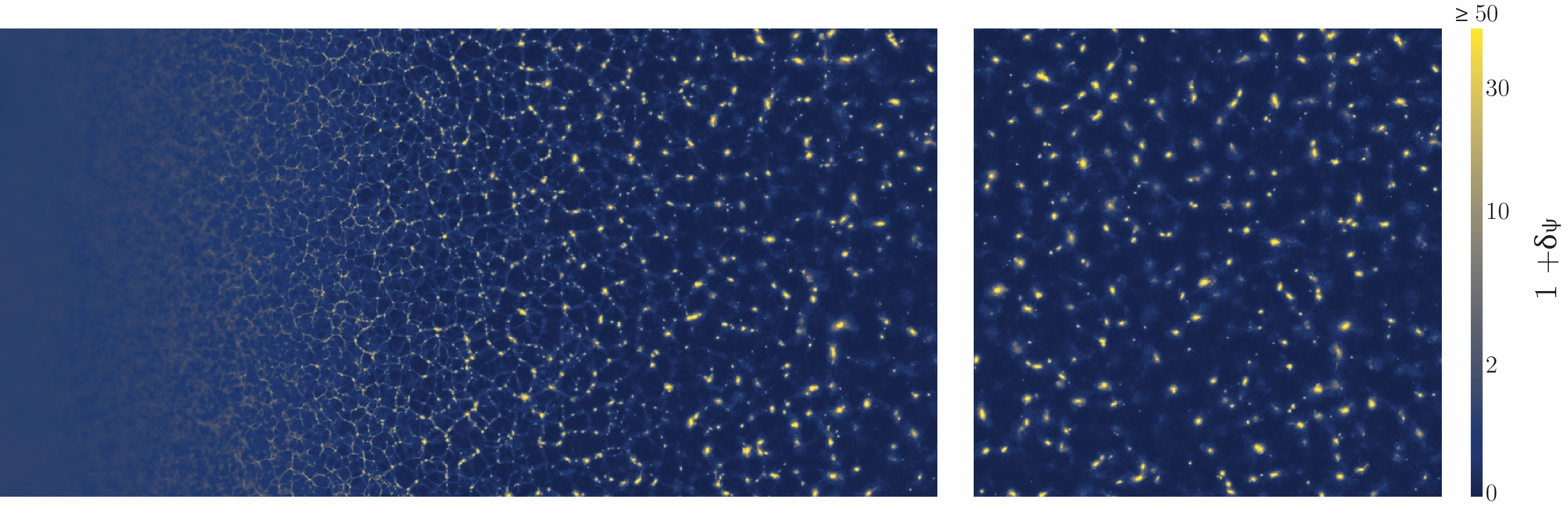
- Modeling PBH formation via a Yukawa-coupled dark sector with one fermion and one scalar, where the scalar mediates a strong, attractive force exceeding gravity.
- Applying cosmological perturbation theory to analyze structure growth under modified gravity, using the differential equation: $\ddot{\delta}_{m}+2H\dot{\delta}_{m}=4\pi G_{N}a^{2}\bar{\rho}_{m}\delta_{m}$, with modified growth due to enhanced forces.
- Evaluating the critical collapse condition for PBH formation using sound speed suppression during phase transitions, particularly in supercooled transitions.
- Analyzing the dynamics of domain walls and cosmic strings as potential PBH seeds, especially in scenarios with trapped heavy particles in false vacuum regions.
- Using the Yukawa potential $V(r) = -\frac{y^2}{4\pi r}e^{-m_{\varphi}r}$ to model short-range attractive forces that enhance density perturbation growth on subhorizon scales.
- Integrating observational constraints from microlensing, neutron star heating, and fast radio bursts to test PBH detection strategies.
Experimental results
Research questions
- RQ1Can primordial black holes form via Yukawa-mediated interactions without requiring new physics beyond supersymmetry?
- RQ2How do phase transitions and topological defects contribute to PBH formation, particularly in supercooled or first-order transition scenarios?
- RQ3Can orphan kilonovae unaccompanied by gravitational waves and associated with fast radio bursts serve as definitive evidence for PBH dark matter?
- RQ4What role do short-lived PBHs play in reheating the early universe and enabling direct collapse of gas clouds into supermassive black holes?
- RQ5Can current astrophysical observations, such as cosmic-ray antiproton fluxes and the GeV excess, be explained by ongoing PBH formation in the galactic center?
Key findings
- Yukawa interactions in a dark sector with a single fermion and scalar can lead to PBH formation via enhanced attractive forces, with the coupling strength $\beta \sim y(M_{\rm Pl}/m_\psi)$ typically much greater than one.
- PBHs can form from subhorizon-scale overdensities in the early universe when scalar-mediated forces dominate over gravity, enabling structure formation during radiation domination.
- An orphan kilonova coinciding with a fast radio burst but lacking a gravitational wave signal could be a smoking-gun signature of PBH dark matter.
- Phase transitions, especially supercooled ones, can enhance PBH production by suppressing sound speed, increasing the critical collapse threshold for black hole formation.
- Short-lived PBHs formed in the present epoch could simultaneously explain the GeV excess and the flux of cosmic-ray antiprotons, as well as rare antihelium events observed by AMS-02.
- PBHs formed from trapped heavy particles in false vacuum regions during phase transitions can collapse into black holes due to confinement at the bubble wall interface.
Read this paper
Open the full text in the Nubint reader and ask about any passage as you read.
Read this paper on NubintThis review was generated by AI from the original paper. Please check the paper before citing it.