
[Paper Review] Nitrogen enhancements 440 Myr after the Big Bang: super-solar N/O, a tidal disruption event or a dense stellar cluster in GN-z11?
This study analyzes JWST/NIRSpec data from GN-z11 at z=10.6, revealing super-solar N/O ratios (log(N/O) > -0.25) inconsistent with standard stellar evolution models at 440 Myr post-Big Bang. The authors propose that nitrogen overproduction may stem from exotic processes like runaway stellar collisions in dense clusters or tidal disruption events, challenging conventional chemical enrichment timelines in early galaxies.
Recent observations of GN-z11 with JWST/NIRSpec revealed numerous oxygen, carbon, nitrogen, and helium emission lines at $z=10.6$. Using the measured line fluxes, we derive abundance ratios of individual elements within the interstellar medium (ISM) of this super-luminous galaxy. Driven by the unusually-bright NIII] $λ$1750 and NIV] $λ$1486 emission lines (and by comparison faint OIII] $λλ$1660, 1666 lines), our fiducial model prefers log(N/O)>-0.25, greater than four times solar and in stark contrast to lower-redshift star-forming galaxies. The derived log(C/O)>-0.78, ($\approx$30 % solar) is also elevated with respect to galaxies of similar metallicity (12+log(O/H)$\approx7.82$), although less at odds with lower-redshift measurements. Given the long timescale typically expected to enrich nitrogen with stellar winds, traditional scenarios require a very fine-tuned formation history to reproduce such an elevated N/O. We find no compelling evidence that nitrogen enhancement in GN-z11 can be explained by enrichment from metal-free Population III stars. Interestingly, yields from runaway stellar collisions in a dense stellar cluster or a tidal disruption event provide promising solutions to give rise to these unusual emission lines at $z=10.6$, and explain the resemblance between GN-z11 and a nitrogen-loud quasar. These recent observations showcase the new frontier opened by JWST to constrain galactic enrichment and stellar evolution within 440 Myr of the Big Bang.
Motivation & Objective
- To determine the gas-phase elemental abundances in GN-z11 using JWST/NIRSpec emission line fluxes at z=10.6.
- To assess whether the observed super-solar N/O ratio is consistent with standard chemical evolution models for early galaxies.
- To evaluate alternative astrophysical mechanisms—such as tidal disruption events or dense stellar clusters—that could explain rapid nitrogen enrichment.
- To compare GN-z11’s emission-line properties with rare nitrogen-loud quasars and assess similarities in ionization and metallicity patterns.
- To explore the implications of these findings for early galaxy formation and the timeline of metal enrichment in the early Universe.
Proposed method
- Measured rest-frame ultraviolet emission line fluxes (e.g., N iii] λ1750, O iii] λλ1660,1666) from JWST/NIRSpec data of GN-z11.
- Used photoionization modeling with CLOUDY to derive ionization structure, electron density, and temperature from observed line ratios.
- Calculated abundance ratios (log(N/O), log(C/O), log(O/H)) using ionization correction factors and dust extinction estimates.
- Varying assumptions on temperature, density, dust, and ionization structure to test robustness of derived N/O and C/O values.
- Evaluated competing scenarios: standard AGB wind enrichment, Population III stars, tidal disruption events (TDEs), and runaway collisions in dense stellar clusters.
- Compared model predictions with observed line fluxes and with the properties of nitrogen-loud quasars to assess consistency.
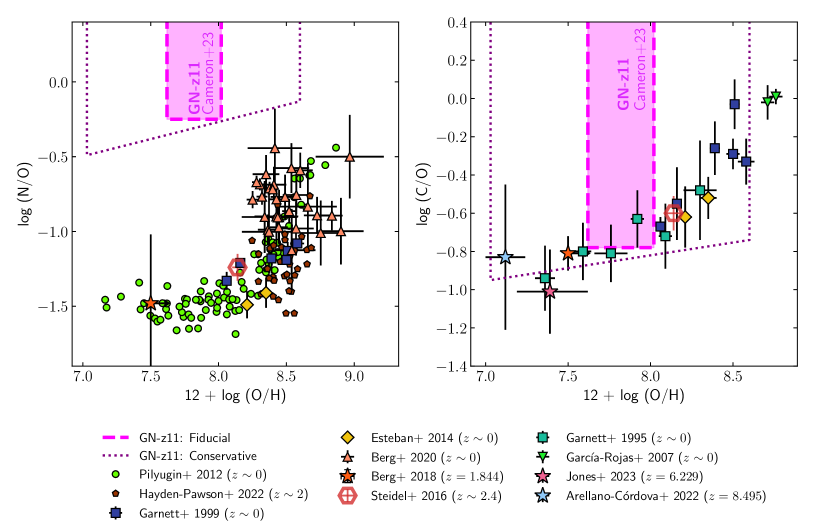
Experimental results
Research questions
- RQ1Can the observed super-solar N/O ratio in GN-z11 at z=10.6 be explained by standard chemical evolution models involving AGB stars?
- RQ2What are the implications of the unusually bright N iii] λ1750 emission line for the ionization and metallicity conditions in GN-z11’s interstellar medium?
- RQ3To what extent can tidal disruption events or dense stellar cluster dynamics explain the high N/O ratio without invoking fine-tuned initial conditions?
- RQ4How do the emission-line properties of GN-z11 compare quantitatively to those of rare nitrogen-loud quasars at lower redshift?
- RQ5What mechanisms could produce rapid nitrogen enrichment on timescales shorter than the typical AGB timescale in a galaxy only 440 Myr after the Big Bang?
Key findings
- The fiducial model derives log(N/O) > -0.25 in GN-z11, indicating super-solar nitrogen-to-oxygen abundance, which is over four times higher than solar.
- The derived log(C/O) > -0.78 (approximately 30% solar) is elevated relative to typical low-redshift galaxies of similar metallicity (12+log(O/H) ≈ 7.82).
- Even under conservative assumptions, the model yields log(N/O) > -0.49, still indicating super-solar N/O, ruling out simple dust or ionization corrections as explanations.
- Standard AGB wind enrichment models cannot reproduce the observed N/O without requiring highly contrived, fine-tuned initial conditions and a non-physical initial mass function.
- Runaway stellar collisions in dense stellar clusters and tidal disruption events (TDEs) emerge as viable alternative mechanisms that can simultaneously explain high N/O and low O/H.
- The emission-line pattern in GN-z11 bears qualitative resemblance to nitrogen-loud quasars, though GN-z11 lies at the extreme outlier end of this rare population.
Read this paper
Open the full text in the Nubint reader and ask about any passage as you read.
Read this paper on NubintThis review was generated by AI from the original paper. Please check the paper before citing it.