
[Paper Review] No Free Lunch in LLM Watermarking: Trade-offs in Watermarking Design Choices
This paper reveals that core design choices in LLM watermarking—robustness, quality preservation, and public detection APIs—create exploitable vulnerabilities, enabling effective watermark-removal and spoofing attacks. It proposes practical defenses, including differential privacy for detection APIs and query-rate limiting, to mitigate these threats while preserving utility.
Advances in generative models have made it possible for AI-generated text, code, and images to mirror human-generated content in many applications. Watermarking, a technique that aims to embed information in the output of a model to verify its source, is useful for mitigating the misuse of such AI-generated content. However, we show that common design choices in LLM watermarking schemes make the resulting systems surprisingly susceptible to attack -- leading to fundamental trade-offs in robustness, utility, and usability. To navigate these trade-offs, we rigorously study a set of simple yet effective attacks on common watermarking systems, and propose guidelines and defenses for LLM watermarking in practice.
Motivation & Objective
- To investigate how desirable properties of LLM watermarking—such as robustness, output quality, and public detection—introduce exploitable security weaknesses.
- To demonstrate that these same properties enable scalable, effective attacks that remove watermarks or forge AI-generated content with fake watermarks.
- To propose practical defenses, including differential privacy and rate limiting, to counteract these attacks while maintaining system utility.
- To establish a set of design guidelines for future watermarking systems that balance security, detectability, and model performance.
Proposed method
- The authors design and evaluate two primary attack vectors: watermark-removal attacks exploiting quality-preserving token distributions and detection API access, and spoofing attacks leveraging robustness to generate misleading, watermarked content.
- They conduct empirical evaluations on Llama-2-7B and OPT-1.3B models using the KGW, Unigram, and Exp watermarking schemes under various attack conditions.
- A differential privacy (DP) defense is implemented by adding noise to detection API responses, with noise scale tuned to maintain ≤2% drop in detection accuracy while reducing spoofing success.
- The effectiveness of the DP defense is evaluated under multiple query scenarios (1×, 20×, 200×) to simulate adversarial query averaging.
- They analyze trade-offs between watermark security, detection accuracy, and model utility through z-score and perplexity (PPL) metrics.
- They recommend identity verification and rate limiting for public detection APIs to prevent abuse in real-world deployment.

Experimental results
Research questions
- RQ1How do robustness and quality preservation in LLM watermarking systems inadvertently enable watermark-removal and spoofing attacks?
- RQ2To what extent can public detection APIs be exploited by attackers to remove watermarks or generate forged watermarked content?
- RQ3Can differential privacy be effectively applied to watermark detection APIs to reduce spoofing attack success without degrading detection accuracy?
- RQ4What are the key trade-offs between watermark security, detection reliability, and model output quality in current LLM watermarking systems?
Key findings
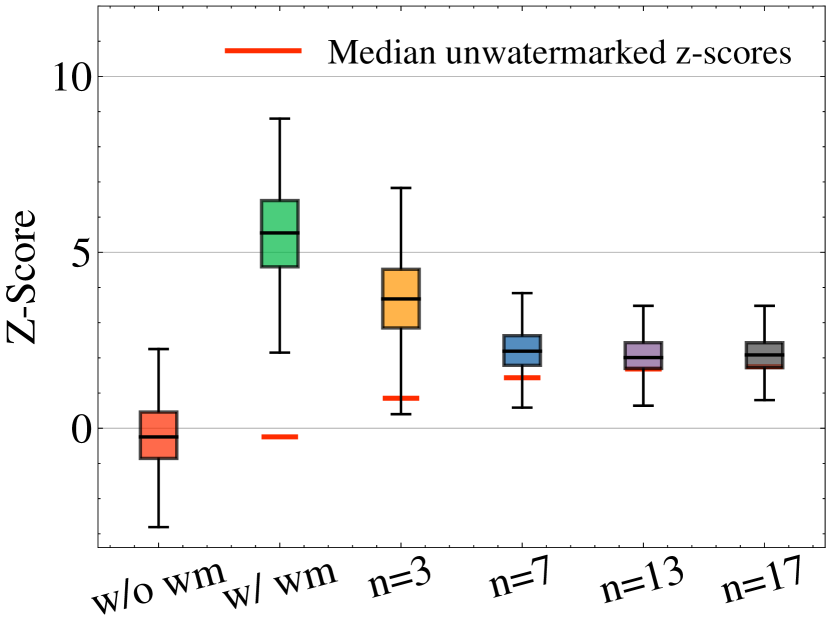
- Watermark-removal attacks that exploit quality-preserving token distributions can reduce z-scores from 5.98 to 1.47 while maintaining low perplexity (PPL ~4.05), effectively evading detection.
- Spoofing attacks that exploit robustness can generate factually incorrect content with z-scores matching the original watermark (e.g., z-score = 5.98), making it appear authentic.
- Differential privacy with σ = 4 reduces spoofing attack success rate to 0% on the KGW watermark, with only a 1% drop in detection accuracy (from 98.2% to 97.2%).
- Even with 200× query averaging, attackers cannot fully recover original scores under DP, showing that DP significantly mitigates spoofing threats.
- The DP defense is effective across multiple models (Llama-2-7B, OPT-1.3B) and watermark schemes (KGW, Unigram, Exp), demonstrating broad applicability.
- Public detection APIs remain vulnerable to both removal and spoofing attacks, necessitating additional controls like query rate limiting and user authentication.
Read this paper
Open the full text in the Nubint reader and ask about any passage as you read.
Read this paper on NubintThis review was generated by AI from the original paper. Please check the paper before citing it.