
[论文解读] No Tension: JWST Galaxies at $z > 10$ Consistent with Cosmological Simulations
本研究利用高分辨率的Renaissance宇宙学模拟,表明詹姆斯·韦伯太空望远镜(JWST)在红移 z > 10 观测到的最 massive 星系(如 GS-z11-0 和 Maisie's Galaxy)与 ΛCDM 模型的预测一致。尽管最初因恒星质量过高而引发对模型张力的担忧,但模拟显示,若将这些星系的恒星质量与恒星形成率向前外推,其结果与理论预期相符,从而解决了明显的矛盾。
Recent observations by JWST have uncovered galaxies in the very early universe via the JADES and CEERS surveys. These galaxies have been measured to have very high stellar masses with substantial star formation rates. There are concerns that these observations are in tension with the $Λ$CDM model of the universe, as the stellar masses of the galaxies are relatively high for their respective redshifts. Recent studies have compared the JWST observations with large-scale cosmological simulations. While they were successful in reproducing the galaxies seen in JADES and CEERS, the mass and spatial resolution of these simulations were insufficient to fully capture the early assembly history of the simulated galaxies. In this study, we use results from the Renaissance simulations, which are a suite of high resolution simulations designed to model galaxy formation in the early universe. We find that the most massive galaxies in Renaissance have stellar masses and star formation rates that are entirely consistent with the observations from the JADES and CEERS surveys. The exquisite resolution afforded by Renaissance allows us to model the build-up of early galaxies from stellar masses as low as 10$^4$ M$_\odot$ up to a maximum stellar mass of a few times 10$^{7}$ M$_\odot$. Within this galaxy formation paradigm, we find excellent agreement with JADES and CEERS. We find no tension between the $Λ$CDM model and current JWST measurements. As JWST continues to explore the high redshift universe, high resolution simulations, such as Renaissance, will continue to be crucial in understanding the formation history of early embryonic galaxies.
研究动机与目标
- 解决关于 JWST 在 z > 10 观测到的星系恒星质量过高可能与 ΛCDM 模型矛盾的担忧。
- 评估高分辨率宇宙学模拟是否能再现早期星系观测到的恒星质量和恒星形成率。
- 通过与聚焦于早期星系形成的更高分辨率模拟对比,评估以往低分辨率模拟的可靠性。
- 评估 JADES 和 CEERS 星系的观测特性是否与 ΛCDM 宇宙中标准星系形成物理规律一致。
- 通过特定星形成率(sSFR)约束,验证外推技术在模拟超出模拟红移范围的星系演化时的有效性。
提出的方法
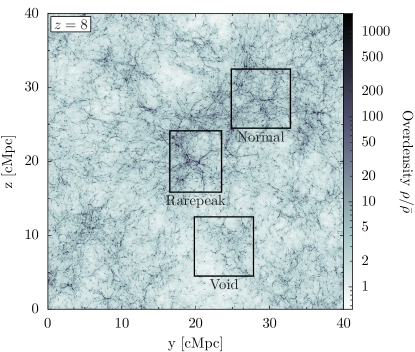
- 使用 Renaissance 模拟套件,该套件在三个高密度区域(RP、Normal 和 High)以高质量和空间分辨率模拟早期星系形成。
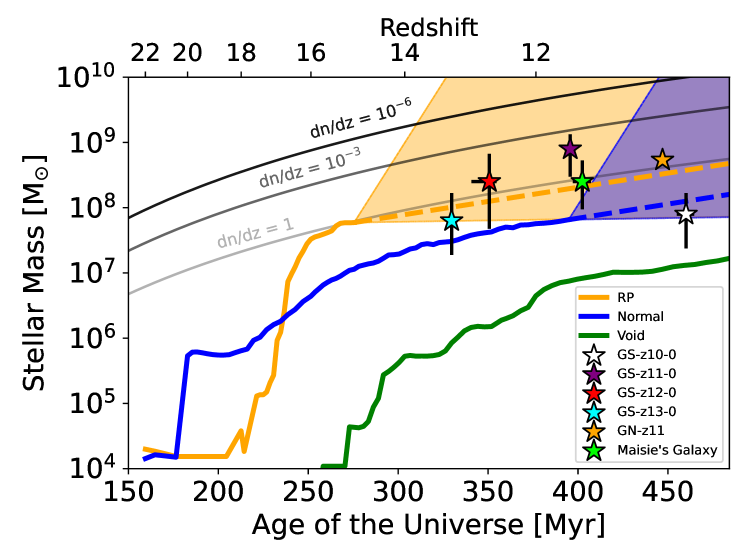
- 追踪从恒星质量低至 10⁴ M⊙ 到约 ~3×10⁷ M⊙ 的星系形成历史,从而实现对早期组装过程的精确建模。
- 通过将模拟中不同晕质量范围内的 sSFR 值向前外推,以匹配观测红移,实现对星形成率的外推。
- 将 Renaissance 模拟中最大质量星系的恒星质量和恒星形成率(SFR)与 JADES 和 CEERS 巡天的观测值进行比较。
- 使用 Beagle(Chevallard & Charlot, 2016)对 JWST 光度和光谱数据中的观测 SFR 和恒星质量进行建模,从而实现与模拟输出的直接对比。
- 通过比较模拟中不同晕质量的 sSFR 趋势,并评估其与观测 sSFR 的一致性,特别是高红移区域,从而验证结果。
实验结果
研究问题
- RQ1JWST 在 z > 10 观测到的星系的恒星质量和恒星形成率是否与 ΛCDM 框架下高分辨率宇宙学模拟的预测一致?
- RQ2Renaissance 模拟凭借其高质量和空间分辨率,能否再现 JWST 检测到的最遥远星系的特性?
- RQ3从较低红移模拟中外推的 sSFR 值在多大程度上与 z > 10 星系的观测特性匹配?
- RQ4在 z > 10 观测到的高质星系是否为异常值,还是在 ΛCDM 模型的统计预期范围内?
- RQ5与以往的低分辨率模拟(如 EAGLE 和 TNG100)相比,高分辨率模拟的结果在多大程度上与 JWST 观测一致?
主要发现
- Renaissance 模拟中最 massive 的星系其恒星质量在将 sSFR 向前外推后,与 JADES 和 CEERS 中观测到的值一致。
- 最 massive 模拟星系的恒星形成率(SFR)与 z > 10 星系的观测 SFR 良好吻合,尤其是在考虑不同晕质量范围内的 sSFR 趋势时。
- 模拟表明,当星系质量达到观测值量级时,恒星形成效率提高且受反馈调节,效率水平达到百分之几,与观测一致。
- GN-z11 和 GS-z11-0 的观测恒星质量超过了 RP 区域模拟的最大质量,但这可能是活动星系核(AGN)活动或宇宙方差所致,而非与 ΛCDM 的根本性矛盾。
- 高分辨率模拟(Renaissance)与低分辨率模拟(K23)的结合提供了强有力且一致的证据,表明 JWST 观测与 ΛCDM 模型之间不存在张力。
- 本研究证实,在 ΛCDM 框架下,大质量星系的快速早期组装在物理上是可能的,恒星形成效率从低质量时的约 0.2% 增加到高质量时的百分之几。
更好的研究,从现在开始
从阅读论文到最终审阅,大幅缩短您的研究时间。
无需绑定信用卡
本解读由 AI 生成,并经人工编辑审核。