
[Paper Review] Nonlinearly Shaped Pulses in Photoinjectors and Free-Electron Lasers
This paper proposes Dispersion Controlled Nonlinear Shaping (DCNS) to generate flattop UV laser pulses at the photocathode of photoinjectors, reducing electron beam emittance and enhancing FEL performance. Simulations in LCLS-II show DCNS pulses yield 35% higher x-ray pulse energy than standard Gaussian pulses due to lower emittance and higher effective charge in the beam core.
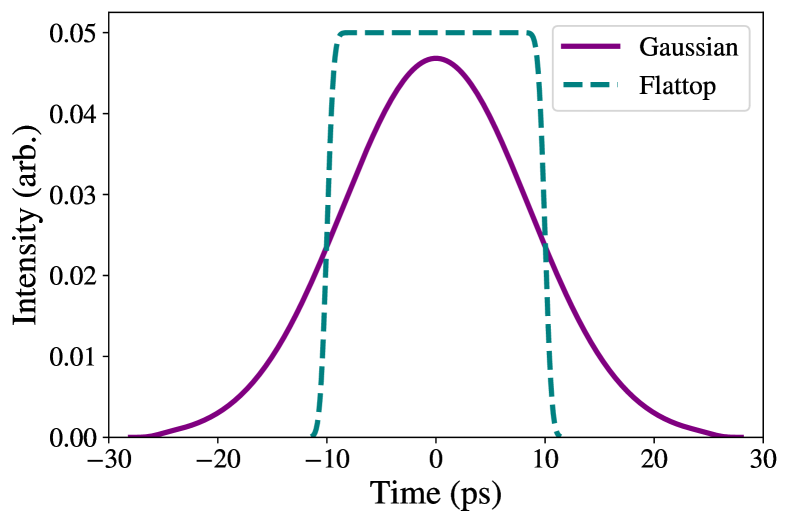
Photoinjectors and Free Electron Lasers (FEL) are amongst the most advanced systems in accelerator physics and have consistently pushed the boundaries of emittance and x-ray peak power. In this paper, laser shaping at the cathode is proposed to further lower the emittance and reduce electron beam tails, which would result in brighter x-ray production. Using dispersion controlled nonlinear shaping (DCNS), laser pulses and beam dynamics were simulated in LCLS-II. The photoinjector emittance was optimized and the resulting e-beam profiles were then simulated and optimized in the linac. Finally, the expected FEL performance is estimated and compared to the current technology: Gaussian laser pulses on the cathode. The e-beams produced by DCNS pulses show a potential for 35% increase in x-ray power per pulse during SASE when compared to the standard Gaussian laser pulses.
Motivation & Objective
- To address the performance limitations of Gaussian laser pulses in photoinjectors, which lead to higher emittance and reduced FEL efficiency.
- To explore whether nonlinearly shaped laser pulses—specifically flattop profiles—can improve electron beam quality and FEL output.
- To evaluate the feasibility and impact of implementing DCNS for high-repetition-rate, high-average-power UV pulse generation at 1 MHz.
- To compare DCNS-based beam dynamics and FEL performance against standard Gaussian pulse operation in LCLS-II.
- To demonstrate that improved longitudinal pulse shaping can enhance beam brightness and x-ray pulse energy without altering core accelerator parameters.
Proposed method
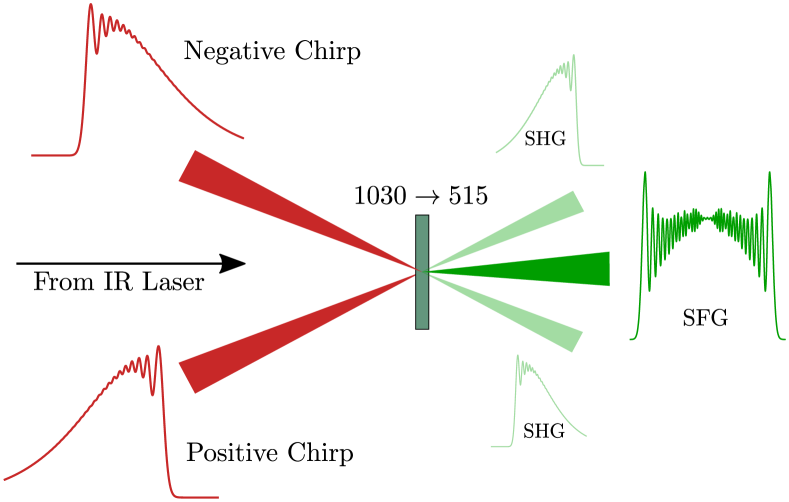
- Employing a cascaded nonlinear conversion chain, DCNS shapes the 1030 nm fundamental pulse by splitting it into two arms with opposite second- and third-order dispersion (SOD and TOD).
- Applying tailored phase profiles via frequency-domain filtering to generate two temporally semi-triangular pulses that sum in a non-collinear sum-frequency generation (SFG) process.
- Using this SFG scheme to produce a frequency-doubled 515 nm pulse with a flattened spectral phase and reduced bandwidth, enabling efficient and high-fidelity UV pulse generation.
- Simulating the full beamline from photocathode to undulator using LCLS-II parameters, with both Gaussian and DCNS pulses as input, including injector and linac optimization.
- Applying the same optimization variables (magnets, phases) to both Gaussian and DCNS cases to ensure fair comparison of beam dynamics and FEL performance.
- Estimating SASE FEL gain and x-ray energy per pulse using undulator gap variation to access different photon energies, with beam parameters derived from core emittance and charge distribution.
Experimental results
Research questions
- RQ1Can nonlinearly shaped laser pulses, specifically flattop profiles, reduce electron beam emittance in photoinjectors compared to standard Gaussian pulses?
- RQ2How does DCNS pulse shaping affect the longitudinal profile and current distribution of the electron beam in the linac?
- RQ3What is the impact of improved emittance and charge distribution on SASE FEL gain and x-ray pulse energy?
- RQ4Can DCNS pulses enable higher x-ray power per pulse at the same average beam parameters, and by how much?
- RQ5Does the flatness of the DCNS beam core contribute to improved spectral brightness or reduced bandwidth in SASE FEL output?
Key findings
- DCNS pulses achieved a 35% increase in estimated x-ray energy per pulse (2.6 mJ vs. 1.9 mJ) compared to Gaussian pulses, primarily due to lower emittance and higher effective charge in the beam core.
- The DCNS beam maintained low emittance (below 0.5 mm-mrad) over 89 pC of the 100 pC bunch, compared to 74 pC in the Gaussian case, indicating better utilization of charge for lasing.
- Despite similar SASE power evolution and time to saturation (not reached within 70 m), the DCNS beam delivered significantly higher x-ray pulse energy due to enhanced current and emittance control.
- The DCNS technique enabled efficient generation of high-fidelity, nearly transform-limited flattop UV pulses at 1 MHz repetition rate, overcoming limitations of conventional pulse-shaping methods.
- The flatness of the DCNS beam core suggests potential for reduced FEL bandwidth and higher spectral brightness, which could benefit ultrafast and high-resolution applications.
- The study demonstrates that longitudinal laser shaping at the photocathode is a viable path to access lower emittance regimes and improve FEL performance without major accelerator redesign.
Read this paper
Open the full text in the Nubint reader and ask about any passage as you read.
Read this paper on NubintThis review was generated by AI from the original paper. Please check the paper before citing it.