
[Paper Review] OBJECT 3DIT: Language-guided 3D-aware Image Editing
This paper introduces OBJECT 3DIT, a language-guided 3D-aware image editing framework that enables precise, physically plausible edits—such as translation, rotation, insertion, and removal—of objects in images while preserving scene geometry, lighting, and shadows. Trained on a synthetic 400K-example dataset (OBJect) of procedurally generated 3D scenes, 3DIT generalizes effectively to real-world images, outperforming baselines in both quantitative metrics and human evaluations, with preference rates exceeding 70% across tasks.
Existing image editing tools, while powerful, typically disregard the underlying 3D geometry from which the image is projected. As a result, edits made using these tools may become detached from the geometry and lighting conditions that are at the foundation of the image formation process. In this work, we formulate the newt ask of language-guided 3D-aware editing, where objects in an image should be edited according to a language instruction in context of the underlying 3D scene. To promote progress towards this goal, we release OBJECT: a dataset consisting of 400K editing examples created from procedurally generated 3D scenes. Each example consists of an input image, editing instruction in language, and the edited image. We also introduce 3DIT : single and multi-task models for four editing tasks. Our models show impressive abilities to understand the 3D composition of entire scenes, factoring in surrounding objects, surfaces, lighting conditions, shadows, and physically-plausible object configurations. Surprisingly, training on only synthetic scenes from OBJECT, editing capabilities of 3DIT generalize to real-world images.
Motivation & Objective
- To address the limitation of existing image editing tools that ignore underlying 3D scene geometry and lighting, leading to physically implausible edits.
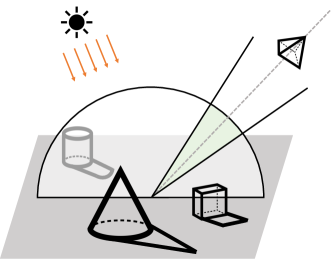
- To introduce a new task—language-guided 3D-aware image editing—where edits respect 3D scene context, including object placement, surfaces, shadows, and lighting.
- To develop a large-scale, procedurally generated dataset (OBJect) with 400K editing examples to support training and evaluation of 3D-aware editing models.
- To design and train 3DIT, a diffusion-based model fine-tuned on OBJect to perform four object-editing tasks with language conditioning.
- To demonstrate that models trained exclusively on synthetic 3D scenes can generalize effectively to real-world images, enabling practical, scene-consistent editing.
Proposed method
- The authors create OBJect, a dataset of 400K image-editing pairs derived from procedurally generated 3D scenes using Objaverse and Blender, with controlled lighting, surfaces, and object placements.
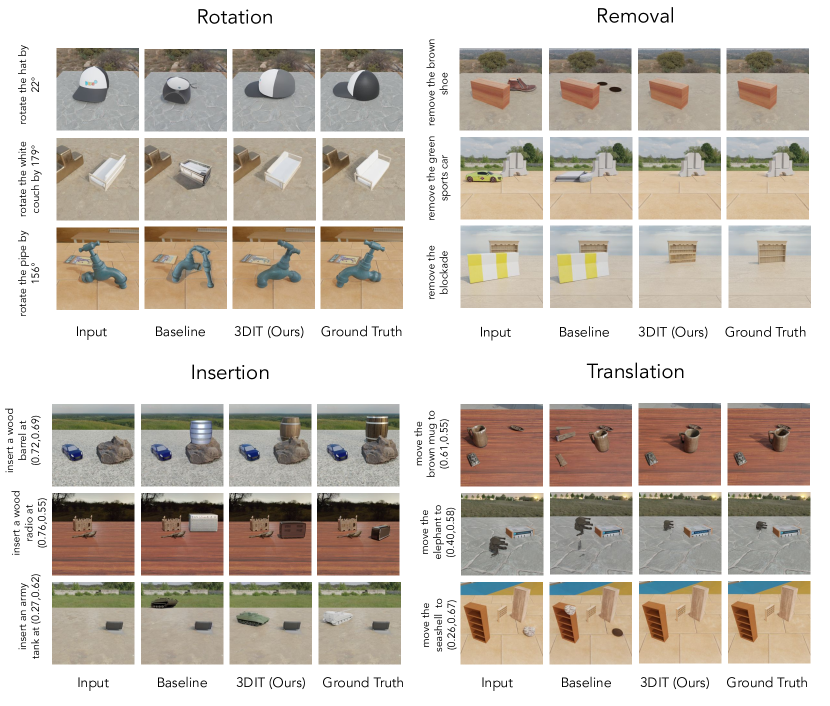
- Each example includes a source image, a natural language instruction describing one of four edits (translation, rotation, insertion, removal), and a ground-truth edited image.
- 3DIT is initialized from the Zero-1-to-3 diffusion model and fine-tuned on the OBJect dataset using a three-stage learning curriculum: web-scale pre-training, 3D-aware pre-training, and task-specific fine-tuning.
- The model supports both single-task and multi-task variants, enabling joint prediction of all four editing operations using a unified architecture.
- The model explicitly models 3D scene consistency by preserving object scale, viewpoint, surface contact, and shadow dynamics during edits.
- Evaluation uses both quantitative metrics (faithfulness, realism) and human preference studies to assess geometric and lighting consistency.
Experimental results
Research questions
- RQ1Can a model trained solely on synthetic 3D scenes perform realistic, 3D-consistent image editing on real-world images?
- RQ2How well can a language-conditioned diffusion model preserve 3D scene properties—such as shadows, object scale, and occlusion—during object editing?
- RQ3To what extent does 3DIT outperform existing baselines in maintaining geometric and lighting consistency during object translation, rotation, insertion, and removal?
- RQ4Can a single multi-task 3DIT model effectively handle all four editing tasks without significant performance degradation?
- RQ5How do human annotators rate 3DIT’s outputs compared to baselines in terms of geometric and lighting fidelity?
Key findings
- 3DIT achieves a human preference score of 73.3% for geometric consistency and 80.0% for lighting consistency on the translation task, significantly outperforming the baseline.
- For the removal task, 3DIT achieves 86.6% preference for geometric consistency and 86.6% for lighting consistency, demonstrating strong occlusion and shadow handling.
- In the rotation task, 3DIT obtains 80.0% preference for geometric consistency and 73.3% for lighting consistency, indicating accurate rotation and shadow rendering.
- The multi-task variant of 3DIT performs well across all four tasks without major degradation, showing effective parameter sharing across editing types.
- Despite being trained only on synthetic data, 3DIT generalizes effectively to real-world images, producing photo-realistic outputs with consistent shadows and scene structure.
- 3DIT successfully in-paints previously occluded regions when objects are removed or repositioned, preserving scene coherence.
Read this paper
Open the full text in the Nubint reader and ask about any passage as you read.
Read this paper on NubintThis review was generated by AI from the original paper. Please check the paper before citing it.