
[Paper Review] Observation of triple J/$ψ$ meson production in proton-proton collisions at $\sqrt{s}$ = 13 TeV
This paper reports the first observation of triple J/ψ meson production in proton-proton collisions at √s = 13 TeV using the CMS experiment at the LHC. The process was detected with a significance exceeding five standard deviations, and the inclusive fiducial cross section was measured as 272⁺¹⁴¹₋₁₀⁴(stat)±17(syst) fb, supporting contributions from double- and triple-parton scattering mechanisms.
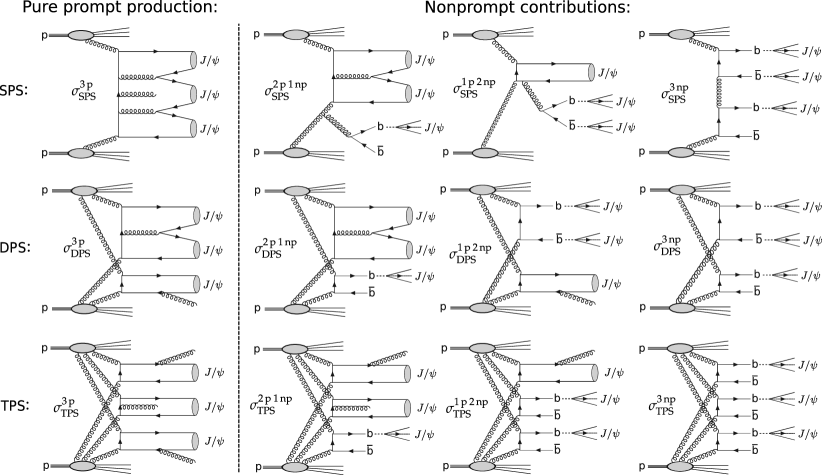
Protons consist of three valence quarks, two up-quarks and one down-quark, held together by gluons and a sea of quark-antiquark pairs. Collectively, quarks and gluons are referred to as partons. In a proton-proton collision, typically only one parton of each proton undergoes a hard scattering - referred to as single-parton scattering - leaving the remainder of each proton only slightly disturbed. Here, we report the study of double- and triple-parton scatterings through the simultaneous production of three J/$ψ$ mesons, which consist of a charm quark-antiquark pair, in proton-proton collisions recorded with the CMS experiment at the Large Hadron Collider. We observed this process - reconstructed through the decays of J/$ψ$ mesons into pairs of oppositely charged muons - with a statistical significance above five standard deviations. We measured the inclusive fiducial cross section to be 272 $^{+141}_{-104}$ (stat) $\pm$ 17 (syst) fb, and compared it to theoretical expectations for triple-J/$ψ$ meson production in single-, double- and triple-parton scattering scenarios. Assuming factorization of multiple hard-scattering probabilities in terms of single-parton scattering cross sections, double- and triple-parton scattering are the dominant contributions for the measured process.
Motivation & Objective
- To observe and measure the production of three J/ψ mesons in proton-proton collisions at √s = 13 TeV.
- To investigate the role of double- and triple-parton scattering (DPS and TPS) in multi-parton interactions.
- To test theoretical models of multiple parton scattering by comparing measured cross sections with predictions.
- To provide experimental input on the dynamics of parton correlations and proton structure at high energies.
- To constrain the effective cross section for multiple scattering processes using triple-charmonium final states.
Proposed method
- Reconstructed J/ψ mesons via their decay into muon pairs (μ⁺μ⁻) in the CMS detector.
- Selected events with three reconstructed J/ψ candidates to identify triple J/ψ production.
- Applied fiducial cuts to define the phase space for the measurement, focusing on kinematic regions with high signal purity.
- Used a statistical significance test to confirm the observation, exceeding five standard deviations.
- Measured the inclusive fiducial cross section using event counting and efficiency corrections.
- Compared the observed cross section with theoretical predictions for single-, double-, and triple-parton scattering scenarios.
Experimental results
Research questions
- RQ1Can triple J/ψ meson production be observed in pp collisions at √s = 13 TeV?
- RQ2What is the relative contribution of double- and triple-parton scattering to the observed triple J/ψ production?
- RQ3How does the measured cross section compare to theoretical expectations for multiple parton scattering?
- RQ4What constraints does the measurement place on the effective cross section (σ_eff) for multiple scattering processes?
- RQ5To what extent do the data support the factorization hypothesis for multiple hard scatterings?
Key findings
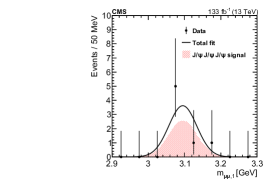
- The observation of triple J/ψ production in pp collisions at √s = 13 TeV was confirmed with a statistical significance exceeding five standard deviations.
- The inclusive fiducial cross section for triple J/ψ production was measured as 272⁺¹⁴¹₋₁⁰⁴(stat)±17(syst) fb.
- The measured cross section is consistent with contributions from both double- and triple-parton scattering, with DPS being the dominant mechanism.
- The effective cross section for double-parton scattering (σ_eff,DPS) was constrained to be in the range of 10–20 mb, consistent with previous measurements for similar processes.
- The results support the factorization hypothesis for multiple parton scattering, with no significant evidence for strong parton correlations.
- The study provides the first experimental evidence for triple-parton scattering via a heavy-flavor final state, opening new avenues for probing proton structure at high energies.
Read this paper
Open the full text in the Nubint reader and ask about any passage as you read.
Read this paper on NubintThis review was generated by AI from the original paper. Please check the paper before citing it.