
[Paper Review] On the Tradeoff between Energy, Precision, and Accuracy in Federated Quantized Neural Networks
This paper proposes a quantized federated learning framework that optimizes energy efficiency by jointly managing precision, accuracy, and energy consumption in wireless networks. By modeling energy costs for local training and uplink transmission with quantized neural networks (QNNs), and using a line search method to minimize total energy while ensuring convergence, the framework reduces energy use by up to 53% compared to standard 32-bit FL, especially for large models.
Deploying federated learning (FL) over wireless networks with resource-constrained devices requires balancing between accuracy, energy efficiency, and precision. Prior art on FL often requires devices to train deep neural networks (DNNs) using a 32-bit precision level for data representation to improve accuracy. However, such algorithms are impractical for resource-constrained devices since DNNs could require execution of millions of operations. Thus, training DNNs with a high precision level incurs a high energy cost for FL. In this paper, a quantized FL framework, that represents data with a finite level of precision in both local training and uplink transmission, is proposed. Here, the finite level of precision is captured through the use of quantized neural networks (QNNs) that quantize weights and activations in fixed-precision format. In the considered FL model, each device trains its QNN and transmits a quantized training result to the base station. Energy models for the local training and the transmission with the quantization are rigorously derived. An energy minimization problem is formulated with respect to the level of precision while ensuring convergence. To solve the problem, we first analytically derive the FL convergence rate and use a line search method. Simulation results show that our FL framework can reduce energy consumption by up to 53% compared to a standard FL model. The results also shed light on the tradeoff between precision, energy, and accuracy in FL over wireless networks.
Motivation & Objective
- To address the challenge of balancing energy efficiency, precision, and accuracy in federated learning over energy-constrained wireless networks.
- To develop a holistic model that accounts for both local training and uplink transmission energy costs in quantized FL.
- To optimize the level of precision in QNNs to minimize total energy consumption while maintaining target accuracy and convergence.
- To provide a systematic analysis of the tradeoff between precision, energy, and accuracy in wireless federated learning.
Proposed method
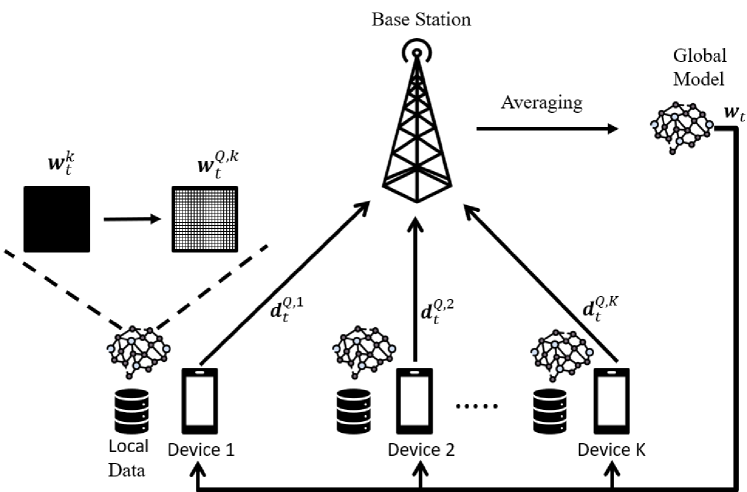
- Proposes a quantized FL framework where both local training and uplink transmission use fixed-precision QNNs with quantized weights and activations.
- Develops a rigorous energy model for local training based on the physical structure of processing chips, capturing computation and memory access costs.
- Derives an energy model for uplink transmission that accounts for quantization, including the impact of precision on data size and transmission energy.
- Analyzes the convergence rate of the quantized FL system using an analytical expression that incorporates quantization error and model size.
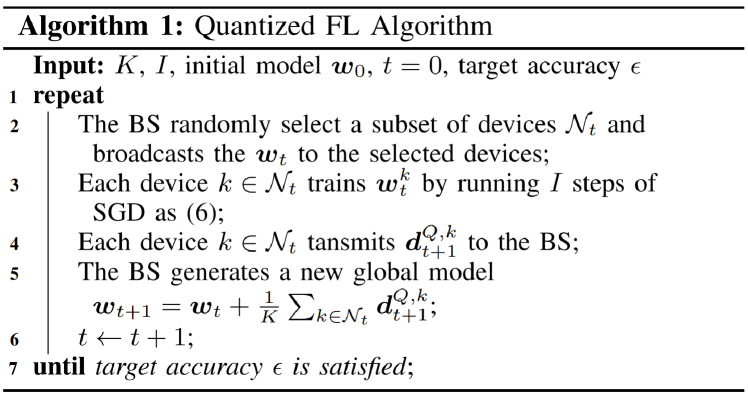
- Formulates an energy minimization problem over the precision level, subject to convergence and accuracy constraints, solved via a line search method.
- Uses a line search algorithm to find the optimal precision level that minimizes total energy while ensuring convergence to a target accuracy.
Experimental results
Research questions
- RQ1What is the optimal level of precision that minimizes total energy consumption in federated learning while maintaining convergence and target accuracy?
- RQ2How does quantization affect the convergence rate of federated learning, and how can this be modeled analytically?
- RQ3What is the tradeoff between energy efficiency, precision, and accuracy in wireless federated learning with resource-constrained devices?
- RQ4How does the number of local iterations influence the optimal precision level for energy minimization?
- RQ5How does model size affect the required precision level and total energy consumption in quantized FL?
Key findings
- The proposed quantized FL framework reduces total energy consumption by up to 53% compared to standard 32-bit federated learning, especially for large models.
- For a 138.6M-parameter CNN (Case 5), the optimal precision level was found to be 15 bits, achieving the maximum energy reduction.
- The optimal precision level increases with model size, as larger models accumulate more quantization error, requiring higher precision to maintain convergence.
- The optimal precision level also increases with the number of local iterations, as higher iteration counts reduce the impact of quantization error through gradient averaging.
- A 10-fold improvement in target accuracy (from ε=0.01 to ε=0.001) requires an additional 127 J of energy and one more bit of precision.
- Energy consumption initially decreases and then increases with precision level, indicating a non-monotonic tradeoff, with an optimal point at n=10 for the studied setup.
Read this paper
Open the full text in the Nubint reader and ask about any passage as you read.
Read this paper on NubintThis review was generated by AI from the original paper. Please check the paper before citing it.