
[Paper Review] Open Source Variational Quantum Eigensolver Extension of the Quantum Learning Machine (QLM) for Quantum Chemistry
This paper introduces OpenVQE, an open-source extension for the Atos Quantum Learning Machine (QLM) that enables efficient development and testing of variational quantum eigensolver (VQE) algorithms for quantum chemistry. It enhances QLM with tools for adaptive UCC-based ansätze, including ADAPT-VQE, fermionic second quantization, and fermion-spin transforms, achieving chemical accuracy on molecules up to 24 qubits using a 41-qubit noiseless simulator.
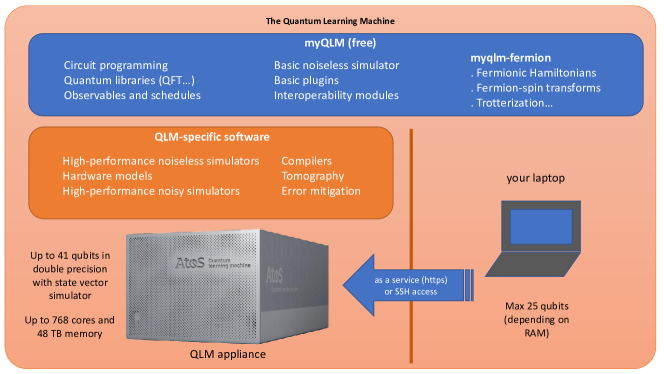
Quantum Chemistry (QC) is one of the most promising applications of Quantum Computing. However, present quantum processing units (QPUs) are still subject to large errors. Therefore, noisy intermediate-scale quantum (NISQ) hardware is limited in terms of qubits counts and circuit depths. Specific algorithms such as Variational Quantum Eigensolvers (VQEs) can potentially overcome such issues. We introduce here a novel open-source QC package, denoted Open-VQE, providing tools for using and developing chemically-inspired adaptive methods derived from Unitary Coupled Cluster (UCC). It facilitates the development and testing of VQE algorithms. It is able to use the Atos Quantum Learning Machine (QLM), a general quantum programming framework enabling to write, optimize and simulate quantum computing programs. Along with Open-VQE, we introduce myQLM-Fermion, a new open-source module (that includes the key QLM ressources that are important for QC developments (fermionic second quantization tools etc...). The Open-VQE package extends therefore QLM to QC providing: (i) the functions to generate the different types of excitations beyond the commonly used UCCSD ans{ä}tz;(ii) a new implementation of the "adaptive derivative assembled pseudo-Trotter method" (ADAPT-VQE), written in simple class structure python codes. Interoperability with other major quantum programming frameworks is ensured thanks to myQLM, which allows users to easily build their own code and execute it on existing QPUs. The combined Open-VQE/myQLM-Fermion quantum simulator facilitates the implementation, tests and developments of variational quantum algorithms towards choosing the best compromise to run QC computations on present quantum computers while offering the possibility to test large molecules. We provide extensive benchmarks for several molecules associated to qubit counts ranging from 4 up to 24.
Motivation & Objective
- Address the challenge of simulating large molecular systems on noisy intermediate-scale quantum (NISQ) hardware with limited qubit counts and circuit depths.
- Overcome the exponential scaling of full configuration interaction (FCI) and coupled-cluster methods by leveraging variational quantum algorithms.
- Develop an open-source software stack that simplifies the implementation, testing, and optimization of VQE algorithms for quantum chemistry.
- Enable interoperability with major quantum programming frameworks and real quantum processors through the myQLM-interop package.
- Advance the state of the art in VQE by implementing adaptive ansätze like ADAPT-VQE and reducing circuit depth through optimized gate sequences.
Proposed method
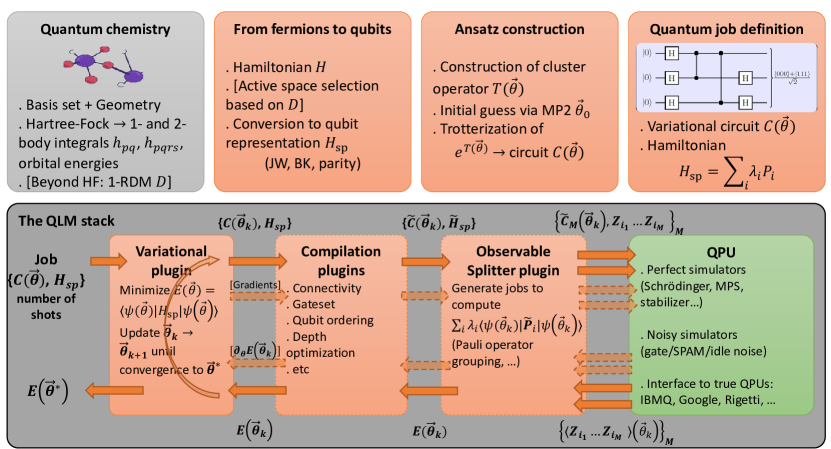
- Introduces OpenVQE, a Python-based open-source package extending the QLM framework for quantum chemistry simulations.
- Provides native support for fermionic second quantization and fermion-to-qubit mappings (e.g., Jordan-Wigner, Bravyi-Kitaev) via the myQLM-fermion module.
- Implements the adaptive derivative assembled pseudo-Trotter (ADAPT-VQE) method for dynamically constructing ansätze with minimal circuit depth.
- Enables generation of various excitation types beyond UCCSD, including UCCGSD, spin-complement-gsd, and k-UpCCGSD, for improved correlation treatment.
- Optimizes quantum circuits by minimizing CNOT gate counts using efficient fermionic and qubit evolution circuits.
- Ensures interoperability with external quantum hardware and software via the myQLM-interop package, supporting execution on IBM, Rigetti, and other QPUs.
Experimental results
Research questions
- RQ1Can adaptive VQE methods like ADAPT-VQE achieve chemical accuracy in ground-state energy calculations for quantum chemistry problems on NISQ devices?
- RQ2How can the number of quantum circuit gates be minimized while preserving accuracy in VQE-based simulations of molecular systems?
- RQ3To what extent can the OpenVQE framework enable efficient development and testing of novel ansätze beyond standard UCCSD?
- RQ4How does the integration of myQLM-fermion with QLM enable scalable simulation of molecules up to 41 qubits on classical hardware?
- RQ5What are the practical limitations of current VQE implementations, and how can optimized ansätze and gate sequences improve convergence and accuracy?
Key findings
- OpenVQE successfully implements ADAPT-VQE and multiple UCC-based ansätze, enabling accurate ground-state energy calculations for molecules with up to 24 qubits.
- The framework achieves chemical accuracy (within 1.6 mH) for small molecules such as H2, LiH, and BeH2, consistent with reference literature values.
- The noiseless Schrödinger-style simulator within QLM supports up to 41 qubits, enabling full simulation of larger molecular systems beyond current NISQ capabilities.
- Circuit optimization reduces CNOT gate counts significantly, improving feasibility for near-term quantum hardware execution.
- Interoperability via myQLM-interop enables seamless deployment of OpenVQE workflows on external quantum processors like IBM and Rigetti.
- Benchmarking confirms that ADAPT-VQE outperforms fixed-length UCCSD in terms of convergence speed and accuracy, especially for strongly correlated systems.
Read this paper
Open the full text in the Nubint reader and ask about any passage as you read.
Read this paper on NubintThis review was generated by AI from the original paper. Please check the paper before citing it.