
[Paper Review] Operator Growth in Open Quantum Systems
This paper introduces a universal framework for operator growth in open quantum systems, showing that scrambling dynamics are fundamentally governed by operator size distributions rather than microscopic error details. It predicts that open-system dynamics suppress out-of-time-ordered correlation (OTOC) decay and control Loschmidt echo decay via operator size, enabling new protocols for measuring operator size distributions via engineered dissipation.
The spreading of quantum information in closed systems, often termed scrambling, is a hallmark of many-body quantum dynamics. In open systems, scrambling competes with noise, errors and decoherence. Here, we provide a universal framework that describes the scrambling of quantum information in open systems: we predict that the effect of open-system dynamics is fundamentally controlled by operator size distributions and independent of the microscopic error mechanism. This framework allows us to demonstrate that open quantum systems exhibit universal classes of information dynamics that fundamentally differ from their unitary counterparts. Implications for Loschmidt echo experiments and the classical simulability of open quantum dynamics will be discussed.
Motivation & Objective
- To develop a universal theoretical framework for understanding quantum information scrambling in open quantum systems, independent of specific error mechanisms.
- To characterize how open-system dynamics—such as decoherence and noise—affect operator growth and information scrambling, particularly through operator size distributions.
- To resolve discrepancies in prior experimental studies of open-system scrambling by linking observed dynamics to operator size evolution.
- To propose a novel, efficient protocol for measuring operator size distributions using engineered dissipation and randomized measurements.
- To explore implications for the classical simulability of open quantum dynamics based on bounded operator size.
Proposed method
- The framework uses operator size distributions as the central quantity to describe the evolution of quantum operators under open-system dynamics, replacing reliance on specific error models.
- It introduces a generating function, $ G_{\mathcal{S}}(\mu) = \sum_{\mathcal{S}} P(\mathcal{S}) e^{-\mu\mathcal{S}} $, to encode the full size distribution and relate it to measurable quantities like fidelity and Loschmidt echo.
- A new experimental protocol is proposed: random single-qubit Pauli operations applied during time evolution implement an effective decoherence channel proportional to $ e^{-\mu\mathcal{S}} $, allowing direct measurement of $ G_{\mathcal{S}}(\mu) $.
- The framework connects Loschmidt echo decay to the average operator size, predicting a decay rate proportional to $ \overline{\mathcal{S}}(t) $, and OTOC decay to the width of the size distribution, which inhibits growth.
- The approach generalizes to non-Lindbladian scenarios, such as perturbed backward evolution, by estimating an effective decoherence rate scaling linearly with $ \overline{\mathcal{S}} $ via Fermi’s golden rule.
- Numerical simulations using a matrix-free Krylov method based on PETSc/SLEPc validate the framework across five distinct open quantum system classes, including 1D and all-to-all interacting systems.
Experimental results
Research questions
- RQ1How does operator size distribution govern the dynamics of quantum information scrambling in open quantum systems, independent of microscopic error mechanisms?
- RQ2Why do experimental observations of OTOC and Loschmidt echo decay in open systems show discrepancies with unitary predictions?
- RQ3Can operator size distributions be measured efficiently without requiring multiple copies or exponentially many measurements?
- RQ4What is the role of operator size in determining the classical simulability of open quantum dynamics?
- RQ5How does perturbed backward evolution in chaotic systems relate to effective decoherence, and does it scale with operator size?
Key findings
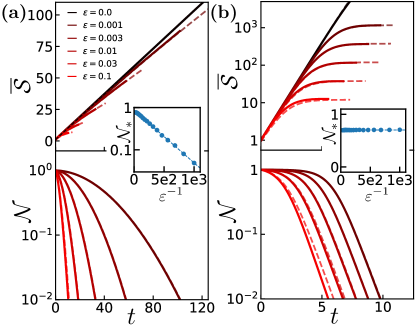
- The Loschmidt echo decays at a rate proportional to the average operator size $ \overline{\mathcal{S}}(t) $, providing a direct link between fidelity loss and operator growth.
- OTOC decay is suppressed in open systems by an amount proportional to the width of the operator size distribution, leading to slower scrambling than in unitary dynamics.
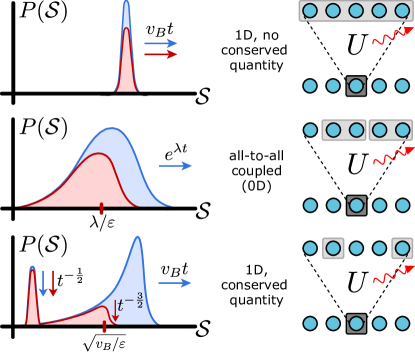
- In all-to-all coupled systems, operator size plateaus at a value $ \sim \lambda / \varepsilon $, indicating a saturation of information spreading due to dissipation.
- For systems with conserved quantities, operator size grows as $ \sim t^d $ under unitary evolution but decays as $ \sim 1/t^d $ under open dynamics, indicating effective localization.
- In integrable systems, operator size grows linearly under unitary evolution but decays as $ \sim 1/t $ under open dynamics, suggesting that decoherence suppresses complexity growth.
- The proposed protocol enables direct measurement of the operator size generating function $ G_{\mathcal{S}}(\mu) $ using randomized Pauli operations and single-shot measurements, avoiding the need for multiple copies or full state tomography.
Read this paper
Open the full text in the Nubint reader and ask about any passage as you read.
Read this paper on NubintThis review was generated by AI from the original paper. Please check the paper before citing it.