
[Paper Review] Optimization of the geometrical stability in square ring laser gyroscopes
This paper proposes a control strategy for enhancing geometrical stability in square ring laser gyroscopes by measuring and locking the two diagonals and perimeter to absolute lengths, enabling high-precision detection of the Earth's rotation for testing general relativity. The method achieves quadratic suppression of scale factor variations, allowing heterolithic (non-monolithic) cavities to meet the $10^{-14}$ rad/s sensitivity required by the GINGER project.
Ultra sensitive ring laser gyroscopes are regarded as potential detectors of the general relativistic frame-dragging effect due to the rotation of the Earth: the project name is GINGER (Gyroscopes IN GEneral Relativity), a ground-based triaxial array of ring lasers aiming at measuring the Earth rotation rate with an accuracy of 10^-14 rad/s. Such ambitious goal is now within reach as large area ring lasers are very close to the necessary sensitivity and stability. However, demanding constraints on the geometrical stability of the laser optical path inside the ring cavity are required. Thus we have started a detailed study of the geometry of an optical cavity, in order to find a control strategy for its geometry which could meet the specifications of the GINGER project. As the cavity perimeter has a stationary point for the square configuration, we identify a set of transformations on the mirror positions which allows us to adjust the laser beam steering to the shape of a square. We show that the geometrical stability of a square cavity strongly increases by implementing a suitable system to measure the mirror distances, and that the geometry stabilization can be achieved by measuring the absolute lengths of the two diagonals and the perimeter of the ring.
Motivation & Objective
- To address the challenge of maintaining extreme geometrical stability in large-area ring laser gyroscopes for detecting the Lense-Thirring effect.
- To enable the use of heterolithic (non-monolithic) cavity structures with standard materials by developing active mirror position control.
- To identify a control strategy that minimizes variations in the Sagnac scale factor $\mathbf{k}_S$ due to cavity deformations.
- To demonstrate that a square cavity geometry offers a stationary point for perimeter and scale factor, enabling stable operation under deformations.
- To provide a formalism based on Fermat’s principle to model beam paths and classify deformations in terms of their impact on optical path length and scale factor.
Proposed method
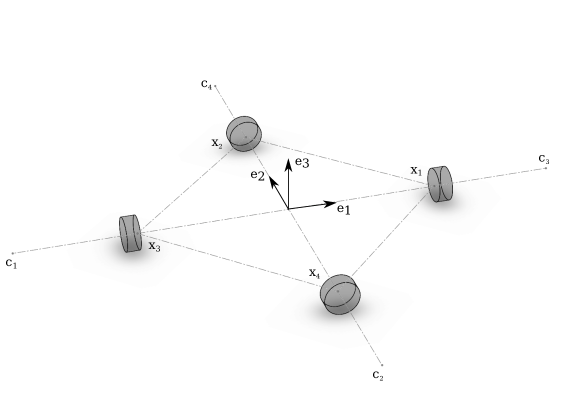
- Modeling the optical cavity geometry using Fermat’s principle, with beam paths determined by mirror center-of-curvature positions.
- Defining deformation parameters $\tau_\alpha$ to classify rigid-body motions and residual distortions of the cavity.
- Deriving normalized expressions for perimeter $\widehat{p}^*$ and scale factor $\widehat{k}^*$ as quadratic forms in normalized deformation parameters $\widetilde{\tau}_\alpha = \tau_\alpha / d_0$, with $d_0$ the nominal diagonal length.
- Imposing constraints: equal diagonal lengths ($||\mathbf{c}_3 - \mathbf{c}_1|| = ||\mathbf{c}_4 - \mathbf{c}_2|| = d_0$) to enforce symmetry and stabilize the system around the regular square geometry.
- Showing that under diagonal locking, variations in $\mathbf{k}_S$ and perimeter depend only on quadratic terms in $\widetilde{\tau}_\alpha$, enabling high-precision control.
- Identifying that large mirror radius of curvature ($h = L/r \approx 1/\sqrt{2}$ avoided) minimizes sensitivity to deformations while maintaining cavity stability.
Experimental results
Research questions
- RQ1How can geometrical deformations in a square ring laser cavity be modeled and classified to assess their impact on the Sagnac scale factor $\mathbf{k}_S$?
- RQ2What control strategy can stabilize the cavity geometry to achieve $10^{-14}$ rad/s sensitivity for general relativity tests?
- RQ3Why is the square cavity geometry particularly favorable for minimizing scale factor variations under deformations?
- RQ4How do diagonal length measurements and perimeter control contribute to achieving a stationary point in cavity perimeter and scale factor?
- RQ5What role does the mirror radius of curvature play in minimizing sensitivity to residual deformations?
Key findings
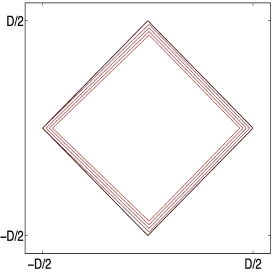
- Locking both diagonals to the same absolute length $d_0$ creates a stationary point in the cavity perimeter, corresponding to the regular square geometry.
- Under diagonal locking, variations in the scale factor $\mathbf{k}_S$ and perimeter depend only on quadratic terms in the deformation parameters $\widetilde{\tau}_\alpha$, enabling high stability.
- The coefficients of $\widetilde{\tau}_5^2$ are identical in both perimeter and scale factor expressions, indicating that diagonal-length fluctuations directly affect both quantities.
- The optimal design avoids $h = L/r \approx 1/\sqrt{2}$, where the cavity becomes unstable due to confocal behavior in the sagittal plane.
- With mirror position control within a few microns, geometrical stability of $1$ part in $10^{10}$ in $\mathbf{k}_S$ can be achieved, meeting the GINGER project’s requirements.
- The formalism supports active control of heterolithic cavities using ultra-stable optical frequency references, enabling large-scale ring laser arrays for fundamental physics.
Read this paper
Open the full text in the Nubint reader and ask about any passage as you read.
Read this paper on NubintThis review was generated by AI from the original paper. Please check the paper before citing it.