
[Paper Review] Optimizing Privacy, Utility and Efficiency in Constrained Multi-Objective Federated Learning
This paper proposes a constrained multi-objective federated learning (CMOFL) framework that jointly optimizes privacy, utility, and training efficiency using multi-objective optimization. It introduces two improved algorithms based on NSGA-II and PSL, providing theoretical convergence guarantees and empirical validation across three privacy mechanisms—randomization, BatchCrypt, and sparsification—demonstrating effective Pareto optimal trade-offs.
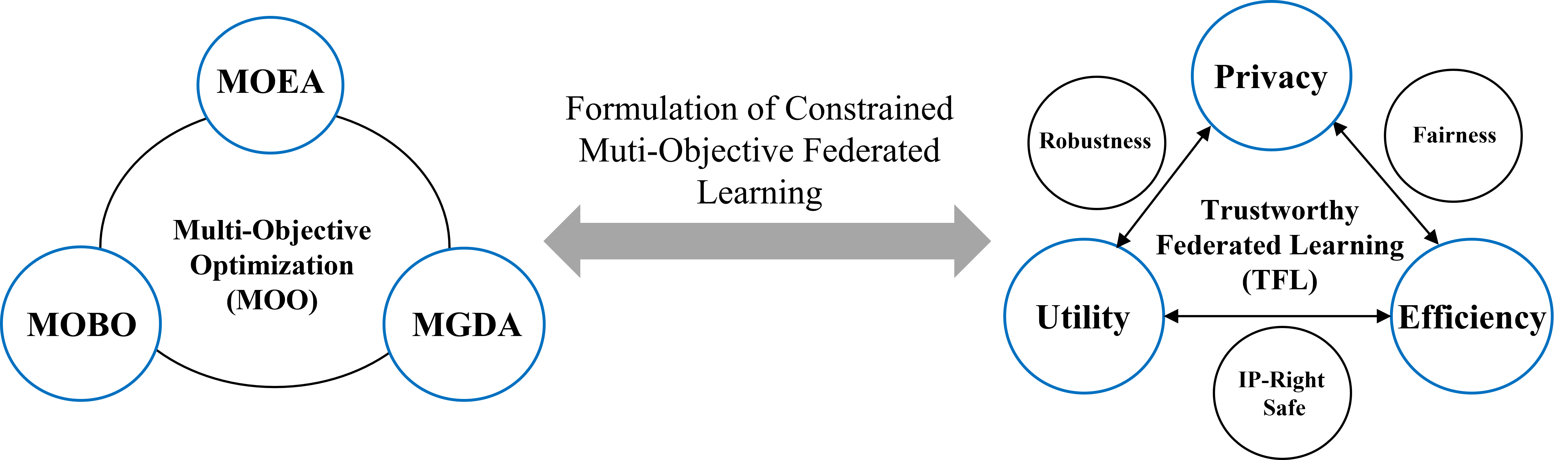
Conventionally, federated learning aims to optimize a single objective, typically the utility. However, for a federated learning system to be trustworthy, it needs to simultaneously satisfy multiple/many objectives, such as maximizing model performance, minimizing privacy leakage and training cost, and being robust to malicious attacks. Multi-Objective Optimization (MOO) aiming to optimize multiple conflicting objectives at the same time is quite suitable for solving the optimization problem of Trustworthy Federated Learning (TFL). In this paper, we unify MOO and TFL by formulating the problem of constrained multi-objective federated learning (CMOFL). Under this formulation, existing MOO algorithms can be adapted to TFL straightforwardly. Different from existing CMOFL works focusing on utility, efficiency, fairness, and robustness, we consider optimizing privacy leakage along with utility loss and training cost, the three primary objectives of a TFL system. We develop two improved CMOFL algorithms based on NSGA-II and PSL, respectively, for effectively and efficiently finding Pareto optimal solutions, and we provide theoretical analysis on their convergence. We design specific measurements of privacy leakage, utility loss, and training cost for three privacy protection mechanisms: Randomization, BatchCrypt (An efficient version of homomorphic encryption), and Sparsification. Empirical experiments conducted under each of the three protection mechanisms demonstrate the effectiveness of our proposed algorithms.
Motivation & Objective
- Address the lack of integrated optimization for privacy, utility, and efficiency in federated learning systems.
- Formulate a unified constrained multi-objective federated learning (CMOFL) framework to enable multi-objective optimization in trustworthy federated learning (TFL).
- Extend existing MOO algorithms (NSGA-II and PSL) to handle the joint optimization of privacy leakage, utility loss, and training cost.
- Provide theoretical convergence analysis for the proposed algorithms under the CMOFL formulation.
- Design and evaluate privacy leakage, utility loss, and training cost metrics across three privacy-preserving mechanisms: randomization, BatchCrypt, and sparsification.
Proposed method
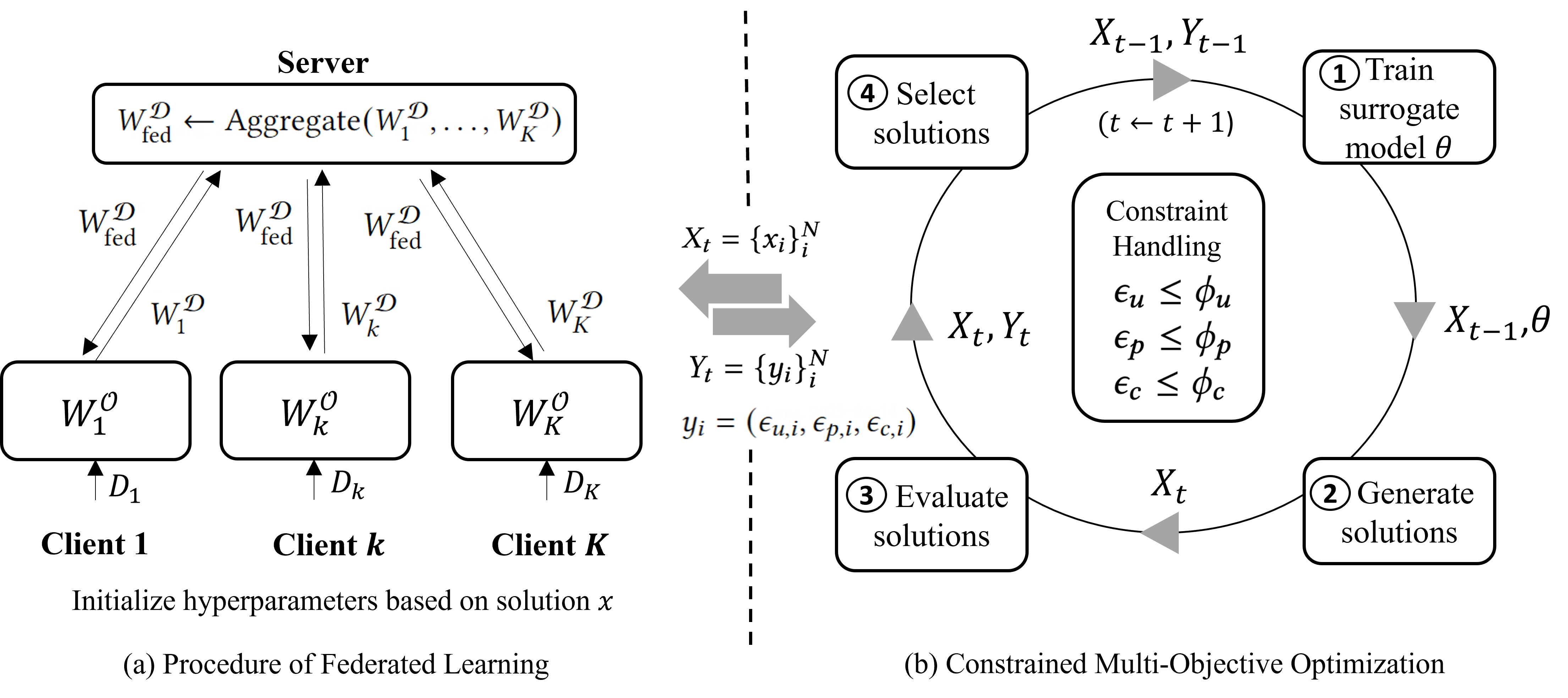
- Formulate CMOFL as a constrained multi-objective optimization problem with three primary objectives: privacy leakage, utility loss, and training cost.
- Adapt NSGA-II and PSL algorithms to handle the multi-objective nature of TFL, incorporating constraints and Pareto front exploration.
- Define objective functions using scalarization techniques, including Tchebyshev and hypervolume-based scalarizations for multi-objective Bayesian optimization.
- Introduce a hypervolume regret bound to analyze convergence, leveraging expected regret and maximum information gain ($\gamma_T$) in Bayesian optimization.
- Design measurement functions for privacy leakage (e.g., via differential privacy), utility loss (model accuracy), and training cost (communication and computation).
- Apply the algorithms under three privacy mechanisms—randomization, BatchCrypt (homomorphic encryption), and sparsification—across multiple experimental settings.
Experimental results
Research questions
- RQ1How can privacy, utility, and efficiency be jointly optimized in federated learning under practical constraints?
- RQ2To what extent do NSGA-II and PSL-based CMOFL algorithms achieve convergence and Pareto optimality in multi-objective FL?
- RQ3How do different privacy mechanisms (randomization, BatchCrypt, sparsification) affect the trade-off between privacy, utility, and training cost?
- RQ4Can the Pareto front reveal critical boundaries for privacy protection strength in real-world applications?
- RQ5What is the theoretical convergence behavior of the proposed CMOFL algorithms under hypervolume and regret-based scalarization?
Key findings
- The proposed CMOFL framework successfully unifies multi-objective optimization with trustworthy federated learning, enabling joint optimization of privacy, utility, and efficiency.
- The NSGA-II and PSL-based CMOFL algorithms achieve convergence with theoretical bounds on hypervolume regret, showing $\text{HV}_{z}(Y^{*}) - \text{HV}_{z}(Y_{T}) \leq O(m^{2}d^{1/2}[γ_{T}ln(T)/T]^{1/2})$.
- Empirical results demonstrate that the Pareto front reveals critical trade-offs: reducing differential privacy noise for better utility leads to a sharp increase in privacy leakage.
- BatchCrypt achieves better utility and lower privacy leakage than randomization at the cost of higher training cost, while sparsification offers a balanced trade-off.
- The Pareto front enables identification of optimal configurations for privacy mechanisms, guiding standardization of privacy levels in practice.
- The algorithms effectively explore the trade-off space across all three objectives, with NSGA-II showing strong performance in convergence and diversity of solutions.
Read this paper
Open the full text in the Nubint reader and ask about any passage as you read.
Read this paper on NubintThis review was generated by AI from the original paper. Please check the paper before citing it.