
[Paper Review] Origins and lifetimes of secular and tidal bars in simulated disc galaxies
The study analyzes 307 Milky Way–mass disc galaxies in TNG50 to identify secular and tidally induced bars, introduces a tidal strength metric S_bar, and links bar formation channels to central stellar-to-dark matter mass fractions and lifetimes.
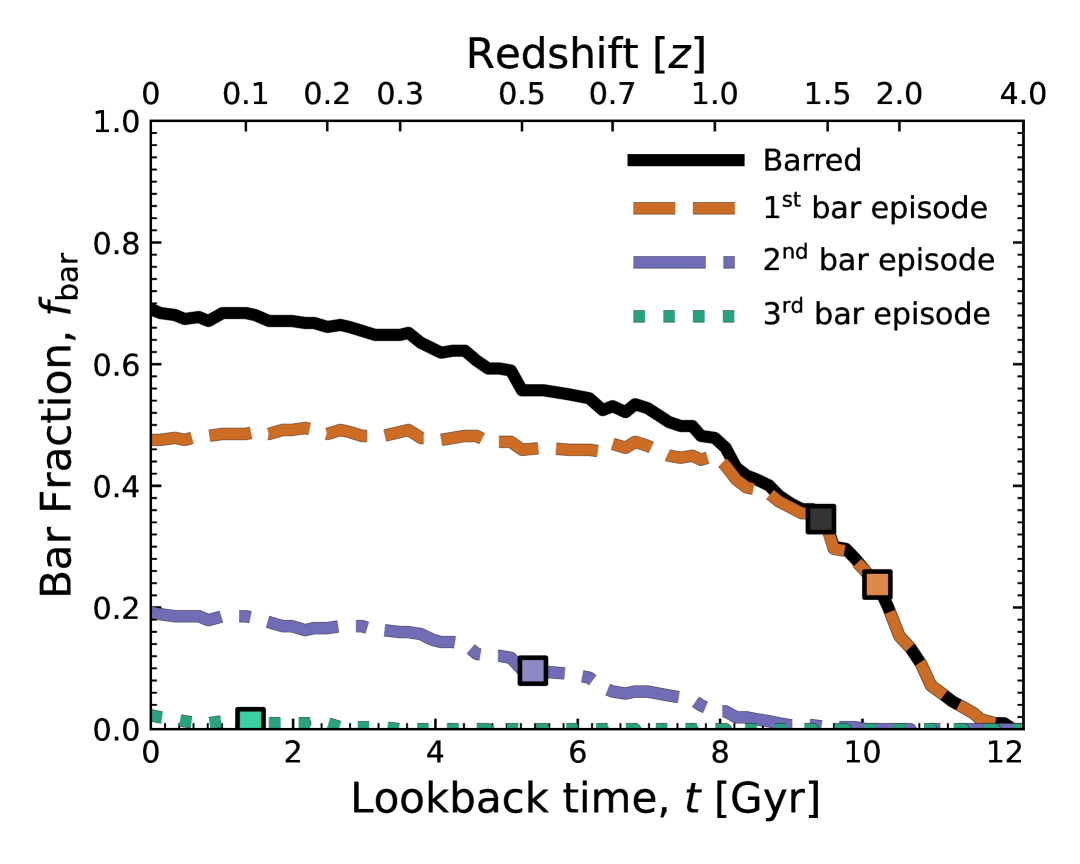
We investigate the formation of stellar bars in 307 Milky Way-mass disc galaxies in the TNG50 cosmological simulation. Most bars form rapidly in dynamically cold discs shortly after the central stellar mass exceeds that of dark matter. In these cases, bar formation is consistent with secular instabilities driven by the disc's self-gravity, which organises stellar orbits into a coherent bar structure. However, around 25 per cent of barred galaxies are dark matter dominated at the time of bar formation, $t_{bar}$, and remain so thereafter. We trace the origin of these bars to tidal perturbations induced by passing satellites or mergers using a new metric, $S_{bar}$, quantifying the tidal field acting on the galaxy. At the time of bar formation, we find a negative correlation between $S_{bar}$ and the central stellar-to-dark matter mass fraction, indicating that more dark matter-dominated discs require stronger tides to trigger bar formation. These tidally induced bars are more likely to be transient than those that form secularly, although bar properties are otherwise similar. However, the host galaxies differ: secular bars arise in relatively compact discs, while tidal bars appear in extended discs whose properties resemble those of unbarred galaxies. Tidal perturbations can therefore induce bars in galaxies otherwise stable to secular formation, highlighting the dual role of the internal galactic structure and the external environment in bar formation.
Motivation & Objective
- Investigate how bars form in MW-mass disc galaxies within a cosmological context using TNG50.
- Determine the roles of disc self-gravity and external tidal perturbations in bar formation.
- Develop and apply a new metric to quantify tidal fields acting on galaxies near bar formation.
- Characterize lifetimes and recurrence of bar episodes across the sample.
Proposed method
- Use Fourier decomposition of face-on stellar surface density to identify bars, focusing on the m=2 mode (A2) and bar properties (A2_max, R_bar, phi_2, Omega_bar).
- Define t_bar as the onset of a barred phase when A2_max >= 0.2 and R_bar >= 1.4 * epsilon_c for at least three snapshots.
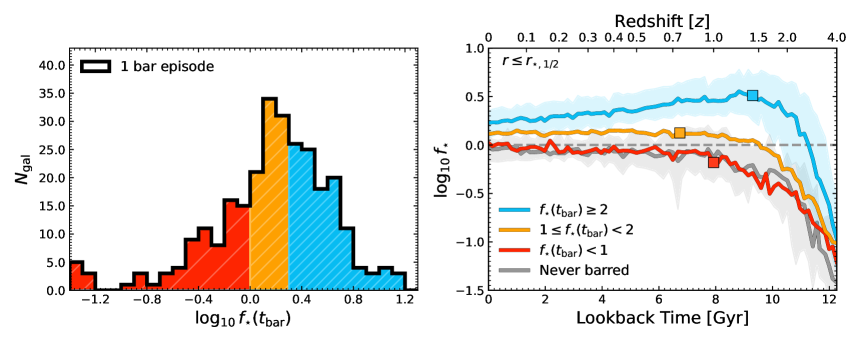
- Compute the central stellar-to-dark matter mass ratio f_star(t_bar) within r_star,1/2 to classify discs as stellar- or DM-dominated at bar formation.
- Introduce the tidal tensor T from the surrounding mass distribution and define the scalar S as the norm of T’s eigenvalues to quantify tidal strength (S_bar = max S within one t_dyn before t_bar).
- Analyze correlations between f_star(t_bar) and S_bar, and compare bar lifetimes and properties for secular versus tidally induced bars.
Experimental results
Research questions
- RQ1What fraction of bars in MW-mass discs form secularly versus tidally?
- RQ2How does the central stellar-to-dark matter mass ratio at bar formation influence the likelihood of secular bar formation?
- RQ3Can a global tidal field metric distinguish secular from tidally induced bars, and how does it relate to bar lifetimes?
- RQ4Do tidally induced bars differ in observable properties from secular bars, and how does environment shape their evolution?
Key findings
- About 25% of barred galaxies are DM-dominated at bar formation and remain DM-dominated thereafter, suggesting tidal triggers for those bars.
- A negative correlation exists between S_bar and f_star(t_bar): more DM-dominated discs require stronger tides to trigger bar formation.
- Secular bars form in relatively compact, stellar-dominated discs and tend to be long-lived, while tidally induced bars form in extended discs and are more often transient.
- Bars can form in both stellar- and DM-dominated discs, but the dominant formation channel depends on disc central mass dominance and tidal environment.
- The lifetime of bars correlates with disc properties: stellar-dominated discs host long-lived bars (median ≈ 9 Gyr), whereas DM-dominated discs yield shorter-lived bars (median ≈ 2 Gyr).
- Tidal perturbations can induce bars in galaxies otherwise stable to secular formation, highlighting the dual role of internal structure and external environment.
Read this paper
Open the full text in the Nubint reader and ask about any passage as you read.
Read this paper on NubintThis review was generated by AI from the original paper. Please check the paper before citing it.