
[Paper Review] Output tracking based on extended observer for nonlinear uncertain systems
This paper proposes a high-gain extended observer for nonlinear uncertain systems to estimate system uncertainty and signal derivatives up to order $ n $, enabling fast convergence of output tracking error and its derivatives to zero despite disturbances. The controller, based on this observer, ensures asymptotic stability and rapid error reduction, validated through theoretical analysis and simulation on a nonlinear system with sinusoidal reference tracking.
A high-gain extended observer is designed for a class of nonlinear uncertain systems. This observer has the ability of estimating system uncertainty, and it can be used to estimate the derivatives of signal up to order n. The controller based on this extended observer can make the tracking error and its derivatives converge to zero rapidly even when uncertainties and disturbances exist. The result of simulation indicates that this method has satisfactory control performance for nonlinear uncertain systems.
Motivation & Objective
- To address the challenge of output tracking in nonlinear systems with unknown disturbances and uncertain dynamics.
- To design an observer capable of estimating both system uncertainty and derivatives of the reference signal up to order $ n $.
- To ensure rapid convergence of tracking error and its derivatives to zero under uncertainty and disturbances.
- To prove the stability of the extended observer and the overall control system.
- To demonstrate the effectiveness of the method through theoretical analysis and simulation.
Proposed method
- A high-gain extended observer is designed using a set of distinct positive real numbers $ \lambda_i $, forming a characteristic polynomial with coefficients $ h_i $.
- The observer structure is defined via a state-space model with matrix $ A $, input matrix $ B $, and a small perturbation parameter $ \varepsilon \in (0,1) $.
- The observer estimates the tracking error vector $ \widehat{e} $, including the uncertainty term $ x_{n+1} = f(\cdot) $, using a feedback term proportional to $ \varepsilon^{-i} (\widehat{e}_1 - e_1) $.
- A sliding mode controller is designed using a switching variable $ \sigma(t) = \widehat{e}_2 + \widehat{e}_1 $, with a reaching law ensuring finite-time convergence to the sliding surface.
- Lyapunov-based stability analysis is used to prove that the estimation error $ \delta(t) = \widehat{e} - e $ converges to a bound proportional to $ \varepsilon $, and the tracking error $ e(t) $ converges to $ \mathcal{O}(\sqrt{\varepsilon}) $.
- The observer is constructed such that its eigenvalues are placed at $ -\lambda_i / \varepsilon^i $, ensuring fast convergence as $ \varepsilon \to 0^+ $.
Experimental results
Research questions
- RQ1Can a high-gain extended observer estimate both system uncertainty and derivatives of the reference signal up to order $ n $ in nonlinear uncertain systems?
- RQ2How can the observer be designed to ensure fast convergence and bounded estimation error under uncertainty?
- RQ3What control law ensures that the output tracking error and its derivatives converge to zero despite unknown disturbances?
- RQ4Can the stability of the extended observer and the overall closed-loop system be rigorously proven?
- RQ5What is the quantitative relationship between the observer gain parameter $ \varepsilon $ and the ultimate bound of the tracking error?
Key findings
- The extended observer achieves rapid convergence of estimation error $ \|\delta(t)\| \to 0 $ as $ \varepsilon \to 0^+ $, ensuring accurate uncertainty and derivative estimation.
- For any fixed $ \varepsilon \in (0,1) $, the estimation error is bounded by $ \|\delta(t)\| \leq \frac{\varepsilon M}{\lambda} \|T\| \|T^{-1}\| $, where $ M $ bounds the derivative of uncertainty and $ \lambda $ is the smallest observer pole.
- The tracking error $ \|e(t)\| $ converges to a bound proportional to $ \sqrt{\varepsilon} $, i.e., $ \|e(t)\| \leq k_p \sqrt{\varepsilon} $, with $ k_p $ a positive constant.
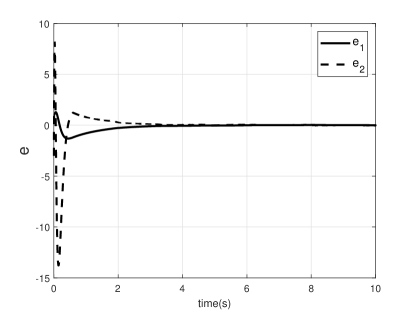
- The simulation results show that the controller achieves fast and accurate output tracking for a nonlinear system with $ y_d = 2\sin t $, even under nonlinearities and disturbances.
- The sliding mode controller ensures finite-time convergence to the sliding surface $ \sigma(t) = 0 $, after which the system remains in a stable, reduced-order dynamics regime.
- Theoretical analysis confirms that the closed-loop system is asymptotically stable, with the Lyapunov function decreasing at a rate proportional to $ \eta_1 \Phi $, ensuring exponential decay of error energy.
Read this paper
Open the full text in the Nubint reader and ask about any passage as you read.
Read this paper on NubintThis review was generated by AI from the original paper. Please check the paper before citing it.