
[Paper Review] Overview of the Instrumentation for the Dark Energy Spectroscopic Instrument
This paper presents the design, integration, and commissioning of the Dark Energy Spectroscopic Instrument (DESI), a multi-object spectrograph installed on the Mayall Telescope to measure redshifts of 20 million galaxies and quasars across cosmic time. DESI achieved over 15 million redshifts in its first year, enabling unprecedented precision in measuring cosmic acceleration, dark energy evolution, and neutrino masses.
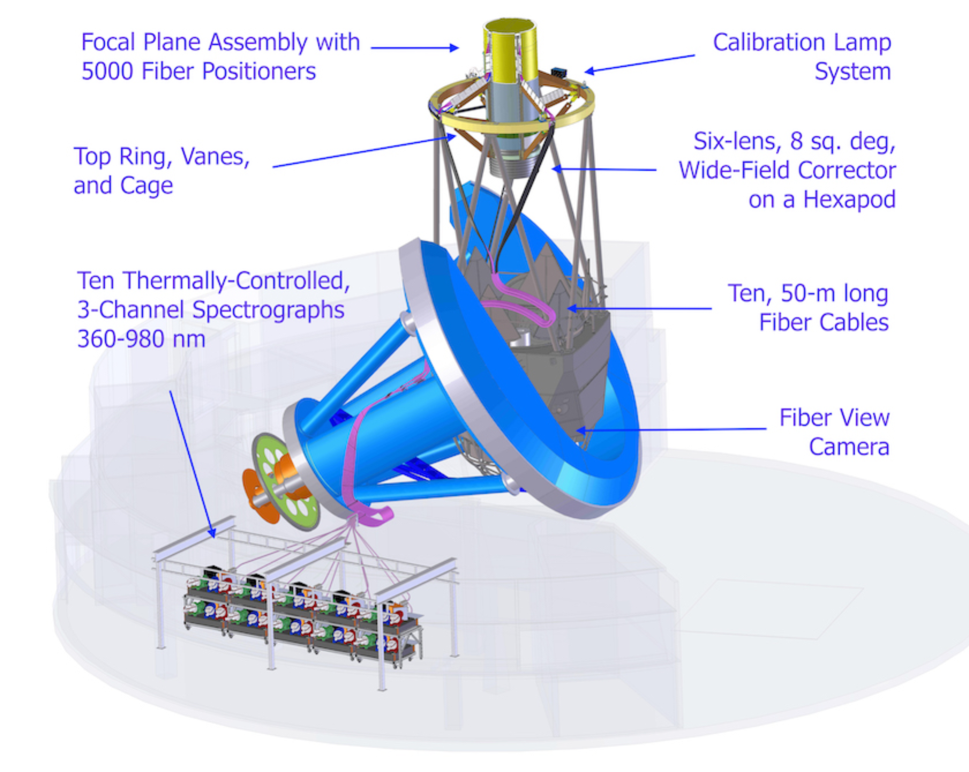
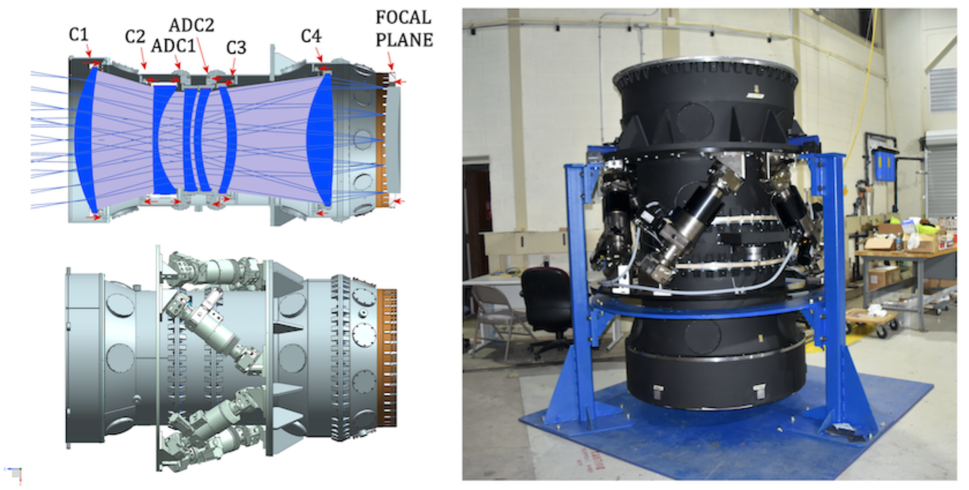
The Dark Energy Spectroscopic Instrument (DESI) has embarked on an ambitious five-year survey to explore the nature of dark energy with spectroscopy of 40 million galaxies and quasars. DESI will determine precise redshifts and employ the Baryon Acoustic Oscillation method to measure distances from the nearby universe to z > 3.5, as well as measure the growth of structure and probe potential modifications to general relativity. In this paper we describe the significant instrumentation we developed for the DESI survey. The new instrumentation includes a wide-field, 3.2-deg diameter prime-focus corrector that focuses the light onto 5020 robotic fiber positioners on the 0.812 m diameter, aspheric focal surface. The positioners and their fibers are divided among ten wedge-shaped petals. Each petal is connected to one of ten spectrographs via a contiguous, high-efficiency, nearly 50 m fiber cable bundle. The ten spectrographs each use a pair of dichroics to split the light into three channels that together record the light from 360 - 980 nm with a resolution of 2000 to 5000. We describe the science requirements, technical requirements on the instrumentation, and management of the project. DESI was installed at the 4-m Mayall telescope at Kitt Peak, and we also describe the facility upgrades to prepare for DESI and the installation and functional verification process. DESI has achieved all of its performance goals, and the DESI survey began in May 2021. Some performance highlights include RMS positioner accuracy better than 0.1", SNR per \sqrtÅ > 0.5 for a z > 2 quasar with flux 0.28e-17 erg/s/cm^2/A at 380 nm in 4000s, and median SNR = 7 of the [OII] doublet at 8e-17 erg/s/cm^2 in a 1000s exposure for emission line galaxies at z = 1.4 - 1.6. We conclude with highlights from the on-sky validation and commissioning of the instrument, key successes, and lessons learned. (abridged)
Motivation & Objective
- To develop and deploy a multi-object spectroscopic instrument capable of measuring redshifts for 20 million extragalactic sources across cosmic time.
- To enable precise cosmological measurements of cosmic acceleration, dark energy evolution, and neutrino masses through high-precision redshift surveys.
- To achieve high on-sky efficiency and low sky background errors (1.6"/hour in RA, 0.1"/hour in declination) through advanced instrumentation and control systems.
- To validate target selection algorithms and instrument performance during Survey Validation before the main survey phase.
- To provide a comprehensive retrospective on project management, schedule, and budget decisions for future large-scale astronomical projects.
Proposed method
- Deployed a robotic, fiber-fed spectrograph with 5,000 fibers on the Mayall Telescope to enable simultaneous redshift measurements of 5,000 sources per exposure.
- Integrated advanced positioners and robotic positioners to accurately point fibers at target objects with sub-arcsecond precision.
- Utilized a multi-tiered calibration system including wavelength, flux, and flat-field calibration to ensure spectroscopic accuracy.
- Conducted on-sky commissioning to verify total throughput and performance under real observing conditions.
- Implemented automated target selection algorithms using multi-band photometry and astrometry from external surveys like Gaia.
- Employed a rigorous data pipeline for redshift measurement, redshift quality assessment, and redshift error budgeting.
Experimental results
Research questions
- RQ1What is the instrumental performance of DESI in terms of throughput, sky background, and pointing accuracy during on-sky operations?
- RQ2How accurately can DESI measure redshifts for galaxies and quasars across redshifts z = 0 to z = 3.7?
- RQ3To what extent does DESI achieve its target survey goals in terms of observing efficiency and data quality?
- RQ4What are the key technical and managerial decisions that enabled DESI to stay on schedule and within budget?
- RQ5How do the redshift measurements from DESI constrain cosmological parameters such as dark energy evolution and neutrino mass?
Key findings
- DESI achieved a sky background error of 1.6"/hour in right ascension and 0.1"/hour in declination, meeting stringent pointing accuracy requirements.
- The instrument measured over 15 million extragalactic redshifts in the first year of main survey operations, making it the largest spectroscopic survey to date.
- DESI will measure the cosmic distance scale with 0.22% precision from z = 0 to z = 1.1, 0.31% from z = 1.1 to z = 1.9, and the Hubble parameter to 0.84% precision from z = 1.9 to z = 3.7.
- The survey will constrain the sum of neutrino masses with significantly improved upper limits and may distinguish between normal and inverted neutrino mass hierarchies.
- DESI’s data will provide strong constraints on modified gravity models through anisotropic clustering measurements.
- The instrument demonstrated high on-sky efficiency with minimal technical downtime, routinely observing 80,000 galaxies and quasars per clear night.
Read this paper
Open the full text in the Nubint reader and ask about any passage as you read.
Read this paper on NubintThis review was generated by AI from the original paper. Please check the paper before citing it.