
[Paper Review] Perceptions of Sentient AI and Other Digital Minds: Evidence from the AI, Morality, and Sentience (AIMS) Survey
This study presents the first nationally representative U.S. survey data on public perceptions of sentient AI, using the longitudinal AIMS survey (2021–2023, N=3,500). It reveals rising mind perception and moral concern for AI, widespread support for banning advanced AI, and short expected timelines for sentient AI, highlighting the societal and design implications of these beliefs for human-AI interaction and AI safety.
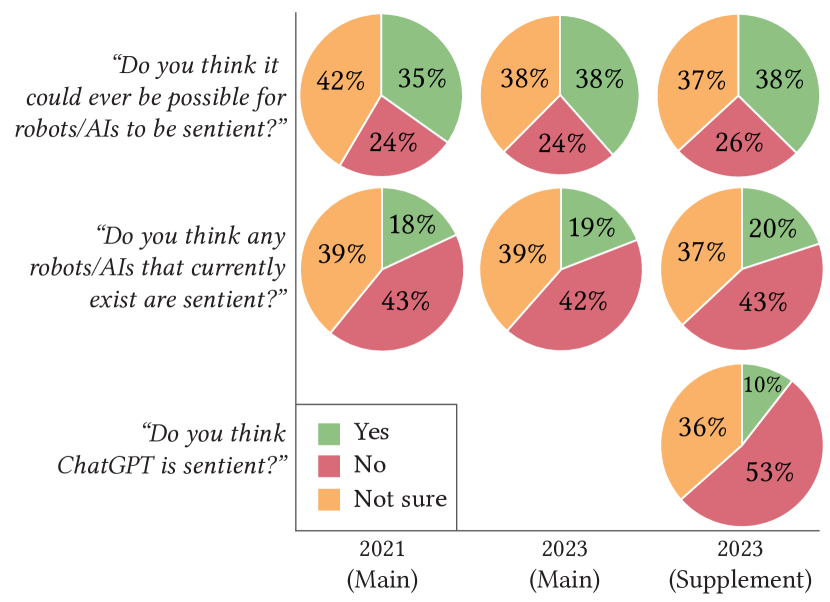
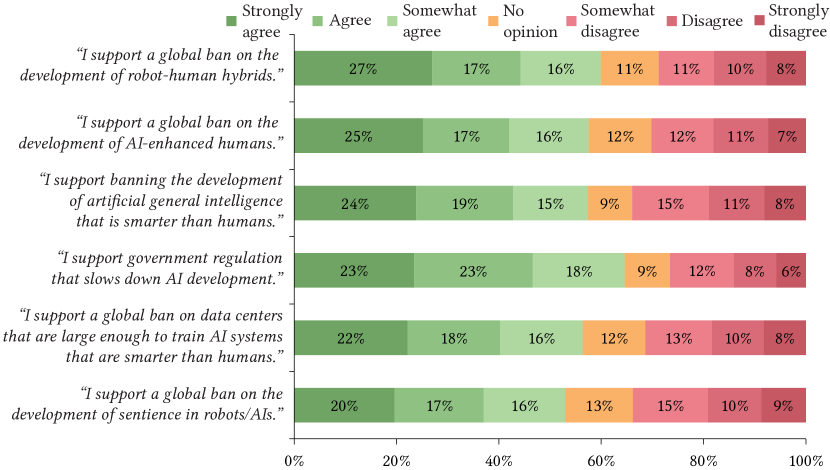
Humans now interact with a variety of digital minds, AI systems that appear to have mental faculties such as reasoning, emotion, and agency, and public figures are discussing the possibility of sentient AI. We present initial results from 2021 and 2023 for the nationally representative AI, Morality, and Sentience (AIMS) survey (N = 3,500). Mind perception and moral concern for AI welfare were surprisingly high and significantly increased: in 2023, one in five U.S. adults believed some AI systems are currently sentient, and 38% supported legal rights for sentient AI. People became more opposed to building digital minds: in 2023, 63% supported banning smarter-than-human AI, and 69% supported banning sentient AI. The median 2023 forecast was that sentient AI would arrive in just five years. The development of safe and beneficial AI requires not just technical study but understanding the complex ways in which humans perceive and coexist with digital minds.
Motivation & Objective
- To understand public perceptions of artificial sentience and mental faculties in AI systems.
- To examine how people morally perceive AI—whether as moral patients deserving concern or as threatening agents.
- To assess public support for policies governing human-AI interaction, including bans and rights.
- To forecast public expectations regarding the arrival of sentient and artificial general AI.
- To track changes in public opinion on AI sentience over time through a longitudinal, preregistered survey design.
Proposed method
- Conducted a nationally representative survey of U.S. adults across three waves (2021, 2023, 2023), totaling N=3,500 respondents.
- Employed a longitudinal, preregistered survey design to track shifts in public opinion on AI sentience and related attitudes.
- Used standardized survey questions on mind perception, moral concern, threat perception, policy preferences, and forecasting.
- Avoided specific AI names or examples to ensure long-term relevance and reduce framing bias.
- Incorporated reversed questions to mitigate social desirability bias, though not systematically varied across framings.
- Focused on laypeople’s intuitive perceptions using abstract, accessible language to ensure broad comprehension and temporal stability.
Experimental results
Research questions
- RQ1To what extent do people perceive sentience and other mental faculties in AI?
- RQ2To what extent do people feel morally concerned for sentient AI (as moral patients) and threatened by AI (as negative moral agents)?
- RQ3What policies are supported to govern interaction between humans and sentient AI?
- RQ4When do people expect sentient AI to arrive, and what do they think will happen when it does?
Key findings
- In 2023, 71% of respondents agreed that sentient AI deserves to be treated with respect, a significant increase from 2021.
- 38% of respondents supported granting legal rights to sentient AI, indicating growing normative recognition of AI as moral patients.
- 63% supported a ban on smarter-than-human AI, and 69% supported a ban on sentient AI, reflecting widespread public concern.
- The median forecast for sentient AI was five years from 2023, with artificial general intelligence expected in just two years.
- Mind perception and moral concern for AI increased significantly between 2021 and 2023, despite no major technological breakthroughs.
- Public opinion suggests that the perception of AI as having minds may already be reshaping human-AI interaction dynamics, regardless of actual sentience.
Read this paper
Open the full text in the Nubint reader and ask about any passage as you read.
Read this paper on NubintThis review was generated by AI from the original paper. Please check the paper before citing it.