
[Paper Review] Performance-Efficiency Trade-offs in Unsupervised Pre-training for Speech Recognition
This paper proposes SEW (Squeezed and Efficient Wav2vec), a redesigned architecture for wav2vec 2.0 that improves both performance and inference efficiency through optimized temporal resolution, efficient feature extraction, and strategic parameter allocation. SEW-D-mid achieves 1.9× faster inference and 13.5% lower WER than W2V2-base on LibriSpeech, while SEW-D-base+ matches W2V2-large performance with half the parameters and 3.2× faster pre-training.
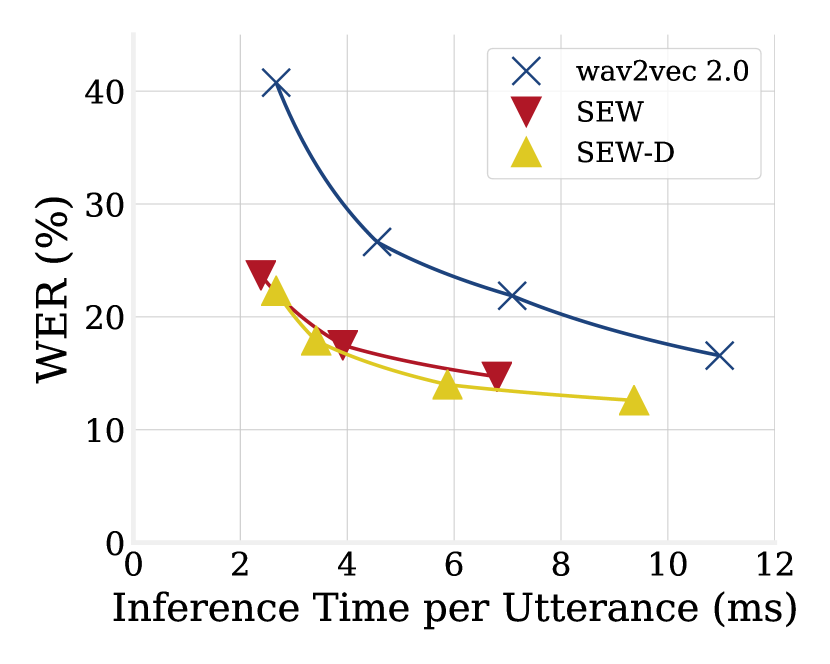
This paper is a study of performance-efficiency trade-offs in pre-trained models for automatic speech recognition (ASR). We focus on wav2vec 2.0, and formalize several architecture designs that influence both the model performance and its efficiency. Putting together all our observations, we introduce SEW (Squeezed and Efficient Wav2vec), a pre-trained model architecture with significant improvements along both performance and efficiency dimensions across a variety of training setups. For example, under the 100h-960h semi-supervised setup on LibriSpeech, SEW achieves a 1.9x inference speedup compared to wav2vec 2.0, with a 13.5% relative reduction in word error rate. With a similar inference time, SEW reduces word error rate by 25-50% across different model sizes.
Motivation & Objective
- To analyze and optimize the performance-efficiency trade-offs in wav2vec 2.0 pre-training for automatic speech recognition.
- To identify architectural components that influence both model accuracy and inference speed.
- To develop a new model architecture that improves both performance and efficiency without increasing model size or computational cost.
- To enable practical deployment of pre-trained ASR models by reducing inference latency and energy consumption.
Proposed method
- Introduces SEW, a new wav2vec 2.0-based architecture with optimized temporal resolution for representation and decoding.
- Designs a lightweight waveform feature extractor that reduces inference time by 50% compared to the original wav2vec 2.0 extractor.
- Redistributes model capacity by assigning more parameters to later layers of the network, improving performance without increasing downstream computation.
- Proposes SEW-D with disentangled attention to further enhance performance and efficiency.
- Employs a two-stage training setup: pre-training on 960h of unlabeled LibriSpeech data, followed by fine-tuning with 100h of labeled data.
- Uses standard fine-tuning hyperparameters from W2V2-base, adjusting learning rate and dropout for stability in larger SEW models.
Experimental results
Research questions
- RQ1How does varying the temporal resolution of the network affect the performance-efficiency trade-off in wav2vec 2.0?
- RQ2Can a more efficient waveform feature extractor maintain performance while halving inference time?
- RQ3What is the optimal distribution of model capacity across different layers in the pre-training network?
- RQ4How does increasing the expressivity of the predictor head impact performance without affecting downstream inference?
- RQ5Can a redesigned architecture outperform the original wav2vec 2.0 in both accuracy and inference speed across diverse ASR setups?
Key findings
- SEW-D-mid achieves a 1.9× inference speed-up and a 13.5% relative reduction in word error rate compared to W2V2-base on LibriSpeech dev-other with 100h of labeled data.
- With similar inference time, SEW reduces WER by 25–50% across different model sizes compared to W2V2.
- SEW-D-base+ achieves comparable word error rates to W2V2-large but with 50% fewer parameters and 3.2× faster pre-training.
- SEW-D-mid reduces inference time by 30% on TED-LIUM 3 and Fisher+Switchboard while achieving lower or comparable WER across all out-of-domain datasets.
- SEW-D-mid outperforms W2V2-base on all tested datasets (TED-LIUM 3, VoxPopuli, Fisher+Switchboard) with only 10h of labeled data, being at least 30% faster.
- The model achieves state-of-the-art performance-efficiency trade-offs, enabling faster, cheaper, and more energy-efficient deployment of self-supervised ASR models.
Read this paper
Open the full text in the Nubint reader and ask about any passage as you read.
Read this paper on NubintThis review was generated by AI from the original paper. Please check the paper before citing it.