
[Paper Review] Personalized Abstractive Summarization by Tri-agent Generation Pipeline
This paper proposes a tri-agent pipeline—comprising a generator, instructor, and editor—for personalized abstractive summarization using large language models. It uses a fine-tuned small instructor model, trained via editor-steered reinforcement learning with feedback from ChatGPT, to generate user-specific editing instructions, significantly improving summary alignment with user preferences on DeFacto and CNNDM datasets.
Tailoring outputs from large language models, like ChatGPT, to implicit user preferences remains a challenge despite their impressive generative capabilities. In this paper, we propose a tri-agent generation pipeline comprising a generator, an instructor, and an editor to enhance output personalization. The generator produces an initial output, the instructor automatically generates editing instructions based on user preferences, and the editor refines the output to align with those preferences. The inference-only large language model (ChatGPT) serves as both the generator and editor, with a smaller model acting as the instructor to guide output generation. We train the instructor using editor-steered reinforcement learning, leveraging feedback from a large-scale editor model to optimize instruction generation. Experimental results on two abstractive summarization datasets demonstrate the effectiveness of our approach in generating outputs that better meet user expectations. Code is available at \url{https://github.com/Wendy-Xiao/chatgpt_editing_summ}
Motivation & Objective
- To address the challenge of personalizing LLM-generated summaries to meet specific user needs.
- To overcome the limitations of one-time generation by introducing an iterative edit-and-refine process.
- To reduce reliance on fine-tuning large models by using a smaller instructor model for instruction generation.
- To improve alignment with user requirements through editor-steered reinforcement learning for the instructor.
- To evaluate the framework on abstractive summarization with coverage and factual consistency as key user criteria.
Proposed method
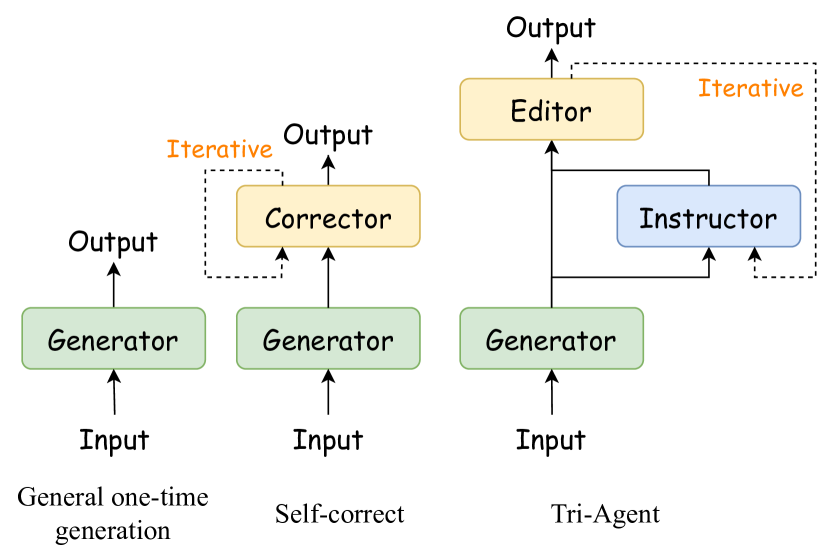
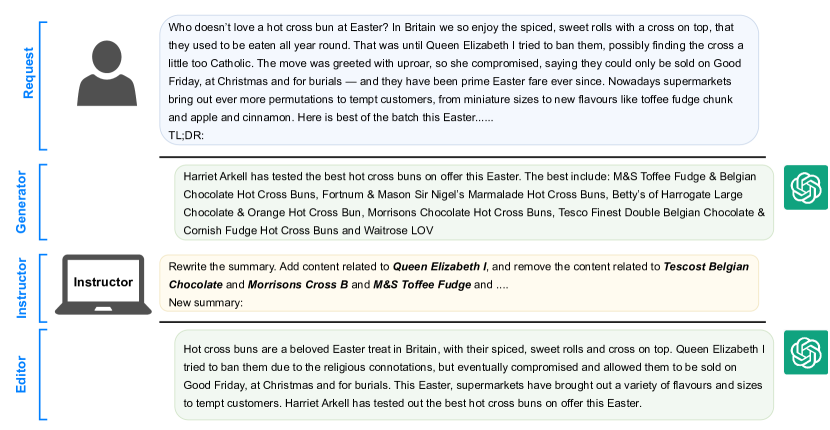
- The generator (ChatGPT) produces an initial summary from input text.
- A smaller instructor model generates natural language editing instructions based on user requirements.
- The editor (ChatGPT) revises the initial summary using the instructor’s instructions.
- The instructor is first supervised-fine-tuned on human-authored instructions, then further optimized via editor-steered reinforcement learning.
- The reward function in RL is based on the quality of the edited output as judged by the editor model, measured via automatic metrics like ROUGE and factual consistency scores.
- The pipeline supports iterative refinement, where multiple rounds of instruction and editing improve alignment with user expectations.
Experimental results
Research questions
- RQ1Can a small instructor model generate editing instructions that significantly improve summary quality when guided by a large language model editor?
- RQ2How effective is editor-steered reinforcement learning in aligning instructor-generated instructions with user preferences?
- RQ3Does iterative editing in the tri-agent pipeline lead to better alignment with user requirements than single-step generation?
- RQ4How does the performance of the tri-agent pipeline compare to baseline methods in terms of ROUGE and factual consistency?
- RQ5Can the framework be extended to other NLP tasks beyond summarization?
Key findings
- The tri-agent pipeline significantly improves summary alignment with user requirements on both DeFacto and CNNDM datasets.
- The use of editor-steered reinforcement learning for instructor training leads to more effective instruction generation than supervised fine-tuning alone.
- Iterative editing with the tri-agent pipeline further enhances summary quality, demonstrating the benefit of multiple refinement steps.
- The final model achieves ROUGE-L scores comparable to supervised baselines while requiring minimal fine-tuning of large models.
- The framework effectively leverages ChatGPT as an editor and avoids the need for direct fine-tuning of large models, reducing computational and access barriers.
- The approach shows promise for extension to other editing-intensive NLP tasks such as wiki-editing and mathematical problem synthesis.
Read this paper
Open the full text in the Nubint reader and ask about any passage as you read.
Read this paper on NubintThis review was generated by AI from the original paper. Please check the paper before citing it.