
[Paper Review] Phylogeny-Inspired Adaptation of Multilingual Models to New Languages
This paper proposes a phylogeny-inspired adapter framework that improves cross-lingual transfer by sharing parameters across adapters of genetically related languages. By structuring adapters in a language family tree, the method achieves over 20% relative performance gain on syntactic and semantic tasks—especially for unseen languages—while maintaining the same parameter count as standard adapters.
Large pretrained multilingual models, trained on dozens of languages, have delivered promising results due to cross-lingual learning capabilities on variety of language tasks. Further adapting these models to specific languages, especially ones unseen during pre-training, is an important goal towards expanding the coverage of language technologies. In this study, we show how we can use language phylogenetic information to improve cross-lingual transfer leveraging closely related languages in a structured, linguistically-informed manner. We perform adapter-based training on languages from diverse language families (Germanic, Uralic, Tupian, Uto-Aztecan) and evaluate on both syntactic and semantic tasks, obtaining more than 20% relative performance improvements over strong commonly used baselines, especially on languages unseen during pre-training.
Motivation & Objective
- Improve cross-lingual transfer for low-resource and unseen languages in multilingual models.
- Address the challenge of limited performance when adapting multilingual models to languages not present during pre-training.
- Leverage linguistic relationships—specifically language phylogeny—to guide efficient adapter parameter sharing.
- Demonstrate that structured, linguistically informed adapter sharing outperforms standard, isolated adapter training.
- Extend the coverage of multilingual NLP systems to underrepresented and indigenous languages using minimal additional parameters.
Proposed method
- Construct a phylogenetic tree of languages based on historical linguistic relationships to define hierarchical adapter sharing.
- Introduce a root adapter at the top of the phylogenetic tree to share parameters across all related languages in a family.
- Train adapters jointly using a masked language modeling objective on monolingual text from each target language.
- Structure the adapter stack as [root_adapter, language_adapter, task_adapter], enabling shared representations across related languages.
- Apply the framework to diverse language families (Germanic, Uralic, Tupian, Uto-Aztecan) and evaluate on syntactic and semantic tasks.
- Maintain the same total number of adapter parameters as standard adapters to ensure fair comparison and computational efficiency.
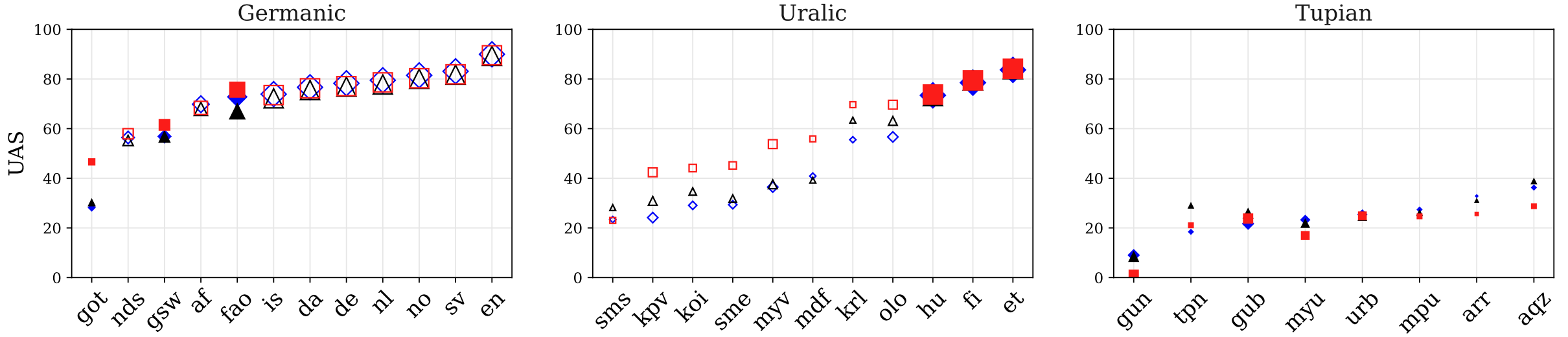
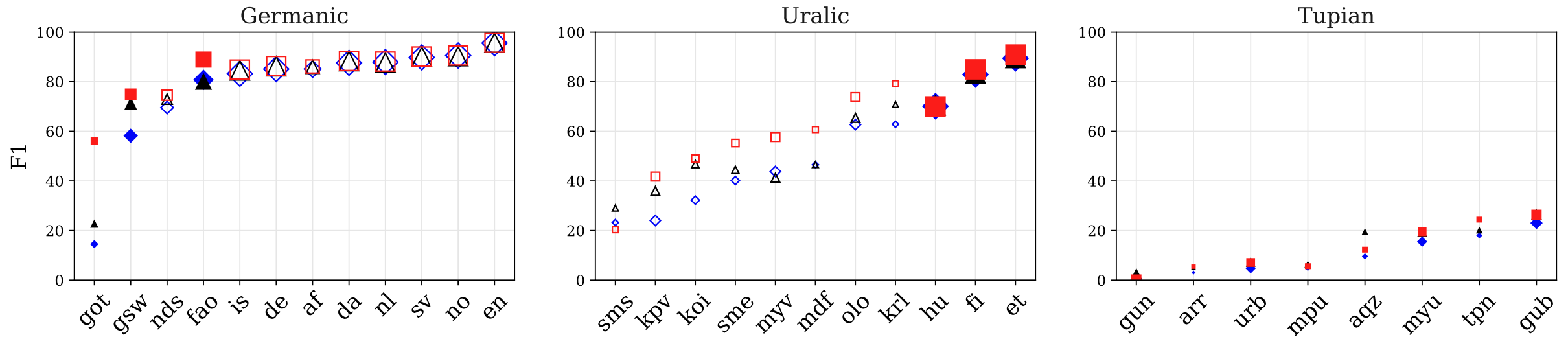
Experimental results
Research questions
- RQ1Can incorporating language phylogeny into adapter parameter sharing improve zero-shot and few-shot cross-lingual transfer?
- RQ2Does shared adaptation across genetically related languages lead to better performance on unseen languages compared to isolated adapter training?
- RQ3How does the hierarchical phylogenetic structure affect performance across diverse language families with varying typological distances?
- RQ4Can this method achieve significant performance gains without increasing the number of trainable parameters?
- RQ5What is the impact of forcing shared representations across highly divergent language subgroups (e.g., Indo-European branches) on overall performance?
Key findings
- The phylogeny-inspired adapter framework achieves over 20% relative performance improvement on syntactic and semantic tasks compared to strong baselines.
- Performance gains are especially pronounced for languages unseen during pre-training, demonstrating strong zero-shot generalization.
- The method maintains the same total number of adapter parameters as standard adapters but achieves significantly better results through structured sharing.
- For languages from the same language family, the hierarchical adapter structure leads to more effective parameter utilization and faster convergence.
- The approach shows robustness across diverse language families, including low-resource Uralic and indigenous American languages.
- Forcing shared representation across highly divergent Indo-European subgroups (e.g., Germanic, Romance, Slavic) leads to performance degradation, suggesting limits to broad phylogenetic sharing.
Read this paper
Open the full text in the Nubint reader and ask about any passage as you read.
Read this paper on NubintThis review was generated by AI from the original paper. Please check the paper before citing it.