
[Paper Review] Pin the Memory: Learning to Generalize Semantic Segmentation
This paper proposes Pin the Memory, a memory-guided meta-learning framework for domain generalization in semantic segmentation. By learning domain-agnostic categorical knowledge through a memory module and optimizing with memory divergence and feature cohesion losses, the method achieves state-of-the-art generalization performance on unseen domains without retraining, outperforming existing domain generalization methods and matching multi-source domain adaptation performance.
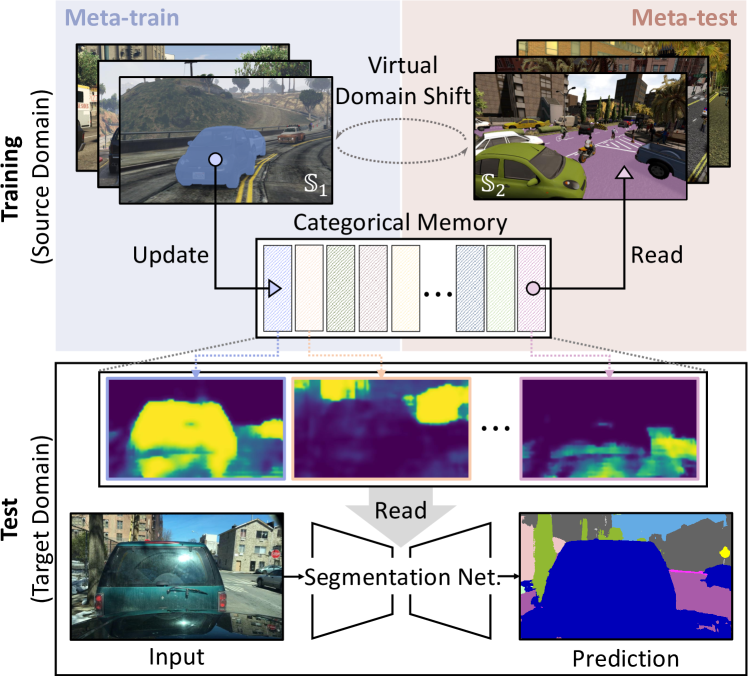
The rise of deep neural networks has led to several breakthroughs for semantic segmentation. In spite of this, a model trained on source domain often fails to work properly in new challenging domains, that is directly concerned with the generalization capability of the model. In this paper, we present a novel memory-guided domain generalization method for semantic segmentation based on meta-learning framework. Especially, our method abstracts the conceptual knowledge of semantic classes into categorical memory which is constant beyond the domains. Upon the meta-learning concept, we repeatedly train memory-guided networks and simulate virtual test to 1) learn how to memorize a domain-agnostic and distinct information of classes and 2) offer an externally settled memory as a class-guidance to reduce the ambiguity of representation in the test data of arbitrary unseen domain. To this end, we also propose memory divergence and feature cohesion losses, which encourage to learn memory reading and update processes for category-aware domain generalization. Extensive experiments for semantic segmentation demonstrate the superior generalization capability of our method over state-of-the-art works on various benchmarks.
Motivation & Objective
- To address the challenge of domain shift in semantic segmentation, where models fail on unseen domains due to distribution shifts.
- To improve generalization by learning domain-agnostic, class-specific knowledge abstracted as categorical memory.
- To enable zero-shot adaptation to arbitrary unseen domains without retraining or fine-tuning.
- To enhance representation robustness through memory-guided meta-learning and complementary loss functions.
Proposed method
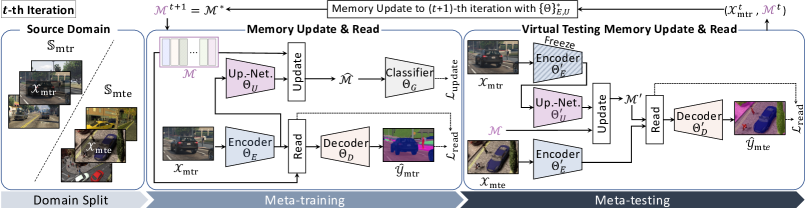
- The method employs a meta-learning framework that splits source domain data into meta-training and meta-testing sets to simulate domain shift during training.
- A learnable memory module stores domain-agnostic prototypes of semantic classes, serving as external guidance during inference on unseen domains.
- The memory is updated via a dedicated network during meta-testing, enabling the model to learn robust memory reading and updating strategies.
- Two novel losses are introduced: memory divergence loss to enhance memory discriminability and feature cohesion loss to promote domain-invariant features.
- The framework uses episodic learning to simulate unseen domain conditions, training the encoder and memory update network jointly under mismatched data distributions.
- During inference, the model uses the pre-learned memory to guide feature representations, reducing ambiguity in unseen domains.
Experimental results
Research questions
- RQ1Can a memory module that stores domain-agnostic categorical knowledge improve generalization in semantic segmentation across unseen domains?
- RQ2How does meta-learning with simulated domain shifts enhance the robustness of memory-guided feature representations?
- RQ3What is the contribution of memory divergence and feature cohesion losses to domain generalization performance?
- RQ4Can memory-guided meta-learning achieve performance comparable to multi-source domain adaptation without access to target domain data?
Key findings
- The proposed method achieves state-of-the-art performance on multiple benchmarks, including Cityscapes, COCO-Stuff, and BDD100K, under domain generalization settings.
- With the combination of memory divergence and feature cohesion losses, the method achieves a 2.1% mIoU gain over MLDG on Cityscapes and a 1.8% gain on COCO-Stuff.
- The method outperforms strong baselines like IBN-Net, RobustNet, and MLDG across all datasets, demonstrating superior generalization capability.
- t-SNE visualization confirms that features from unseen domains are better separated and less ambiguous when using the memory-guided approach.
- The method maintains competitive inference speed (13.56ms) and only a small increase in parameters (45.22M) and FLOPs (277.69), indicating cost-effectiveness.
- Ablation studies show that both memory update and meta-learning are essential, with performance dropping significantly when either is removed.
Read this paper
Open the full text in the Nubint reader and ask about any passage as you read.
Read this paper on NubintThis review was generated by AI from the original paper. Please check the paper before citing it.