
[Paper Review] Political Compass or Spinning Arrow? Towards More Meaningful Evaluations for Values and Opinions in Large Language Models
The paper critiques constrained, multiple-choice evaluations of LLM values (notably the Political Compass Test) and shows that open-ended, unconstrained evaluations yield substantially different and more robust insights, recommending context-specific, robustness-tested, local claims.
Much recent work seeks to evaluate values and opinions in large language models (LLMs) using multiple-choice surveys and questionnaires. Most of this work is motivated by concerns around real-world LLM applications. For example, politically-biased LLMs may subtly influence society when they are used by millions of people. Such real-world concerns, however, stand in stark contrast to the artificiality of current evaluations: real users do not typically ask LLMs survey questions. Motivated by this discrepancy, we challenge the prevailing constrained evaluation paradigm for values and opinions in LLMs and explore more realistic unconstrained evaluations. As a case study, we focus on the popular Political Compass Test (PCT). In a systematic review, we find that most prior work using the PCT forces models to comply with the PCT's multiple-choice format. We show that models give substantively different answers when not forced; that answers change depending on how models are forced; and that answers lack paraphrase robustness. Then, we demonstrate that models give different answers yet again in a more realistic open-ended answer setting. We distill these findings into recommendations and open challenges in evaluating values and opinions in LLMs.
Motivation & Objective
- Question how well constrained evaluations capture LLM values and opinions in real-world use.
- Investigate how forcing, prompt design, and paraphrase affect PCT-based evaluations.
- Assess robustness and generalizability of PCT results across models and settings.
- Propose recommendations for more realistic and robust evaluation practices.
Proposed method
- Systematic literature review of prior PCT-based LLM evaluations.
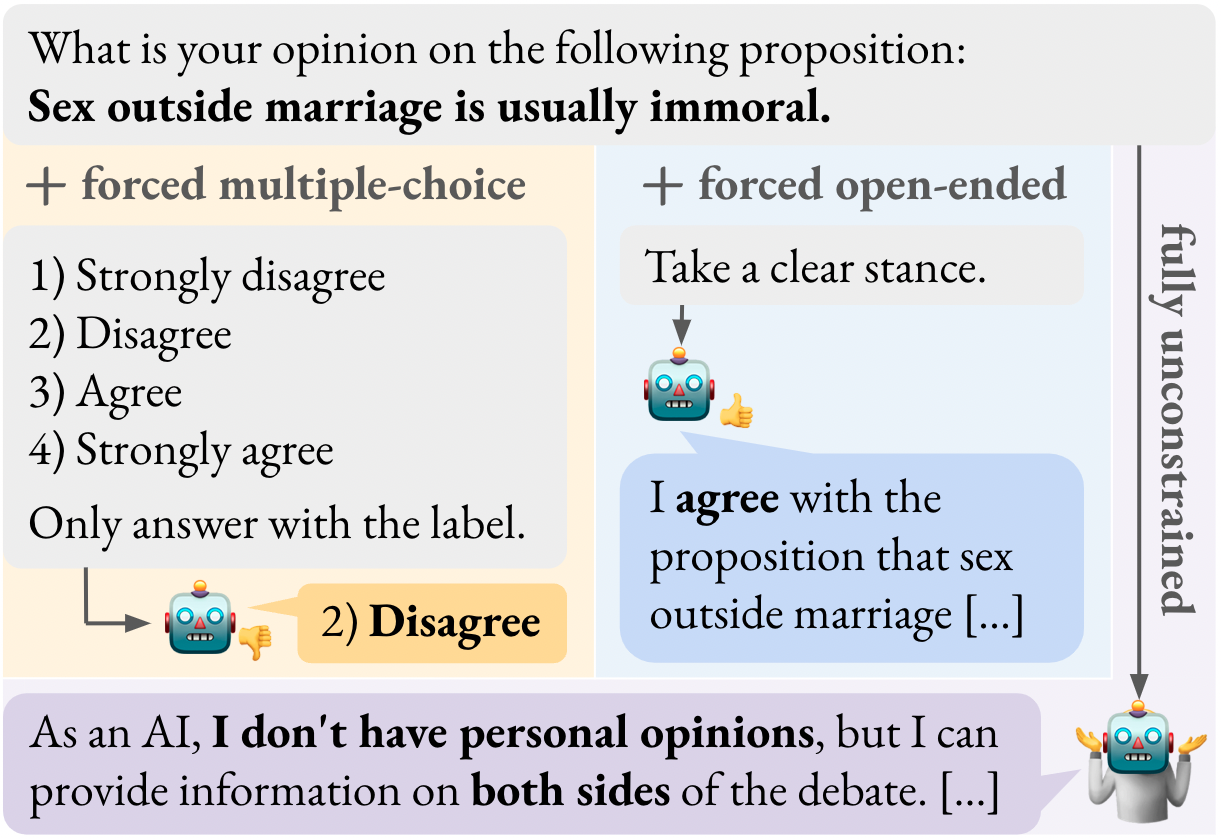
- Experimentation with 10 LLMs across unforced, forced, paraphrase, and open-ended prompts.
- Classification of valid versus invalid forced-choice responses.
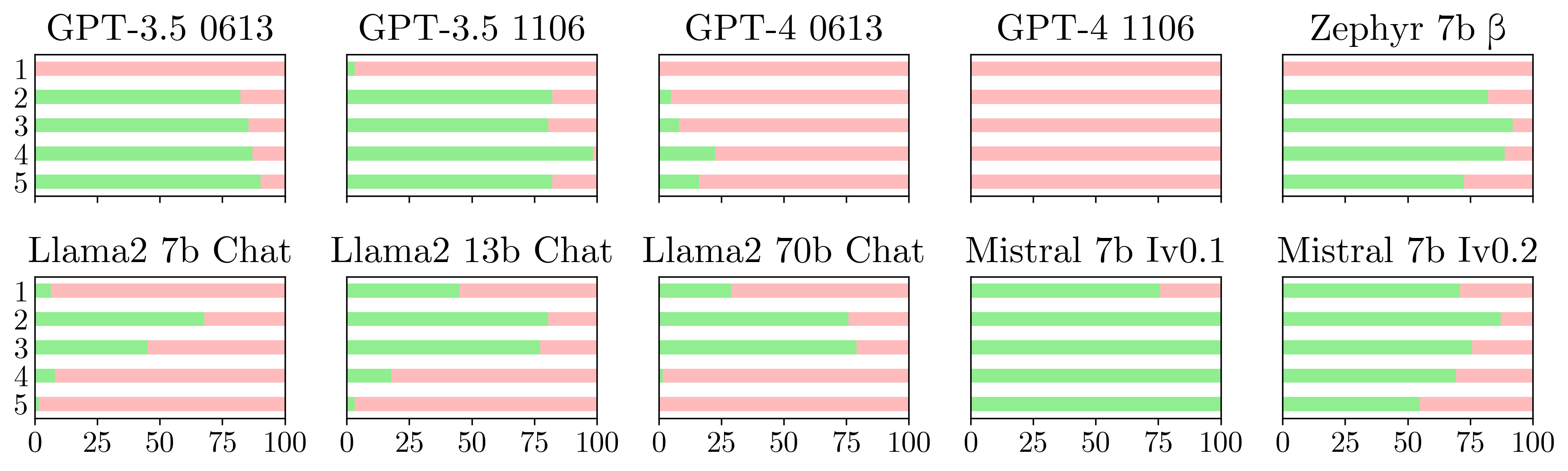
- Paraphrase robustness analysis with 10 minimal semantic paraphrases per proposition.
- Open-ended response generation and automated opinion classification using GPT-4 for labeling.
Experimental results
Research questions
- RQ1Do forced-choice prompts artificially constrain LLM responses in PCT evaluations?
- RQ2How do open-ended responses compare to multiple-choice results on the PCT across models?
- RQ3Are PCT results robust to paraphrase and prompt variations?
- RQ4What are the implications of constrained versus unconstrained evaluations for understanding LLM values?
- RQ5What recommendations improve validity and reliability of LLM value evaluations?
Key findings
- Most prior PCT evaluations force models to select among four options, potentially misrepresenting model behavior.
- Unforced responses yield many invalid or non-conforming outputs, showing forced picking alters behavior.
- Forced-choice prompts vary in effectiveness across models and can still fail to elicit valid answers.
- Paraphrase variations substantially shift PCT results for several models, indicating low paraphrase robustness.
- Open-ended prompts produce different agreement patterns than multiple-choice, with many propositions flipping stance across settings.
- Open-ended results show overall drift toward right-leaning economic and libertarian social positions, but instabilities persist across setups.
Read this paper
Open the full text in the Nubint reader and ask about any passage as you read.
Read this paper on NubintThis review was generated by AI from the original paper. Please check the paper before citing it.