
[Paper Review] Popularity Bias Is Not Always Evil: Disentangling Benign and Harmful Bias for Recommendation
This paper proposes TIDE, a time-aware disentangled framework that separates benign popularity bias from harmful conformity-driven bias in recommendation by leveraging temporal dynamics: static item quality remains stable over time, while conformity is highly time-sensitive. By intervening on the conformity component during inference, TIDE improves recommendation performance by preserving quality signals while mitigating group conformity effects, validated on three real-world datasets.
Recommender system usually suffers from severe popularity bias -- the collected interaction data usually exhibits quite imbalanced or even long-tailed distribution over items. Such skewed distribution may result from the users' conformity to the group, which deviates from reflecting users' true preference. Existing efforts for tackling this issue mainly focus on completely eliminating popularity bias. However, we argue that not all popularity bias is evil. Popularity bias not only results from conformity but also item quality, which is usually ignored by existing methods. Some items exhibit higher popularity as they have intrinsic better property. Blindly removing the popularity bias would lose such important signal, and further deteriorate model performance. To sufficiently exploit such important information for recommendation, it is essential to disentangle the benign popularity bias caused by item quality from the harmful popularity bias caused by conformity. Although important, it is quite challenging as we lack an explicit signal to differentiate the two factors of popularity bias. In this paper, we propose to leverage temporal information as the two factors exhibit quite different patterns along the time: item quality revealing item inherent property is stable and static while conformity that depends on items' recent clicks is highly time-sensitive. Correspondingly, we further propose a novel Time-aware DisEntangled framework (TIDE), where a click is generated from three components namely the static item quality, the dynamic conformity effect, as well as the user-item matching score returned by any recommendation model. Lastly, we conduct interventional inference such that the recommendation can benefit from the benign popularity bias while circumvent the harmful one. Extensive experiments on three real-world datasets demonstrated the effectiveness of TIDE.
Motivation & Objective
- To address the limitation of existing methods that treat all popularity bias as harmful and seek to eliminate it entirely.
- To recognize that popularity bias stems from two distinct factors: item quality (benign) and user conformity (harmful), both of which should be treated differently.
- To develop a method that disentangles these two factors using temporal patterns, as item quality is time-invariant while conformity is time-sensitive.
- To design an intervention strategy during inference that leverages the benign bias (quality) while suppressing the harmful bias (conformity).
- To improve recommendation performance by preserving intrinsic item quality signals while reducing the amplification of popularity due to social influence.
Proposed method
- Proposes a time-aware disentangled framework (TIDE) where click generation is modeled as a combination of three components: static item quality, dynamic conformity effect, and user-item matching score.
- Models the conformity effect using a time-sensitive function that aggregates recent clicks on an item, capturing its transient, group-driven nature.
- Assumes a causal graph where item quality is time-invariant, conformity is time-varying, and user-item matching is independent of popularity bias.
- Employs interventional inference by intervening on the conformity module during prediction, effectively removing its influence while retaining quality and matching signals.
- Uses a sum-exponential structure to model the conformity effect based on the number and recency of recent clicks.
- Trains the model end-to-end with a recommendation loss, while disentangling components via architectural design and intervention during inference.
Experimental results
Research questions
- RQ1Can temporal dynamics be leveraged to distinguish between benign popularity bias (driven by item quality) and harmful popularity bias (driven by conformity)?
- RQ2Does disentangling these two factors lead to improved recommendation performance compared to methods that treat all popularity bias as harmful or ignore it?
- RQ3Can interventional inference effectively suppress the harmful conformity effect while preserving the beneficial signal from item quality?
- RQ4How do the temporal patterns of item ratings and popularity correlate, and what insights do they provide about the dual nature of popularity bias?
- RQ5Is the proposed TIDE framework robust across different real-world recommendation datasets with varying popularity skew?
Key findings
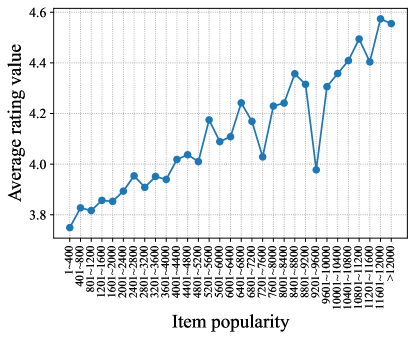
- Empirical analysis shows that more popular items tend to have higher average ratings, indicating the presence of benign popularity bias where high popularity correlates with better item quality.
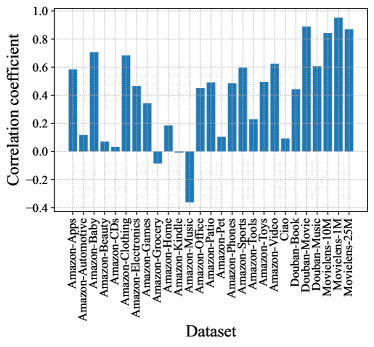
- For a large proportion of items, item ratings exhibit a negative correlation with their current popularity, revealing the dynamic and harmful nature of conformity bias over time.
- TIDE achieves state-of-the-art performance on three real-world datasets (e.g., Amazon, Yelp, MovieLens), outperforming baselines that either eliminate popularity bias or directly inject popularity scores.
- Interventional inference in TIDE leads to significant performance gains by suppressing conformity effects while preserving quality and user preference signals.
- The ablation study confirms that both the time-aware conformity modeling and the disentangled intervention mechanism are essential for performance improvement.
- The framework demonstrates robustness across datasets with varying popularity skew, confirming its generalizability in real-world recommendation scenarios.
Read this paper
Open the full text in the Nubint reader and ask about any passage as you read.
Read this paper on NubintThis review was generated by AI from the original paper. Please check the paper before citing it.