
[Paper Review] Pragmatically Appropriate Diversity for Dialogue Evaluation
This paper introduces Pragmatically Appropriate Diversity (PA Diversity), a framework that evaluates dialogue response diversity based on the speech act of the preceding utterance. It shows that automatic diversity metrics and human judgments from creative writers align with PA Diversity, demonstrating that response diversity should vary by speech act type, not be treated uniformly across conversations.
Linguistic pragmatics state that a conversation's underlying speech acts can constrain the type of response which is appropriate at each turn in the conversation. When generating dialogue responses, neural dialogue agents struggle to produce diverse responses. Currently, dialogue diversity is assessed using automatic metrics, but the underlying speech acts do not inform these metrics. To remedy this, we propose the notion of Pragmatically Appropriate Diversity, defined as the extent to which a conversation creates and constrains the creation of multiple diverse responses. Using a human-created multi-response dataset, we find significant support for the hypothesis that speech acts provide a signal for the diversity of the set of next responses. Building on this result, we propose a new human evaluation task where creative writers predict the extent to which conversations inspire the creation of multiple diverse responses. Our studies find that writers' judgments align with the Pragmatically Appropriate Diversity of conversations. Our work suggests that expectations for diversity metric scores should vary depending on the speech act.
Motivation & Objective
- To investigate whether speech act types in dialogue constrain the diversity of appropriate responses.
- To develop a new evaluation metric, Pragmatically Appropriate Diversity (PA Diversity), that accounts for speech act-based constraints on response diversity.
- To validate PA Diversity using a novel human evaluation task with creative writers who rate the potential for diverse responses in conversational prompts.
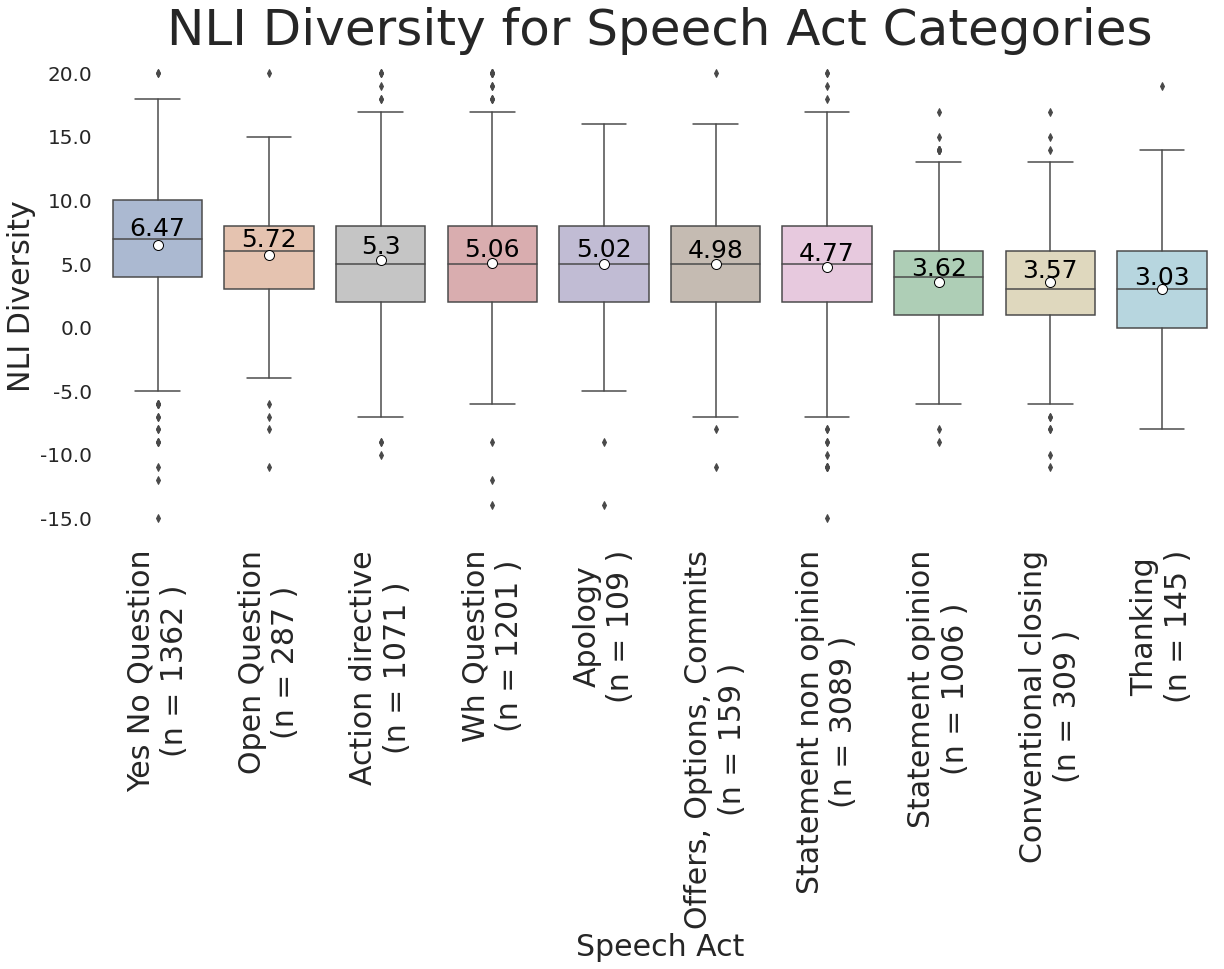
- To assess whether automatic diversity metrics like NLI Diversity detect differences in diversity based on speech act types.
- To guide future dialogue model evaluation and generation by showing that diversity expectations should vary by speech act.
Proposed method
- The authors analyze a multi-response dialogue dataset (DailyDialog++) with both human-labeled and automatically predicted speech acts.
- They compute automatic diversity metrics—specifically NLI Diversity and Sentence-BERT-based diversity—on response sets across different speech act types.
- They design a new human evaluation task where creative writers rate how much a conversation prompt inspires multiple diverse responses on a 5-point scale.
- They compare writer judgments to automatic metrics and speech act types to validate the PA Diversity concept.
- They use statistical analysis to test whether PA Diversity scores differ significantly across speech act categories.
- They explore the potential for using PA Diversity to guide model evaluation and generation, suggesting rule-based systems for low-PA-Diversity conversations.
Experimental results
Research questions
- RQ1Does the most recent speech act in a conversation constrain the diversity of pragmatically appropriate responses?
- RQ2Can automatic diversity metrics detect differences in response diversity based on speech act types?
- RQ3Do human judgments from creative writers align with the Pragmatically Appropriate Diversity of a conversation?
- RQ4Is NLI Diversity more effective than Sentence-BERT in detecting speech act-based diversity differences?
- RQ5Can PA Diversity be used to guide dialogue model evaluation and generation strategies?
Key findings
- The most recent speech act significantly constrains the diversity of appropriate responses, with questions allowing higher diversity than apologies or closings.
- Automatic diversity metrics, especially NLI Diversity, detect meaningful differences in response diversity across speech act types.
- Creative writers’ ratings of response diversity show significant correlation with the PA Diversity hypothesis, supporting its validity.
- NLI Diversity outperforms Sentence-BERT in distinguishing diversity levels across speech acts, confirming its sensitivity to semantic variation.
- The study reveals that not all conversations are equally diverse in their response potential, and diversity expectations should be contextually adjusted by speech act.
- Some writers consistently rated all conversations highly, indicating individual differences in perception of creative potential, highlighting the need for context-aware evaluation.

Read this paper
Open the full text in the Nubint reader and ask about any passage as you read.
Read this paper on NubintThis review was generated by AI from the original paper. Please check the paper before citing it.